Archive for the ‘J. Elke Ertle’ Category

History of the Euro

Thursday, May 2nd, 2013

On this day in history in 1998, during negotiations that lasted well past midnight, European Union members agreed to adopt a common currency: the euro.

Negotiations had been long and arduous, having begun almost three decades earlier when members of the European Economic Community (EEC) had met in Den Haag, Netherlands, to launch an economic and monetary union. Belgium, France, West Germany, Italy, Luxembourg, and the Netherlands were the original six members. Finally, in 1991, European leaders set up the European Union (EU) by signing the Maastricht Treaty. It took seven more years, before the European Union elected the eleven countries that would initially participate in the new currency. On May 2, 1998, Austria, Belgium, Finland, France, West Germany, Ireland, Italy, Luxembourg, Netherlands, Portugal, and Spain became the first member countries to adopt the euro. They had to meet strict criteria such as budget deficit limitations, debt ratio limitations, low inflation, and interest rate limitations. Greece failed to meet the criteria; Denmark, Sweden and Great Britain elected not to participate.

The May 2 accord almost faltered when most member countries voted for Wim Duisenburg of the Netherlands to become the first president of the European Central Bank. The French insisted on their own candidate, Jean-Claude Trichet. An agreement was finally reached when Mr. Duisenberg hinted that he might resign half way through his term in office. He cited his advanced age. Then, on midnight of January 1, 1999, the euro was launched as an electronic currency. It became legal tender on January 1, 2002.


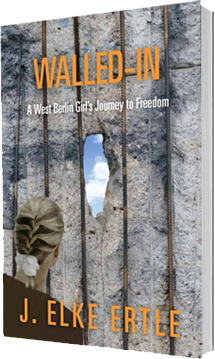
For a sneak peek at the first 20+ pages of my memoir, Walled-In: A West Berlin Girl’s Journey to Freedom, click “Download a free excerpt” on my home page and feel free to follow my blog about anything German: Historical or current events, people, places or food.

Walled-In is my story of growing up in Berlin during the Cold War. Juxtaposing the events that engulfed Berlin during the Berlin Blockade, the Berlin Airlift, the Berlin Wall, and Kennedy’s Berlin visit with the struggle against my equally insurmountable parental walls, Walled-In is about freedom vs. conformity, conflict vs. harmony, domination vs. submission, loyalty vs. betrayal.


Nightingales Return

Wednesday, May 1st, 2013

Viele europäische Vogelarten auf dem Rückzug

Last week, once again, the nightingales returned to Berlin for their annual stopover that typically lasts six weeks. This year their arrival signaled the end of an exceptionally long and miserable winter that had plagued the city, and Berliners were delighted to greet their musical, feathered friends.

Every year, these small, brown migratory songbirds spend the winter in southwest Africa and fly to Central Europe to mate. Following their brief stay, they continue their flight to breeding grounds in forests and scrub in Northern Europe. Nightingales have reddish tails and do not naturally occur in the Americas. With up to 300 different songs they have the largest repertoire of any bird. Although their name implies that they sing only at night, they actually sing day and night. However, their song tends to be much more noticeable at night because few other birds compete during those hours.

Last week, the returning nightingales were spotted not far from Schloss Bellevue (castle Bellevue) in the Tiergarten, Berlin’s two-square-mile urban park. As an interesting side note–this neoclassical castle, first erected in 1786, severely damaged during World War II, and refurbished in the 50s, is now the official residence of the German president. But because it does not include living quarters, he doesn’t actually live there. The president lives in a villa in the southwestern district of Dahlem instead.


For a sneak peek at the first 20+ pages of my memoir, Walled-In: A West Berlin Girl’s Journey to Freedom, click “Download a free excerpt” on my home page and feel free to follow my blog about anything German: historic or current events, people, places or food.

Walled-In is my story of growing up in Berlin during the Cold War. Juxtaposing the events that engulfed Berlin during the Berlin Blockade, the Berlin Airlift, the Berlin Wall and Kennedy’s Berlin visit with the struggle against my equally insurmountable parental walls, Walled-In is about freedom vs. conformity, conflict vs. harmony, domination vs. submission, loyalty vs. betrayal.


Happiness

Tuesday, April 30th, 2013

Happiness lies ahead for those who cry; those who hurt; those who have searched, and those who have tried, for only they can appreciate the importance of people who have touched their lives.


For a sneak peek at the first 20+ pages of my memoir, Walled-In: A West Berlin Girl’s Journey to Freedom, click “Download a free excerpt” on the home page of http://www.walled-in-berlin.com. Walled-In is a story of growing up in Berlin during the Cold War.


Honey Bee Cluster

Monday, April 29th, 2013

bee-swarm

Having read about the losses of bee populations worldwide, I was astonished to see a huge honey bee cluster hanging from a branch of my neighbors’ small fruit tree the other day. The bees had literally appeared overnight. To my amazement, thousands of bees clung to each other in a cluster the shape of a giant pinecone. The next day I was even more surprised when a humming sound, akin to freeway noise,”rapidly arose in the backyard, intensified, and subsided, all within seconds. I looked up just long enough to witness thousands of bees speckle the sky as they headed southeast. Sure enough, my neighbors’ bees were gone.

The experience had just been remarkable enough for me to want to learn more about bees. Did you know that April to June is bee-swarming season in San Diego? From what I read, a bee colony has little incentive to swarm during the first year of a queen’s life. But during her second spring, she appears to be programmed to swarm. Spring bloom and longer days create a desire for the colonies to split and to create new ones. During that period, the queen bee and roughly 10,000-15,000 worker bees will leave their existing location to find a new home. Until they do, they may take up temporary residency, clustering on a tree branch, as they did in my neighbors’ yard.

While most of the bees remain clustered together on this intermediate stop, 20-50 scout bees will forage for a permanent location. Each scout then promotes the potential site she found by dancing in a specific way to indicate direction and distance. The more animated her dance, the more excited about her findings she is. Different scouts may promote different sites. When all scouts agree on a location the entire honey bee cluster flies to it. It was the swarming to their final location that I witnessed the other day. And it was a sight worth seeing.

One final piece of advice: If you encounter a cluster of bees, call a beekeeper. Do not kill or disturb the bees by spraying pesticides or water on them.


For a sneak peek at the first 20+ pages of my memoir, Walled-In: A West Berlin Girl’s Journey to Freedom, click “Download a free excerpt” on my home page and feel free to follow my blog about anything German: historic and current events, people, places and food.

Walled-In is my story of growing up in Berlin during the Cold War. Juxtaposing the events that engulfed Berlin during the Berlin Blockade, the Berlin Airlift, the Berlin Wall and Kennedy’s Berlin visit with the struggle against my equally insurmountable parental walls, Walled-In is about freedom vs. conformity, conflict vs. harmony, domination vs. submission, loyalty vs. betrayal.


The Suez Canal

Thursday, April 25th, 2013

On 25 April 1859, construction of the one-hundred-one-mile long Suez Canal began, connecting the Mediterranean Sea with the Gulf of Suez, a northern branch of the Red Sea.

Although the canal wasn’t completed until 1869, the desire to connect the Nile River in Egypt as well as the Mediterranean Sea to the Red Sea has a long history. The first canal in the area was constructed in the 13th Century B.C.E. Eventually, it fell into neglect, and in the 8th Century its use stopped completely. In the late 1700s, Napoleon Bonaparte wanted to build a new canal, but miscalculations made the project appear infeasible.Finally, in the mid-1800s, the French diplomat and engineer, Ferdinand de Lesseps, convinced the Egyptian viceroy Said Pasha that a canal could be built after all.

In 1858, the Compagnie Universelle du Canal was formed and given the right to begin construction and operate the canal for 99 years. Subsequently, the Egyptian government was to regain control of the waterway. Construction began as planned on April 25, 1859, and the Suez Canal opened ten years later, on November 17, 1869. The cost of construction was $100 million.


Favorite German city

Wednesday, April 24th, 2013

In a recent survey, the market research institute, YouGov, asked Germans to name their favorite German city in which they would like to live and work. Respondents could choose from a list of fourteen. All had populations of more than half a million.

Every sixth citizen chose — not the capital — but Hamburg, making it the Germans favorite German city. Berlin and Munich shared the second place in popularity. However, analyzed by age, the data showed that young adults of 25 years of age or less picked Berlin as their top choice while older adults preferred Hamburg.


For a sneak peek at the first 20+ pages of my memoir, Walled-In: A West Berlin Girl’s Journey to Freedom, click “Download a free excerpt” on my home page and feel free to follow my blog about anything German: historic or current events, people, places or food.

Walled-In is my story of growing up in Berlin during the Cold War. Juxtaposing the events that engulfed Berlin during the Berlin Blockade, the Berlin Airlift, the Berlin Wall and Kennedy’s Berlin visit with the struggle against my equally insurmountable parental walls, Walled-In is about freedom vs. conformity, conflict vs. harmony, domination vs. submission, loyalty vs. betrayal.

 

School of Experience

Tuesday, April 23rd, 2013

Just when you think you have graduated from the school of experience,
along comes a whole new course.


For a sneak peek at the first 20+ pages of my memoir, Walled-In: A West Berlin Girl’s Journey to Freedom, click “Download a free excerpt” on the home page of http://www.walled-in-berlin.com. Walled-In is a story of growing up in Berlin during the Cold War.


Paradigm Shift

Monday, April 22nd, 2013

A paradigm shift is an abrupt change in one’s point of view. All of a sudden, we interpret an event differently than moments earlier. Most of us have experienced altered perceptions at one time or another. I recall one in particular. I was making small talk with a colleague. After having occupied neighboring offices for many years and working on related projects, Robin and I had become friends. We often shared our joys and frustrations. A pretty brunette with soft brown eyes and an infectious smile, Robin was the kind of person who leaves chocolates on your desk when your day has gone south, and if you aren’t feeling well, she’ll try her best to cheer you up.

While Cindy, our coworker, was recovering from a foot operation at home, I asked Robin if she had heard anything about Cindy’s recuperation. “How’s she doing?” I wondered.

Robin looked at me wide-eyed. “Didn’t I tell you? She’s got big sores on her butt.”

I was taken back a notch. I had been unaware that the two of them were on such intimate terms.

“No, I haven’t heard,” I admitted.

Robin went on, “I got some stuff for her last night and put it on her butt. I hope it helps.”

An image wanted to unfold before my eyes, but I quickly squashed it by changing my vantage point. “Well, she’s been sitting a lot. Maybe that’s why she developed sores.”

“I don’t think so. She rarely sits. She usually lies down because of her arthritis,” Robin added.

Now I was completely flabbergasted. I hadn’t kept up with the details of Cindy’s medical condition, but neither had I ever noticed signs of arthritis in my interactions with her. And I certainly had never seen her lie down at work. “She has arthritis?” I wondered.

Without missing a beat, Robin added, “I took her to Petco last night and had her nails trimmed. They were getting really long.”

My mental wheels went into overdrive for several seconds. Then I broke out laughing.”Robin, I was talking about Cindy. You were talking about your dog, Cinder, weren’t you?”

Have you ever experienced a paradigm shift?


Wedding of the Century

Thursday, April 18th, 2013

On 18 April 1956, war-ravaged Europe celebrated the “Wedding of the Century” between the Prince of Monaco, Rainier III, and American actress Grace Kelly. With this marriage, Grace, known for her theatrical performances, live drama productions, and successful films, took on the title of Princess Consort Gracia Patricia of Monaco.

The couple first met during a photo session in May 1955. At that time, Prince Rainier was the wealthiest bachelor in the world. After the meeting, the pair continued to correspond, and when the prince toured America seven months later, he visited the Kelly family. Although he claimed not to have planned the trip around a rendezvous with the American actress, rumors had it that he was actively seeking a wife. It was said that due to a 1918 treaty with France, Monaco was to revert to France if Rainier did not produce an heir.

Three days into his visit, the prince proposed. He first bestowed upon his fiancé a friendship ring of diamonds and rubies, then a twelve-carat emerald-cut diamond engagement ring. Prior to the wedding, Grace was required to take a fertility test and to sign a contract relinquishing all rights to the couples’ children in case of a divorce. The Kelly family also agreed to a dowry of two million dollars.

The glamorous civil ceremony that followed was broadcast across Europe and watched by an estimated thirty million people on television. During the forty-minute ceremony the 142 official titles that Grace had acquired in the union were formally recited. Although there were only eighty guests at the civil ceremony, at the reception that followed, the citizens of Monaco could shake hands with the new princess. A religious ceremony followed the next day, after which the prince and princess left for a seven-week honeymoon cruise.

Prince Rainier and Princess Grace had three children: Caroline, Albert, and Stéphanie. The family resided in a 235-room hilltop palace overlooking the Mediterranean Sea. In September of 1982, Princess Grace suffered a stroke while driving, which caused her to lose control of the car and tumble to her death.


60 Years Refugee Camp Marienfelde

Wednesday, April 17th, 2013

The Marienfelde Notaufnahmelager (refugee camp Marienfelde) in former West Berlin once was the first haven of safety for many refugees from East Germany and Eastern Europe. Between 1949 and 1989 (the fall of the Berlin Wall) every fifth East German citizen left for the West.

Marienfelde opened its doors on April 14, 1953. During its operation, the camp saw more than one quarter of the four million refugees pass through its doors. Some came with a suitcase, others with even less. The camp supplied expatriates with temporary housing and provisions while starting residency permit applications. Meanwhile, the East German government considered Marienfelde an American enemy installation with the express purpose of assembling and arming criminal elements to disrupt life in the Peoples’ State. Although this was communist propaganda, a recent study, commissioned by the Stiftung Berliner Mauer and conducted by the American historian, Keith R. Allen, confirms that the refugee camp Marienfelde played an important role in the West’s information gathering efforts about East Germany.

East German refugees making due at the Marienfelde Refugee Center, photo J. Elke Ertle, 2015

East German refugees making due at the Marienfelde Refugee Center, photo J. Elke Ertle, 2015

Last week, on the 60th anniversary of Marienfelde, German Federal President Joachim Gauck said to those in attendance, “We are proud that our government was able to successfully integrate so many people.”
An ongoing exhibition at Gedenkort Marienfelde, called Escape within Divided Germany tells the story of the thousands who rather left their homes and families than to have their freedom curtailed. The display includes photos, films, and nine hundred original documents that portray daily life in the camp: the wait, the uncertainty, and the crowdedness. Some of the rooms, their original iron bunk beds intact, can also be visited.

Today, the buildings are filled with refugees from Syria, Bosnia, Chechnya, and Afghanistan. In 2012, approximately 8,200 refugees requested asylum.


For a sneak peek at the first 20+ pages of my memoir, Walled-In: A West Berlin Girl’s Journey to Freedom, click “Download a free excerpt” on my home page and feel free to follow my blog about anything German: historic and current events, people, places and food.

Walled-In is my story of growing up in Berlin during the Cold War. Juxtaposing the events that engulfed Berlin during the Berlin Blockade, the Berlin Airlift, the Berlin Wall and Kennedy’s Berlin visit with the struggle against my equally insurmountable parental walls, Walled-In is about freedom vs. conformity, conflict vs. harmony, domination vs. submission, loyalty vs. betrayal.