Archive for the ‘J. Elke Ertle’ Category

Trouble

Tuesday, April 16th, 2013

You know you’re in trouble when you realize that the light at the end of the tunnel is an oncoming train.
–Author unknown


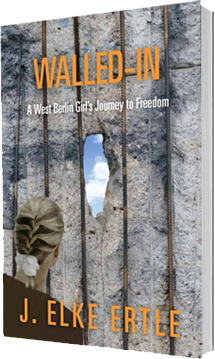
For a sneak peek at the first 20+ pages of my memoir, Walled-In: A West Berlin Girl’s Journey to Freedom, click “Download a free excerpt” on the home page of http://www.walled-in-berlin.com. Walled-In is a story of growing up in Berlin during the Cold War.


Reluctant Convert

Monday, April 15th, 2013

A skeptic by nature and by and large disinclined to buy into non-specific promises, I confidently stepped into one of those new designer churches a few weeks ago. Bright, airy, and inviting, with lots of glass and chrome, the sanctuary seemed to beg for a closer look. And before I knew it, I found myself standing on consecrated grounds.

In one swift scan I assessed my surroundings. The men and woman seated along one wall of this place of worship were heathens, I guessed. Each one had been paired with a church elder, wearing an eye-catching blue T-shirt with a logo on his chest. They were ubiquitous and easy to recognize. I had no doubt that these dyads were involved in one-on-one Bible Study. On the opposite side of the sanctuary, other prospective converts clustered around an elder in apparent group-study. I surmised that Sunday school was in full swing as well because children as young as two years of age were seemingly riveted in prayer. And in the front of this House of God, High Priests dispensed the Holy Sacrament from behind an altar.

A bit taken back by the intensity of the atmosphere around me, I was about to retreat when one of the elders greeted me warmly and invited me deeper into the sanctuary. I shook my head, “I’m a non-believer.”

“No problem,” the young man replied without the slightest hint of pressure and gently led me to the Tree of Knowledge. “I’m Trevor. Here, taste this fruit,” he tempted me. “It’s the fruit of wisdom. I’ll bet you’ve never tasted anything like it. Go ahead. Try it!”

Wary at first, I took a small bite. It was good. I took another bite.
“Once you tasted this fruit, you’ll never want anything else,” Trevor assured me.

I don’t recall what happened next, but before I knew it, I was scheduled for my first One-to-One at the Church of the Apple because I now, too, own a Mac.


Ellis Island

Thursday, April 11th, 2013

On 11 April 1890, Ellis Island was designated a federal immigration station. When it opened two years later, great changes in immigration patterns had become apparent. Arrivals from Northern and Western Europe (Scandinavia, Germany, Great Britain, and Ireland) were slowing while arrivals from Southern and Eastern Europe (Italy, Greece, Poland, Czechoslovakia, Hungary, Serbia, Slovenia, and Russia) were increasing. Most immigrants to the United States had left the Old World to escape war, drought, famine, or religious persecution and hoped for greater opportunities in the New World. Millions of these new arrivals passed through Ellis Island until the station closed its doors in 1954. Between 1900 and 1914, its peak years of operation, 5,000 to 10,000 people passed through Ellis Island on a daily basis. It has been estimated that close to 40% of all current U.S. citizens can trace at least one of their ancestors to coming through this station.

In 1976, Ellis Island was opened to the public. Visitors can now tour the Ellis Island Immigration Museum and trace their ancestors through arrival records that became available to the public in 2001.


The Perfect Ending

Tuesday, April 9th, 2013

I wanted a perfect ending.  Now I’ve learned the hard way that some poems don’t rhyme, and some stories don’t have a clear beginning, middle, and end. Life is about not knowing, having to change, taking the moment and making the best of it, without knowing what is going to happen next.

From Gild Radner’s Delicious Ambiguity


For a sneak peek at the first 20+ pages of my memoir, Walled-In: A West Berlin Girl’s Journey to Freedom, click “Download a free excerpt” on the home page of http://www.walled-in-berlin.com. Walled-In is a story of growing up in Berlin during the Cold War.


Field Station Teufelsberg

Monday, April 8th, 2013

The motto, In God we trust; all others we monitor, was never more applicable than in West Berlin during the Cold War. During those years, the US National Security Agency (NSA) erected a Field Station in the British sector of the city where I grew up. Located at the edge of Berlin’s largest forested area, the Grunewald, the post’s mission remained shrouded in secrecy. Rumors had it that the purpose of the station, used by both American and British personnel, was to eavesdrop on the communications of East Germany, the Soviet Union and Warsaw Pact countries.

The complex stood atop of the Teufelsberg (Devil’s Mountain), a hill that was man-made from close to 424 million cubic feet of World War II rubble. Between 1945 (the end of the war) and 1950, it had been the job of Truemmerfrauen (rubble women) to sift through tons of debris, pick out reusable bricks, chip away the mortar, and to load them onto carts and lories as reconstruction material. The leftover refuse was then lugged to the Grunewald and other locations in the city. It was from this rubble, that the 377-foot-highTeufelsberg was created; and on top of it, the NSA erected a 262 foot-high spy station.

The first intelligence units moved onto the mound in July 1961. More permanent buildings were erected in 1963. Three huge globes and two radomes topped the facilities. Over the years, the station grew into one of the West’s largest intelligence-gathering posts. Its secret mission continued until the fall of the Berlin Wall in 1989 after which the station was closed and the equipment removed. But the building shells remained, and they are still standing today.

The 1990s brought talks of preserving Field Station Teufelsberg as a spy museum. Six years later, the site was sold to developers with plans for a hotel, a restaurant, and a museum.  But the project was abandoned when funds ran out. In 2008, American filmmaker David Lynch tried to turn the site into a Transcendental Meditation Center but could not secure the city’s approval. More recently, there have been calls to preserve the site and turn it into a memorial.

Also visit http://walled-in-berlin.com/j-elke-ertle-/legacy-of-rubble-women/ to read about the work of the Truemmerfrauen (rubble women).


For a sneak peek at the first 20+ pages of my memoir, Walled-In: A West Berlin Girl’s Journey to Freedom, click “Download a free excerpt” on my home page and feel free to follow my blog about anything German: historic and current events, people, places and food.

Walled-In is my story of growing up in Berlin during the Cold War. Juxtaposing the events that engulfed Berlin during the Berlin Blockade, the Berlin Airlift, the Berlin Wall and Kennedy’s Berlin visit with the struggle against my equally insurmountable parental walls, Walled-In is about freedom vs. conformity, conflict vs. harmony, domination vs. submission, loyalty vs. betrayal.



Berlin Wall Controversy

Wednesday, April 3rd, 2013

Following unsuccessful negotiations earlier this month between city officials and investor, Maik Uwe Hinkel, construction crews moved in at 5 A.M. last Wednesday and removed four additional sections (15.75 feet) of one of the two remaining stretches of the Berlin Wall, called the East Side Gallery. Hinkel says the segments had to be removed to provide access for his luxury condominium project overlooking the River Spree, a site that was once part of the infamous deathstrip. Although BBC News reports that the stretch was heritage-listed in 1991, the protection apparently applies only to the wall itself, not the land it stands on.

A section of the East Side Gallery was removed to make room for these condos, photo © J. Elke Ertle, 2015

A section of the East Side Gallery was removed to make room for these condos, photo © J. Elke Ertle, 2015

The East Gallery was recently restored at a cost of more than 2 million euros to the city of Berlin, and about 120 International artists covered it with colorful murals. Scenes include an East German Trabant car and a fraternal kiss between Soviet leader Leonid Brezhnev and East German party chief Erich Honecker. Although Hinkel called the removal temporary on Wednesday, many Berliners worry that removal will turn out to be permanent, sacrificing history for profit.

“The Berlin Wall is the most significant symbol of the division of Berlin,” deputy director of the Berliner Mauer Stiftung, Maria Nooke said, according to the Huffington Post reports. “On the one hand it demonstrates the repression in East Germany, on the other hand it demonstrates how Germans peacefully overcame that repression. After a while there was a growing need to deal with that part of history and to preserve it for future generations.”

You may also want to visit http://walled-in-berlin.com/j-elke-ertle/save-the-berlin-wall/


For a sneak peek at the first 20+ pages of my memoir, Walled-In: A West Berlin Girl’s Journey to Freedom, click “Download a free excerpt” on my home page and feel free to follow my blog about anything German: historic and current events, people, places and food.

Walled-In is my story of growing up in Berlin during the Cold War. Juxtaposing the events that engulfed Berlin during the Berlin Blockade, the Berlin Airlift, the Berlin Wall and Kennedy’s Berlin visit with the struggle against my equally insurmountable parental walls, Walled-In is about freedom vs. conformity, conflict vs. harmony, domination vs. submission, loyalty vs. betrayal.
 

Life isn’t what happens

Tuesday, April 2nd, 2013

Life isn’t what happens to us.  It’s about how we perceive what happens to us.

–Author unknown


For a sneak peek at the first 20+ pages of my memoir, Walled-In: A West Berlin Girl’s Journey to Freedom, click “Download a free excerpt” on my home page and feel free to follow my blog about anything German: historic or current events, people, places or food.

Walled-In is my story of growing up in Berlin during the Cold War. Juxtaposing the events that engulfed Berlin during the Berlin Blockade, the Berlin Airlift, the Berlin Wall and Kennedy’s Berlin visit with the struggle against my equally insurmountable parental walls, Walled-In is about freedom vs. conformity, conflict vs. harmony, domination vs. submission, loyalty vs. betrayal.



Legacy of Rubble Women

Monday, April 1st, 2013

Rubble women, or Trümmerfrauen in German, were at the heart of the German reconstruction following World War II. When the war ended in 1945, Germany’s large cities lay in ruins. Bombings and ground fighting had left behind tons and tons of rubble. If all of this debris had been loaded onto railroad cars, the resulting train would have been 99,500 miles long and stretched four times around the earth.

Since so many men had died or were still held prisoners of war, it was up to the surviving women, children, and the elderly to clean up the mess. In Berlin, forty percent of all structures in the city had been destroyed, and 60,000 Trümmerfrauen went to work. Some volunteered, others were conscripted by Allied law. With few tools, these women carried off the debris, including steel girders, beams and wall sections, and formed human chains that handed small pails of rubble from one person to the next. With their bare hands, the rubble women loaded the debris onto carts and lories. Because of the lack of horses and motorized trucks immediately after the war, they often ended up pulling the wagons themselves.

Rubble was the main postwar reconstruction material. Before materially sound bricks could be reused, Trümmerfrauen had to knock or scrap off the mortar. Although the work was hard, it only paid 0.70 Deutsche Mark ($0.35) per hour. Even for that time, it was an extremely low wage. But most women volunteered for something other than pay: They worked for an upgrade of their food ration classification. Food was so scarce that in some cases it amounted to barely more than 700 calories per day. While non-working residents fell into category V-the lowest classification-heavy laborers, which included Trümmerfrauen, fell into category II. This higher classification translated into 400 grams of fat per month-twice the standard ration-100 grams of meat, and one pound of bread per day. Because it was a way to survive and to feed their families, rubble women came from all walks of life, from worker families to members of the previously well-to-do upper class.

But it was not until 1987 that the German Government remembered its still living rubble women for their contribution to the postwar reconstruction by giving them a small increase in their pension benefits.

Also visit http://www.walled-in-berlin.com/j-elke-ertle/field-station-teufelsberg/ to read about what happened to all that debris.


For a sneak peek at the first 20+ pages of my memoir, Walled-In: A West Berlin Girl’s Journey to Freedom, click “Download a free excerpt” on my home page and feel free to follow my blog about anything German: historic and current events, people, places and food.

Walled-In is my story of growing up in Berlin during the Cold War. Juxtaposing the events that engulfed Berlin during the Berlin Blockade, the Berlin Airlift, the Berlin Wall and Kennedy’s Berlin visit with the struggle against my equally insurmountable parental walls, Walled-In is about freedom vs. conformity, conflict vs. harmony, domination vs. submission, loyalty vs. betrayal.

 

Berlin-Brandenburg Airport Delayed Again

Friday, March 29th, 2013

Last week, the completion of the new Berlin-Brandenburg airport was postponed for the forth time in two years. Meant to replace two of the city’s smaller airports, Tegel in the West and Schoenefeld in the East, the grand opening of this new state-of-the-art metropolitan airport was originally scheduled for October 30, 2011.

Unresolved construction defects forced the opening to be rescheduled first for June 3, 2012, then for March 17, 2013, and most recently for October 27, 2013. But that date, too, had to be scrapped because 20,000 to 40,000 defects remain. Failings range from minor issues, such as cracked floor tiles, to major flaws in the fire protection system. A few weeks ago, an electrical problem caused the entire airport to be lit up around the clock before the turn-off switch could be located.

Earlier this month, Hartmut Mehdorn, the hands-on Ex-Chief of Deutsche Bahn and Air Berlin, became the new Airport Chief. His track record includes ordering last-minute scale-back modifications to Berlin’s new main rail terminal in order to meet the planned opening date. Current projections for the completion of Berlin-Brandenburg airport name 2014 as the earliest date. Most likely, it will be 2015 before the giant airport will open its doors.


For a sneak peek at the first 20+ pages of my memoir, Walled-In: A West Berlin Girl’s Journey to Freedom, click “Download a free excerpt” on my home page and feel free to follow my blog about anything German: historic or current events, people, places or food.

Walled-In is my story of growing up in Berlin during the Cold War. Juxtaposing the events that engulfed Berlin during the Berlin Blockade, the Berlin Airlift, the Berlin Wall and Kennedy’s Berlin visit with the struggle against my equally insurmountable parental walls, Walled-In is about freedom vs. conformity, conflict vs. harmony, domination vs. submission, loyalty vs. betrayal.
 

Living in a Rut

Tuesday, March 26th, 2013

A frog was caught in a deep rut. In spite of the help of his friends, he couldn’t get out. They finally left him there in despair. The next day, one of his friends saw him hopping about outside the rut as chipper as could be. “What are you doing here?” the friend asked. “I thought you couldn’t get out?”

“I couldn’t,” the frog replied, “but a big truck came down the road and I had to get out.”

Some of us are living beneath our capabilities. Because we cannot do great things, we are inclined not to do anything.

–Author unknown


For a sneak peek at the first 20+ pages of my memoir, Walled-In: A West Berlin Girl’s Journey to Freedom, click “Download a free excerpt” on my home page and feel free to follow my blog about anything German: historic or current events, people, places or food.

Walled-In is my story of growing up in Berlin during the Cold War. Juxtaposing the events that engulfed Berlin during the Berlin Blockade, the Berlin Airlift, the Berlin Wall and Kennedy’s Berlin visit with the struggle against my equally insurmountable parental walls, Walled-In is about freedom vs. conformity, conflict vs. harmony, domination vs. submission, loyalty vs. betrayal.