Archive for the ‘J. Elke Ertle’ Category

Time’s Value

Tuesday, May 21st, 2013

To come to know the value of a year, ask a student who failed his finals.

To come to know the value of a month, ask a mother who bore a premature child.

To come to know the value of a week, ask the publisher of a weekly magazine.

To come to know the value of an hour, ask two lovers who are waiting for each other.

To come to know the value of a minute, ask someone who has missed his plane.

To come to know the value of a second, ask someone who has survived an accident.

To come to know the value of a millisecond, ask someone who won a silver medal at the Olympics.


Time waits for no one. Seize each moment because it is precious. Share it with a special friend, and it becomes priceless.


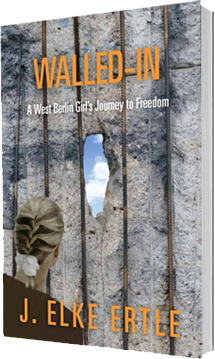
For a sneak peek at the first 20+ pages of my memoir, Walled-In: A West Berlin Girl’s Journey to Freedom, click “Download a free excerpt” on the home page of http://www.walled-in-berlin.com. Walled-In is a story of growing up in Berlin during the Cold War.


First Review

Monday, May 20th, 2013

Last week, I received the first review of Walled-In: A West Berlin Girl’s Journey to Freedom. It came from Laurel-Rain Snow and was posted on Goodreads and Laurel’s blog. When I read her review I was so thrilled that I did not sleep all night. Laurel gave Walled-In 5 of 5 stars! Here is what she had to say about Walled-In:

Laurel-Rain‘s review

May 15, 13

5 of 5 stars

Read from May 11 to 15, 2013

Tyranny takes many forms, from the restrictions of freedom imposed by governments to the familial constraints that markedly prevent an individual’s personal growth.

Growing up in post-war Germany, the author shows the reader what her world looked like, both at home and on the larger canvas that was her life within Berlin after the building of the Wall.


“Walled-In” reveals much about the young woman’s pursuit of individual freedom, and as I read about her personal struggles and the family dynamics, much of it tolled a familiar bell for me.

Our lives did not mirror one another’s, since I grew up in the US and did not face the governmental restrictions that dictated her life; however, the era in which we were each born was very similar and the family dynamics I experienced echoed hers. I could totally relate to her feelings and rooted for her escape.

My escape was made simpler by the governmental freedoms I enjoyed, but freedom from any tyranny can feel just as exhilarating, no matter how different the cage may be.

Other aspects of the story were wonderfully drawn, from the historical context in which she grew to the world at large that offered opportunities for change. This was a beautifully told story that is even more inspirational because of the parallels between Berlin under siege and the uncompromising world of family. Five stars.

Laurel-Rain Snow is an Amazon Vine reviewer and has a goal of reading 200 books a year. Follow her reviews on her blog, http://www.snowconnections.wordpress.com.Walled-In will be released in ten days. Let me know if you agree with Laurel’s assessment.


For a sneak peek at the first 20+ pages of my memoir, Walled-In: A West Berlin Girl’s Journey to Freedom, click “Download a free excerpt” on my home page and feel free to follow my blog about anything German: historic or current events, people, places or food.

Walled-In is my story of growing up in Berlin during the Cold War. Juxtaposing the events that engulfed Berlin during the Berlin Blockade, the Berlin Airlift, the Berlin Wall and Kennedy’s Berlin visit with the struggle against my equally insurmountable parental walls, Walled-In is about freedom vs. conformity, conflict vs. harmony, domination vs. submission, loyalty vs. betrayal.

 

Helmut Schmidt succeeds Willy Brandt

Thursday, May 16th, 2013

On this day in 1974–on May 16–Helmut Schmidt succeeded Willy Brandt as Chancellor of the Federal Republic of Germany (West Germany). Only days earlier, Guenter Guillaume, one of Willy Brandt’s personal assistants, had been exposed as an agent of the Stasi, the East German secret service. A disgraced Brandt had resigned in the wake of the espionage expose. Since that time, it is widely believed however, that the Guillaume affair was only the trigger, not the cause, for Brandt’s resignation. Willy Brandt’s leadership had also been plagued by scandals about serial adultery. And he had reportedly struggled with alcohol and depression.

From 1957 to 1966, Willy Brandt was the Mayor of West Berlin, a time when East-West tension peaked and ultimately led to the construction of the Berlin Wall. Brandt spoke out openly against Soviet Premier Nikita Khrushchev’s 1958 proposal that Berlin become a “free city.” His relationship with President John F. Kennedy was such that in early 1961, a year before elections in the Federal Republic of Germany, the United States were hoping that Brandt would replace Konrad Adenauer as Chancellor of West Germany. However, following the construction of the Berlin Wall in August 1961, Brandt was so disappointed in Kennedy that he criticized him publicly by stating, “Berlin expects more than words.”

A fellow Social Democrat, Helmut Schmidt, succeeded Brandt as the Chancellor of the Federal Republic of Germany. He successfully led his country through a worldwide economic recession and the oil crisis of the 1970s.


For a sneak peek at the first 20+ pages of my memoir, Walled-In: A West Berlin Girl’s Journey to Freedom, click “Download a free excerpt” on the home page of http://www.walled-in-berlin.com. Walled-In is a story of growing up in Berlin during the Cold War.


President Barack Obama to visit Berlin

Wednesday, May 15th, 2013

President Barack Obama and First Lady Michelle Obama will end a three-day trip to Europe trip with a visit to Berlin next month. Following a summit in Northern Ireland, the president is scheduled to meet with German Chancellor Angela Merkel to discuss bilateral global questions. Prior to his 2008 election, President Obama held a major campaign rally in Berlin, which drew an enthusiastic crowd of more than 200,000. A Democratic presidential candidate at the time, Mr. Obama had hoped to speak in front of Berlin’s historic Brandenburg Gate. But Chancellor Merkel would not have it. She maintained that this privilege was reserved for presidents. Mr. Obama ended up speaking at the nearby victory column.

According to the White House, President Obama’s visit will come one week before the 50th anniversary of President John F. Kennedy’s unforgettable “Ich bin ein Berliner” speech. Fifty years, ago, on June 26, 1963, I too, stood in the crowd of 450,000 who had gathered in front of Schoeneberger Rathaus, Berlin’s city hall, to hear John F. Kennedy speak. It was during the height of the Cold War when Mr. Kennedy pledged solidarity with West Berlin. When he said, “As a free man, I take pride in the words ‘Ich bin ein Berliner’,” we interpreted his words to mean that America would not sell us out to the Russians.

I recently wrote a book, entitled “Walled-In: A West Berlin Girl’s Journey to Freedom.” In it I describe what it was like to grow up in West Berlin during the time when the city was still divided into the capitalist west and the communist east.


For a sneak peek at the first 20+ pages of my memoir, Walled-In: A West Berlin Girl’s Journey to Freedom, click “Download a free excerpt” on my home page and feel free to follow my blog about anything German: historic and current events, people, places and food.

Walled-In is my story of growing up in Berlin during the Cold War. Juxtaposing the events that engulfed Berlin during the Berlin Blockade, the Berlin Airlift, the Berlin Wall and Kennedy’s Berlin visit with the struggle against my equally insurmountable parental walls, Walled-In is about freedom vs. conformity, conflict vs. harmony, domination vs. submission, loyalty vs. betrayal.


How to avoid criticism

Tuesday, May 14th, 2013

It is easy to avoid criticism.  All you have to do is say nothing, do nothing, and be nothing.


For a sneak peek at the first 20+ pages of my memoir, Walled-In: A West Berlin Girl’s Journey to Freedom, click “Download a free excerpt” on the home page of http://www.walled-in-berlin.com. Walled-In is a story of growing up in Berlin during the Cold War.


Onkel Dagobert

Monday, May 13th, 2013

Speaking of role models, mine was Onkel Dagobert Duck when I was ten. Christina, my classmate, had brought a Mickey Mouse comic book to school. The glossy introduced me to Disney’s cartoon characters. I thoroughly enjoyed the adventures of Donald Duck and his nephews Tick, Trick, and Track. But I idolized the triplet’s great uncle, Dagobert Duck. It was the stingy miser who set my imagination on fire.

Here was this elderly business duck, dressed in a red frock, top hat, pince-nez glasses, and spats who had accumulated so much money that the heaps of bills and coins piled high in his basement. In fact, Onkel Dagobert was forced to turn the pile regularly with a pitchfork to prevent his fortune from growing moldy. With shrewdness and thrift he had become the richest duck in the world.

At age ten, I wanted to be like Onkel Dagobert because in the mid 50s my parents and I still lived in a one-room apartment. There was barely enough money to make ends meet. Luxury items were out of the question. A touch of Onkel Dagobert was what we needed. I had been thrifty. I had bank-deposited every Pfennig I had won playing cards with my parents during long winter evenings. Still, to my knowledge, I did not need a pitchfork to turn the pile. What was I doing wrong? In any case, I was going to model myself after Onkel Dagobert and maybe I, too, would be able to dive into my mountain of money.

Decades later I learned that Donald Duck’s nephews were actually named Huey, Dewey, and Louie by their creator. And the children in the United States called my hero Uncle Scrooge. Where did these names originate? Uncle Scrooge, I learned, was named after the miser, Ebenezer Scrooge, from the novel “A Christmas Carol.” Onkel Dagobert, on the other hand, got his name from a Merovingian king. The Merovingian dynasty ruled Germania Superior from the middle of the 5th century. This region was a province of the Roman Empire at that time and included southwestern Germany and today’s cities of Wiesbaden and Mainz.

Fifty years have passed since those childhood fantasies, and I know only one thing for sure: I still don’t need a pitchfork, not even a hand shovel.


For a sneak peek at the first 20+ pages of my memoir, Walled-In: A West Berlin Girl’s Journey to Freedom, click “Download a free excerpt” on my home page and feel free to follow my blog about anything German: historic and current events, people, places and food.

Walled-In is my story of growing up in Berlin during the Cold War. Juxtaposing the events that engulfed Berlin during the Berlin Blockade, the Berlin Airlift, the Berlin Wall and Kennedy’s Berlin visit with the struggle against my equally insurmountable parental walls, Walled-In is about freedom vs. conformity, conflict vs. harmony, domination vs. submission, loyalty vs. betrayal.


The Schuman Plan

Thursday, May 9th, 2013

On this day in history in 1950–on May 9–the French foreign minister, Robert Schuman, made a proposal at a press conference that later became known as The Schuman Plan. He proposed a single authority to control the production of steel and coal. His plan led to the creation of the European Coal and Steel Community. The need for such an authority had grown out of the Second World War, which had ended only five years earlier. The conflict had nearly destroyed the European continent. By 1950, there was a great deal of momentum towards greater European co-operation in order to avoid future conflicts and destruction.

By placing the coal and steel industries of France and West Germany under a common authority and by opening membership to other European countries, the Schuman Plan laid the foundation for the establishment of the European Economic Community. In essence, The Schuman Plan marked the birth of Europe. It was the forerunner of the European Union,  and Robert Schuman is considered one of the Founding Fathers of the EU.


For a sneak peek at the first 20+ pages of my memoir, Walled-In: A West Berlin Girl’s Journey to Freedom, click “Download a free excerpt” on the home page of http://www.walled-in-berlin.com. Walled-In is a story of growing up in Berlin during the Cold War.


It’s Asparagus Season!

Wednesday, May 8th, 2013

415px-Asparagus_NL

It’s “Spargelzeit” (asparagus season) in Berlin between April and June. This year, the unusually long winter delayed the opening of the season to April 25. But now, Spargelzeit is in full swing. The German love affair with white asparagus–not green–led to a consumption of 127,000 tons last year. You will hardly find a restaurant or roadside stand that does not feature this heavenly crop. Berlin’s finest white asparagus is grown in Beelitz, about 30 miles south of Berlin. Farmers set up huge tents along the growing fields, and carloads and busloads of asparagus aficionados enjoy the celebrated vegetable, dug fresh out of the ground.

Asparagus officinalis is native to most of Europe, northern Africa and western Asia. To cultivate it, the shoots are covered with soil as they grow. Not being exposed to sunlight, they retain their white color. Germans will tell you that the white version is more tender and less bitter than its green cousin. But it must be peeled before consumption.

The rest of Germany is crazy about asparagus as well. Many cities hold an annual “Spargelfest” (asparagus festival). Schwetzingen in the Rhein-Neckar-triangle crowns an Asparagus Queen every year. And in the Bavarian city of Nuernberg the fastest asparagus peelers of the region meet for annual competitions.

Asparagus is low in calories, low in sodium, a good source of vitamins and minerals, and an excellent source of dietary fiber. The easiest way to prepare it is to boil the peeled shoots briefly and to serve them with browned butter, cubed ham, and boiled potatoes.

Voila ! A delicious meal.


For a sneak peek at the first 20+ pages of my memoir, Walled-In: A West Berlin Girl’s Journey to Freedom, click “Download a free excerpt” on my home page and feel free to follow my blog about anything German: historic and current events, people, places and food.

Walled-In is my story of growing up in Berlin during the Cold War. Juxtaposing the events that engulfed Berlin during the Berlin Blockade, the Berlin Airlift, the Berlin Wall and Kennedy’s Berlin visit with the struggle against my equally insurmountable parental walls, Walled-In is about freedom vs. conformity, conflict vs. harmony, domination vs. submission, loyalty vs. betrayal.

 

Explore. Dream. Discover.

Tuesday, May 7th, 2013

Twenty years from now you will be more disappointed by the things you didn’t do than by the ones you did do. So throw off the bowlines. Sail away from the safe harbor. Catch the trade winds in your sail. Explore. Dream. Discover.

–Mark Twain


For a sneak peek at the first 20+ pages of my memoir, Walled-In: A West Berlin Girl’s Journey to Freedom, click “Download a free excerpt” on my home page and feel free to follow my blog about anything German: Historical or current events, people, places or food.

Walled-In is my story of growing up in Berlin during the Cold War. Juxtaposing the events that engulfed Berlin during the Berlin Blockade, the Berlin Airlift, the Berlin Wall, and Kennedy’s Berlin visit with the struggle against my equally insurmountable parental walls, Walled-In is about freedom vs. conformity, conflict vs. harmony, domination vs. submission, loyalty vs. betrayal.



Pet Peeve

Monday, May 6th, 2013

tandem image 

I have a pet peeve. I cringe every time I see a heterosexual tandem bike team. Why? How many tandems have you seen with the woman sitting in front? Watching for many years I have seen exactly one such pair. Invariably, the man pedals in front, has a 180º view, and controls the handlebars. He is usually also considerably larger and blocks his partner’s view. Whatever happened to equality of the sexes?

My husband and my male friends tell me that the man sits in front to protect the lady. “The back seat is much safer,” they say. “The heavier person should always sit in front. That’s the way bikes are designed.” Well, if safety is the only reason, then why do I see fathers sitting in the back with their teen son occupying the front?  Surely, they don’t want their child to get hurt. I fail to buy into the safety concern as the prime reason. Besides, if bikes are engineered in such a way that the front seat is unsafe, surely our engineers could come up with a better design. No, I suspect it has something to do with old-fashioned chauvinism. What do you think?

But let me tell you about the one instance in which I actually did see the woman sitting in the front seat of a tandem. That afternoon, my husband and I were taking a leisurely walk along Shelter Island when I spotted a heterosexual tandem team ahead of us. Clearly, it was a woman who was pedaling in the front and a man doing his part in the back of the bike. You can image my joy. Finally, there was a man who was willing to relinquish the front seat to his female bike partner. I squealed with delight as I pointed out the sight to my husband. Fifteen minutes later, the tandem returned. Barely able to control my excitement, I ran up to the two bikers. “Congratulations,” I shouted to the lady at the helm, “This is the first tandem I’ve ever seen with the lady in the front.  How did you do it?”

After a brief and uncomfortable silence the woman replied, “My husband is blind.”

Since then I just keep my pet peeves to myself.


For a sneak peek at the first 20+ pages of my memoir, Walled-In: A West Berlin Girl’s Journey to Freedom, click “Download a free excerpt” on the home page of http://www.walled-in-berlin.com. Walled-In is a story of growing up in Berlin during the Cold War.