Archive for the ‘J. Elke Ertle’ Category

Vegetation of the mental world

Monday, March 24th, 2014

Ideas are the vegetation of the mental world. Like individuals, they live and die. They flourish, according to their nature, in one soil or climate. They droop in another.

–M. Dixon


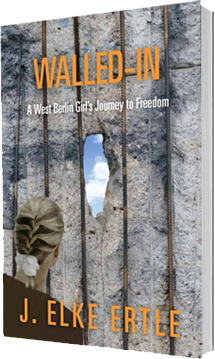
For a sneak peek at the first 20+ pages of my memoir, Walled-In: A West Berlin Girl’s Journey to Freedom, click “Download a free excerpt” on the home page of http://www.walled-in-berlin.com. Walled-In is a story of growing up in Berlin during the Cold War.


Stalin Note

Thursday, March 20th, 2014

The Stalin note was a diplomatic paper. On March 10, 1952, Joseph Stalin’s deputy foreign minister, Andrei Gromyko, delivered three identical documents to his postwar Allies–the United States, France and Great Britain. The Stalin note was the first of four pieces of correspondence on the same subject, all initiated by Marshal Stalin. The paper proposed a peace treaty between the four Allies and the East- and West-occupied Germanys to end the country’s artificial division.

Content of the Stalin Note

In this diplomatic note, Stalin proposed German reunification but attached several stipulations. Aside from other requirements, he proposed reunification of East and West Germany, providing that the occupying powers withdraw their armed forces and liquidate all of their bases in Germany. He further demanded that once reunited, Germany would be required to forfeit her right to enter into a military alliance with any power, that had taken part in WWII. Stalin suggested a four-power conference to act on his proposal by signing a peace treaty with Germany.

http://muse.jhu.edu/journals/journal_of_cold_war_studies/summary/v013/13.4.ruggenthaler.html

Four-power conference

The conference never took place. Germany and the three Western Allies feared that a peace treaty of this nature could result in the reunited Germany’s inability to protect her borders. They also recognized that signing this peace treaty would mean that the reunited Germany would be barred from aligning herself with the Western powers. As history shows those interpretations prevailed. The Cold War continued to heat up over the next three decades, and East and West became more firmly entrenched in their respective blocs. Germany remained divided until the German Democratic Republic (East Germany) collapsed in 1990.

The question remains

Historians have been divided ever since on the intent of the Stalin note. The questions remain (1) Did the West German, Western European, and American leaders miss a much earlier opportunity for German reunification? (2) Were the Soviets offering a sincere path toward German reunification in 1952 or was the Stalin Note a ploy to facilitate the incorporation of Germany into the Eastern bloc? Opinions differ to this day.


For a sneak peek at the first 20+ pages of my memoir, Walled-In: A West Berlin Girl’s Journey to Freedom, click “Download a free excerpt” on my home page and feel free to follow my blog about anything German: historic and current events, people, places and food.

Walled-In is my story of growing up in Berlin during the Cold War. Juxtaposing the events that engulfed Berlin during the Berlin Blockade, the Berlin Airlift, the Berlin Wall and Kennedy’s Berlin visit with the struggle against my equally insurmountable parental walls, Walled-In is about freedom vs. conformity, conflict vs. harmony, domination vs. submission, loyalty vs. betrayal.


Little things in life

Monday, March 17th, 2014

“Sometimes the littlest things in life are the hardest to take. You can sit on a mountain more comfortably than on a tack.”

–Anonymous


For a sneak peek at the first 20+ pages of my memoir, Walled-In: A West Berlin Girl’s Journey to Freedom, click “Download a free excerpt” on the home page of http://www.walled-in-berlin.com. Walled-In is a story of growing up in Berlin during the Cold War.


Life is like a kite

Thursday, March 13th, 2014

Life is like a kite in many ways. A paper kite must be anchored in order to be able to soar into the sky. In much the same way, our lives must be anchored so that we may enjoy a happy, healthy and productive existence. Let’s take a look at the similarities between the two:

Colorful kites

Colorful kites

Paper kite

A paper kite consists of three parts: the wing (which is the body), the kite line and the anchor. So that our kite may soar high into the sky rather than come crashing down to earth after a tentative roll and pitch, it must be tethered to an anchor system. Tethering is necessary so that tension can develop in the kite line. That tension will convert to lift and drag. Lift is generated when air flows over and under the kite’s surface, producing low pressure above and high pressure below the wing. Drag is generated along the direction of the wind. The kite line must be tied to an anchor, which can be static (pitched into beach sand, turf, or attached to a tree) or dynamic (a person running, a boat, or a car). Kite line and anchors are the two components that keep our paper kite in the air.

Life

Similarly, we need a kite line tethered to an anchor to keep our life from rolling, pitching and crashing. Some people’s lives are tied to spiritual anchors; others are anchored in their family; still others are moored to their work, their achievements, their pets, or their hobbies. Just as the kite line and anchor keep the paper kite in the air, we need an emotional and mental anchor that lets us build resilience and gives us the ability to cope. Just like a well-anchored paper kite will soar beautifully, so will an emotional anchor help us face family tragedies, set backs, disappointments, and peer pressure. No doubt, we will face strong winds at times, and there will be plenty of lift and drag along the way. So, what is your anchor?


For a sneak peek at the first 20+ pages of my memoir, Walled-In: A West Berlin Girl’s Journey to Freedom, click “Download a free excerpt” on the home page of http://www.walled-in-berlin.com. Walled-In is a story of growing up in Berlin during the Cold War.


Keep on going

Monday, March 10th, 2014

Keep on going, and chances are that you will stumble on something, perhaps when you are least expecting it. I never heard of anyone stumbling on something sitting down.

–Charles F. Kettering


For a sneak peek at the first 20+ pages of my memoir, Walled-In: A West Berlin Girl’s Journey to Freedom, click “Download a free excerpt” on the home page of http://www.walled-in-berlin.com. Walled-In is a story of growing up in Berlin during the Cold War.


Did Churchill coin “Iron Curtain”?

Thursday, March 6th, 2014

In the United States it is often erroneously believed that Sir Winston Churchill coined the phrase “iron curtain,” when he travelled to Fulton, Missouri, on 5 March 1946. It had been a mere ten months since World War II had ended in Europe. Only one of the three signatories of the Potsdam Agreement was still in power: Soviet Union’s Marshal Joseph Stalin. U.S. President Franklin D. Roosevelt had passed away and been replaced by Harry. S. Truman. Sir Winston Churchill had lost the British election to Clement Atlee. At this point in time, the U.S. and Great Britain were mainly concerned with the state of their own post-war economies and remained grateful to Russia that she had taken a prominent role in ending the war.

“The Sinews of Peace” Speech by Churchill

On this day in early March 5, Churchill gave an address at Westminster College in Fulton. His speech was entitled, “The Sinews of Peace.” He began by speaking of his admiration for the Soviet Union and by welcoming her into the circle of leading nations. He expressed understanding for Russia’s need for security on her western frontiers. But then he cautioned, “A shadow has fallen upon the scenes so lately lighted by the Allied victory. Nobody knows what Soviet Russia and its Communist international organization intends to do in the immediate future, or what are the limits, if any, to their expansive and proselytizing tendencies.” He went on to say, “From Stettin in the Baltic to Trieste in the Adriatic, an iron curtain has descended across the Continent. Behind that line lie all the capitals of the ancient states of Central and Eastern Europe. Warsaw, Berlin, Prague, Vienna, Budapest, Belgrade, Bucharest and Sofia, all these famous cities and the populations around them lie in what I must call the Soviet sphere, and all are subject in one form or another, not only to Soviet influence but to a very high and, in many cases, increasing measure of control from Moscow.”

Following the speech, the phrase “iron curtain” became widely known. To hear Churchill’s speech in its entirety, visit https://winstonchurchill.org/resources/speeches/1946-1963-elder-statesman/the-sinews-of-peace/


“Iron Curtain” became a household word. Although it is still widely held that Churchill coined the term “iron curtain” during his 1946 The Sinews of Peace speech, that belief is inaccurate. He had used the term for decades already. The phrase was first used in 1920 by British author and suffragette Ethel Snowden in her book Through Bolshevik Russia. In 1945, Nazi Propaganda Minister Joseph Goebbels used the term in his 25 February 1945 speech entitled The Year 2000. http://research.calvin.edu/german-propaganda-archive/goeb49.htm But after Churchill’s post-war speech in Fulton, the phrase became synonymous with the way the West viewed the East. The phrase became so popular that I, a post-war child growing up in Berlin, Germany, remember it as one of the givens in my vocabulary. To me at that young age, “iron curtain” meant Cold War, and I was convinced that Sir Winston Churchill had coined it.

.


Sir Winston Churchill

Sir Winston Churchill

Churchill’s view on the Berlin situation

Sir Winston Churchill also foreshadowed what, indeed, ended up happening in Berlin a couple of years later when the Russians blockaded all ground access routes to West Berlin. In his speech, Churchill said, “An attempt is being made by the Russians in Berlin to build up a quasi-Communist party in their zone of Occupied Germany by showing special favors to groups of left-wing German leaders. At the end of the fighting last June, the American and British Armies withdrew westwards, in accordance with an earlier agreement, to a depth at some points of 150 miles upon a front of nearly four hundred miles, in order to allow our Russian allies to occupy this vast expanse of territory, which the Western Democracies had conquered. If now the Soviet Government tries, by separate action, to build up a pro-Communist Germany in their areas, this will cause new serious difficulties in the British and American zones.”


For a sneak peek at the first 20+ pages of my memoir, Walled-In: A West Berlin Girl’s Journey to Freedom, click “Download a free excerpt” on my home page and feel free to follow my blog about anything German: historic and current events, people, places and food.

Walled-In is my story of growing up in Berlin during the Cold War. Juxtaposing the events that engulfed Berlin during the Berlin Blockade, the Berlin Airlift, the Berlin Wall and Kennedy’s Berlin visit with the struggle against my equally insurmountable parental walls, Walled-In is about freedom vs. conformity, conflict vs. harmony, domination vs. submission, loyalty vs. betrayal.

 

Unrecorded Past

Monday, March 3rd, 2014

“The unrecorded past is none other than our old friend, the tree in the primeval forest, which fell without being heard.”

–Barbara Tuchman


For a sneak peek at the first 20+ pages of my memoir, Walled-In: A West Berlin Girl’s Journey to Freedom, click “Download a free excerpt” on my home page and feel free to follow my blog about anything German: Historical or current events, people, places or food.

Walled-In is my story of growing up in Berlin during the Cold War. Juxtaposing the events that engulfed Berlin during the Berlin Blockade, the Berlin Airlift, the Berlin Wall, and Kennedy’s Berlin visit with the struggle against my equally insurmountable parental walls, Walled-In is about freedom vs. conformity, conflict vs. harmony, domination vs. submission, loyalty vs. betrayal.


Temples of science closed to German women

Thursday, February 27th, 2014

The temples of science remained closed to German women until 1900-1909. The reasons were two-fold: (1) By the late 19th century, the university student bodies had turned increasingly middle class. Educators and demographers began to fear that entry of women into universities would further strengthen this “downward” trend. (2) Professors held the socially equivalent rank of a minister at the time and did not wish to see their rank diminished by bluestockings (intellectual woman). Prussia, in particular, was known for its opposition to women matriculating at university.

Pressure Grew

Initially, women’s groups called for demonstrations. Then an extensive survey of scientists, writers and artists came out in favor of the educational interests of women. In 1891, the German Reichstag placed the question of admitting women to universities on its agenda.

Hearing (auditing) students

By 1896, a number of German universities allowed women to hear (audit) university courses. But even at that, admittance remained difficult. A woman who wanted to enroll in a university course had to first obtain permission from the State, the university, and the professor. If permission was granted, then her choice of courses was limited to those that readily lend themselves to female attributes (nursing, teaching). Since auditing students were denied graduation, many women audited classes only for their personal benefit.

Matriculating students

Baden was the first German state to allow women to graduate. The year was 1900. Bavaria followed in 1904, Wuerttemberg in 1904, Saxony in 1906, Thuringia in 1907, Hesse and Prussia in 1908, and Mecklenburg in 1909. Still, the road to a higher education remained strewn with boulders for German women for years to come. Public, and often private sentiment, maintained that women did not have the necessary mental or social prerequisites for university entry and were generally better suited for family life.


For a sneak peek at the first 20+ pages of my memoir, Walled-In: A West Berlin Girl’s Journey to Freedom, click “Download a free excerpt” on my home page and feel free to follow my blog about anything German: historic and current events, people, places and food.

Walled-In is my story of growing up in Berlin during the Cold War. Juxtaposing the events that engulfed Berlin during the Berlin Blockade, the Berlin Airlift, the Berlin Wall and Kennedy’s Berlin visit with the struggle against my equally insurmountable parental walls, Walled-In is about freedom vs. conformity, conflict vs. harmony, domination vs. submission, loyalty vs. betrayal.


Clock of Life

Tuesday, February 25th, 2014

The clock of life is wound but once, and no man has the power to tell just when the hands will stop, at late or early hour. Now is the only time you own. Live, love, toil with a will. Place no faith in time. For the clock may soon be still.


For a sneak peek at the first 20+ pages of my memoir, Walled-In: A West Berlin Girl’s Journey to Freedom, click “Download a free excerpt” on the home page of http://www.walled-in-berlin.com. Walled-In is a story of growing up in Berlin during the Cold War.


Black-Red-Gold: The colors of the German Flag

Thursday, February 20th, 2014

Black-Red-Gold are the colors of the German national flag. Why? The choice may date back to the Middle Ages. The coat of arms of the Holy Roman Empire of the German Nation contained a black eagle with red claws and beak set against a golden background. King Friedrich I walked on a black, red and golden carpet at his coronation in 1152. And Friedrich II wore a black, red and yellow cape when he was crowned King of the Germans in 1212.

Black-Red-Gold, the National Flag of the Federal Republic of Germany

Black-Red-Gold, the National Flag of the Federal Republic of Germany

Black-Red-Gold during Napoleon

Although these seem logical explanations for choosing Black-Red-Gold as the colors of the German flag, the choice most likely has its true origin in the 1813 liberation wars against Napoleon. German soldiers–the Luetzow Free Corps–wore black uniforms with golden buttons and red emblems on their shoulders. http://www.fahnen-flaggen-wappen.de/nationalflagge-deutschland_fid41.html/

The colors signified the progression from servitude (black) through bloody battles (red) to the light of freedom (gold).

Black-Red-Gold under pressure

In 1850 the Prussian King, Friedrich Wilhelm IV, abolished Black-Red-Gold and introduced black, white and red as the national colors. Following WWI In 1919, Black-Red-Gold was reintroduced, but in 1933, the Nazis abolished it once more and introduced a black and white flag with the red swastika.

Black-Red-Gold in modern times

On 23 May 1949, Black-Red-Gold was adopted as Germany’s official flag by the Federal Republic of Germany and a few days later by the German Democratic Republic (East Germany).

Ten years later, however, East Germany added their National Emblem to the flag. It consisted of a hammer (workers) and a compass (academia), surrounded by ears of corn (farmers). With this modification East Germany was able to differentiate itself from the Federal Republic of Germany and avoid having to swear on the flag of the West.


For a sneak peek at the first 20+ pages of my memoir, Walled-In: A West Berlin Girl’s Journey to Freedom, click “Download a free excerpt” on my home page and feel free to follow my blog about anything German: historic or current events, people, places or food.

Walled-In is my story of growing up in Berlin during the Cold War. Juxtaposing the events that engulfed Berlin during the Berlin Blockade, the Berlin Airlift, the Berlin Wall and Kennedy’s Berlin visit with the struggle against my equally insurmountable parental walls, Walled-In is about freedom vs. conformity, conflict vs. harmony, domination vs. submission, loyalty vs. betrayal.