Archive for the ‘J. Elke Ertle’ Category

Winston Churchill on fanatics

Tuesday, February 18th, 2014

Winston Churchill described a fanatic as someone who can’t change his mind and won’t change the subject.


For a sneak peek at the first 20+ pages of my memoir, Walled-In: A West Berlin Girl’s Journey to Freedom, click “Download a free excerpt” on my home page and feel free to follow my blog about anything German: historic or current events, people, places or food.

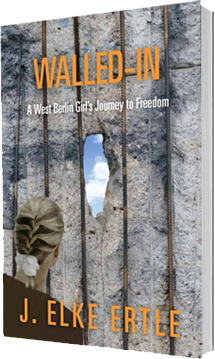
Walled-In is my story of growing up in Berlin during the Cold War. Juxtaposing the events that engulfed Berlin during the Berlin Blockade, the Berlin Airlift, the Berlin Wall and Kennedy’s Berlin visit with the struggle against my equally insurmountable parental walls, Walled-In is about freedom vs. conformity, conflict vs. harmony, domination vs. submission, loyalty vs. betrayal.

Destruction of Dresden

Thursday, February 13th, 2014

The destruction of Dresden occurred toward the end of WWII. The city, with a population of 350,000, was a cultural landmark in Northern Germany with many world famous museums and historic buildings. Its town center was of little to no military significance. Sixty-nine years ago today, most of the people living in the city center perished.

What happened

During the night of February 13 to February 14,1945, British Lancaster bombers dropped a barrage of high explosive and incendiary bombs on the city center. They did so in two waves. The attacks occurred three hours apart. Then, during the middle of the second day, American B-17 Flying Fortresses bombed Dresden again. Together, the Allies dropped 3,300 tons of bombs on the city within a 24-hr period. The resulting firestorm reached temperatures of 1,300 degrees Fahrenheit. The incendiary bombs burned for two days. The heat caused the surface of the roads to melt, and peoples’ feet burned as they tried to run away.

The death toll is difficult to estimate. It ranges between 25,000 and 135,000. The reason for the variation is that 25,000 bodies were located. But Dresden also served as a temporary refuge for the people running from the advancing Russian Army, making it impossible to accurately estimate the number of people who perished. In addition, many could not be buried that quickly and were burned instead. Those numbers are also difficult to assess. http://www.historylearningsite.co.uk/world-war-two/the-bombing-campaign-of-world-war-two/the-bombing-of-dresden/

Why it happened

Opinions differ sharply on the reason for the destruction of Dresden. Although the city center was of little to no military significance, some scholars maintain that Dresden was located in Nazi Germany. The Allies were at war with Nazi Germany. That alone represents sufficient justification.

Others believe that Britain and the United States feared Russia might wish to turn its back on Allied postwar agreements regarding Germany. They believe that the western Allies hoped that a demonstration of power would act as a deterrent.

Still others maintain that Dresden was a legitimate target because of its rail base which could be used to transport troops to the front lines and fight against Russia.

Dresden post-WWII

When Germany was divided following WWII, Dresden ended up in the Russian sector. Their Communist occupiers rebuilt the city in the 1950s and spared no effort in restoring the cultural landmark to its pre-WWII charm. You may also wish to read about Dresden’s Zwinger Dresden’s Frauenkirche , Dresden’s Semper Opera House , and Green Vault .

A commemorative plaque reminds visitors today who it was that destroyed the city and who it was that restored the city to its old splendor.

A Commemorative plaque, installed during the Communist era, reminds the visitor that Anglo-American bombers destroyed Dresden in 1945

A Commemorative plaque, installed during the Communist era, reminds visitors that Anglo-American bombers destroyed Dresden in 1945


For a sneak peek at the first 20+ pages of my memoir, Walled-In: A West Berlin Girl’s Journey to Freedom, click “Download a free excerpt” on my home page and feel free to follow my blog about anything German: historic and current events, people, places and food.

Walled-In is my story of growing up in Berlin during the Cold War. Juxtaposing the events that engulfed Berlin during the Berlin Blockade, the Berlin Airlift, the Berlin Wall and Kennedy’s Berlin visit with the struggle against my equally insurmountable parental walls, Walled-In is about freedom vs. conformity, conflict vs. harmony, domination vs. submission, loyalty vs. betrayal.


serving on a committee

Monday, February 10th, 2014

If you think that serving on a committee is a time consuming and thankless task, consider Harry Chapman’s advice. It may put a whole new spin on the situation. Here is what he recommends:

“Having served on various committees, I have drawn up a list of rules: Never arrive on time; this stamps you as a beginner. Don’t say anything until the meeting is half over; this stamps you as being wise. Be as vague as possible; this avoids irritating the others. When in doubt, suggest that a subcommittee be appointed. Be the first to move for adjournment; this will make you popular; it’s what everybody is waiting for.”


For a sneak peek at the first 20+ pages of my memoir, Walled-In: A West Berlin Girl’s Journey to Freedom, click “Download a free excerpt” on the home page of http://www.walled-in-berlin.com. Walled-In is a story of growing up in Berlin during the Cold War.


Berlin’s Stolpersteine

Thursday, February 6th, 2014

Stolpersteine, often translated as “stumbling blocks”, are small, cobble-sized memorial stones that protrude from the pavement. The last time I visited my hometown of Berlin, I noticed that two such stones were embedded in the pavement in front of the building in which I once lived. The upper surface of each Stolperstein was fitted with a brass plate. The plate was engraved with an individual’s name, year of birth and death, and a few words about the person. I had never seen stones like these before and inquired about their meaning. To my surprise, there are thousands of them, and they are the work of one man.

Stolpersteine for the Danziger Familie - Berlin Charlottenburg, Suarezstrasse and Kuno-Fischer-Strasse, photo J. Elke Ertle © 2014

Stolpersteine for the Danziger Familie – Berlin Charlottenburg, Suarezstrasse and Kuno-Fischer-Strasse, photo J. Elke Ertle © 2014

Stolperstein Concept

The Berlin-born sculptor, Gunter Demnig, is said to have first conceived of the idea of creating Stolpersteine when he met a women near his Cologne studio. He said she was unaware that gypsies had once lived in the neighborhood. Demnig conjectured that concentration camp victims, who are frequently identified by numbers only, tend to lose their individuality as a result. To restore that identify he considered creating memorial stones with the victims’ names and identifying information. That was in the early 1990s. Since then, he has created many Stolpersteine to commemorate victims of the Holocaust. The vast majority of his stones commemorate Jewish Holocaust victims. But many are also dedicated to gypsies, Jehovah’s Witnesses, Blacks, military deserters, physically and mentally disabled individuals, and to those who opposed the Nazi party.

Stolperstein Locations

By May 1996, Demnig had laid the first 50 Stolpersteine in Berlin. Since then he has put down over 5,000 memorial stones in the city and more than 38,000 in over 800 cities and municipalities in Germany. In addition, he has installed memorial stones in twelve other European countries www.stolpersteine-berlin.de.

Critics

Not everyone approves of Demnig’s concept. Charlotte Knobloch, president of the Central Council of Jews in Germany, has objected to Stolpersteine because of their installation in the pavement where people walk. It feels like people are walking on the names of the dead, she says. http://www.sueddeutsche.de/muenchen/opfer-des-ns-terrors-neue-diskussion-ueber-die-stolpersteine-1.677117


For a sneak peek at the first 20+ pages of my memoir, Walled-In: A West Berlin Girl’s Journey to Freedom, click “Download a free excerpt” on my home page and feel free to follow my blog about anything German: historic and current events, people, places and food.

Walled-In is my story of growing up in Berlin during the Cold War. Juxtaposing the events that engulfed Berlin during the Berlin Blockade, the Berlin Airlift, the Berlin Wall and Kennedy’s Berlin visit with the struggle against my equally insurmountable parental walls, Walled-In is about freedom vs. conformity, conflict vs. harmony, domination vs. submission, loyalty vs. betrayal.


Live one day at a time

Monday, February 3rd, 2014

“Live one day at a time and make it a masterpiece.”

–Dale West


For a sneak peek at the first 20+ pages of my memoir, Walled-In: A West Berlin Girl’s Journey to Freedom, click “Download a free excerpt” on the home page of http://www.walled-in-berlin.com. Walled-In is a story of growing up in Berlin during the Cold War.


Big Boys

Thursday, January 30th, 2014

Big Boys is the title of a story that won “Best of Dime Stories” recognition at a recent San Diego Dime Stories reading – an open mic event at which authors present three-minute prose. Big Boys is a touching Big-Guy-Little-Guy story that closes with a provoking quote. Don Ryan is a painter as well. Visit him at Facebook to view some of his work.

BIG BOYS

by Don Ryan

Little boys know there are bigger boys. And that they are not a bigger boy. They are not as fast. They are not as strong. They must be deferential. Or assertive at their peril. That in time they will become bigger boys does not compensate. Even if they get bigger, the bigger boys will also get bigger and the little boys will just be bigger little boys.

We would meet on a grassless lot, strewn with pebbles and glass. A sand-lot. Our uniforms were our after-school street clothes. The game was football, tackle football. No two-hand touch, no flags to grab. The players were a mix of 4th, 5th, and 6th graders.  Two captains were selected by vote-less affirmation.  They threw fingers, odds or evens, for first choice. The order of selection was usually an accurate reflection of how you could play.  Little guys were picked last. I was a little guy.

Plays were scratched in the dirt of the sandlot.  I never got an assignment to run with the ball, or to go out for a pass. I might be told as an afterthought: You stay in and block. I guess our quarterback got tired of repeating himself, telling me to stay in and block, so he told me to go deep for a pass. Of course the other team ignored me and I was five yards in back of the defenders when I looked around. Our quarterback was scrambling and couldn’t find anyone open to pass to. Except me.

What the hell, better an incomplete pass than a loss behind the line of scrimmage. So he let go with a heave of desperation in my direction.

The ball floated in the air like a Goodyear Blimp with laces. It slowed as it rose to its apogee, then accelerated as it arched down at me below. Never had I seen such a majestic flight, then or since. To my own disbelief, my arms cradled it in. I turned and raced to the goal line.

The defense was incredulous and outraged, stomping their feet, pointing their fingers and yelling at each other, and smacking their heads in disgust. I don’t remember how my team reacted. I do remember that after that when sides were picked, I was chosen sooner. And more passes came my way.

So what? There are more ways of becoming a big boy than having birthdays. Was an event that happened to an eight-year-old, so long ago, important? Someone has said:

Greatness, however brief,

Stays with one 

Forever.

Indeed. Decades later, I am still telling the story.


Dime Stories is a Meetup Group that learns or shares something http://www.meetup.com/DimeStories/. They meet on the second Friday of every month at 7:30 p.m. at San Diego Writer’s Ink at NTC at Liberty Station, 2730 Decatur Blvd., Barrack 16, Suite 204, San Diego, CA 92106.


For a sneak peek at the first 20+ pages of my memoir, Walled-In: A West Berlin Girl’s Journey to Freedom, click “Download a free excerpt” on my home page and feel free to follow my blog about anything German: historic and current events, people, places and food.

Walled-In is my story of growing up in Berlin during the Cold War. Juxtaposing the events that engulfed Berlin during the Berlin Blockade, the Berlin Airlift, the Berlin Wall and Kennedy’s Berlin visit with the struggle against my equally insurmountable parental walls, Walled-In is about freedom vs. conformity, conflict vs. harmony, domination vs. submission, loyalty vs. betrayal.


One of the hardest decisions in life

Tuesday, January 28th, 2014

One of the hardest decisions you’ll ever face in life is whether to walk away or to try harder.

–Anonymous

That’s my thought of the day for you. What do you usually do?


For a sneak peek at the first 20+ pages of my memoir, Walled-In: A West Berlin Girl’s Journey to Freedom, click “Download a free excerpt” on the home page of http://www.walled-in-berlin.com. Walled-In is a story of growing up in Berlin during the Cold War.


Hotel Adlon Part 2

Thursday, January 23rd, 2014

To read about the history of Berlin’s Hotel Adlon from the time of the German Empire through World War II, visit http://www.walled-in-berlin.com/j-elke-ertle/hotel-adlon-part-1/. Today’s post will bring the reader to the present-day.

Hotel Adlon during the Cold War

In the division of Berlin, the surviving wing of the Hotel Adlon ended up on the east side of the city. In 1952, the East German government demolished the damaged parts of the building along with all the other structures surrounding Pariser Platz. The one remaining Adlon wing was renovated in 1964 but closed to hotel guests in the 1970s. It remained in use until 1984 by providing housing to East German apprentices who were learning the hotel business. Then it was demolished as well.

Hotel Adlon reopens

The new Adlon reopened on 23 August 1997, seven years after German reunification. This new building occupied the original site plus some adjacent land. However, the new Hotel Adlon is not a replica of the old pre-WWII building. The new Hotel Adlon was constructed with lower ceilings and more floors to allow for additional rooms. Operated as Hotel Adlon Kempinski Berlin, two new wings have been added since reopening. One new wing opened in 2003 and is known as the Adlon Palais; the other opened in 2004 and is known as the Adlon Residenz. Presently, the Hotel Adlon offers 382 rooms including 78 suites. Its 5-room presidential suite includes top security, a personal butler, and limousine service.

The current Hotel Adlon Kempinski Berlin

The current Hotel Adlon Kempinski Berlin

Hedda Adlon’s wish

Hedda Adlon, widow of the last owner of the hotel, wrote her memoir in 1955. It is entitled, “Hotel Adlon” and was published in the German language. It has been republished many times, including in several English language versions. Hedda closed by saying “I want to rebuild the Hotel Adlon, but only when East and West are reunited again and only on the spot where it originally stood und where I spent the happiest time of my life: in the heart of Berlin at Unter den Linden 1.” At that time, no one dreamed that reunification would become a reality soon.

Hedda passed away more than 20 years before the Wall tumbled in 1989. Her wish came true with the exception that the address is now Unter den Linden 77, not Unter den Linden 1. That is because the grand boulevard was originally numbered starting at the Brandenburg Gate. In the East German era, it was renumbered, starting from the other end.


For a sneak peek at the first 20+ pages of my memoir, Walled-In: A West Berlin Girl’s Journey to Freedom, click “Download a free excerpt” on my home page and feel free to follow my blog about anything German: historic or current events, people, places or food.

Walled-In is my story of growing up in Berlin during the Cold War. Juxtaposing the events that engulfed Berlin during the Berlin Blockade, the Berlin Airlift, the Berlin Wall and Kennedy’s Berlin visit with the struggle against my equally insurmountable parental walls, Walled-In is about freedom vs. conformity, conflict vs. harmony, domination vs. submission, loyalty vs. betrayal.


the three R’s

Monday, January 20th, 2014

Follow the three R’s: Respect for self; respect for others, and responsibility for all your actions.

–Dali Lama


For a sneak peek at the first 20+ pages of my memoir, Walled-In: A West Berlin Girl’s Journey to Freedom, click “Download a free excerpt” on my home page and feel free to follow my blog about anything German: historic or current events, people, places or food.

Walled-In is my story of growing up in Berlin during the Cold War. Juxtaposing the events that engulfed Berlin during the Berlin Blockade, the Berlin Airlift, the Berlin Wall and Kennedy’s Berlin visit with the struggle against my equally insurmountable parental walls, Walled-In is about freedom vs. conformity, conflict vs. harmony, domination vs. submission, loyalty vs. betrayal


Hotel Adlon Part 1

Thursday, January 16th, 2014

The palatial Hotel Adlon, located only steps east of the famous Brandenburg Gate in the heart of Berlin, Germany, has a fascinating history. Zweites Deutsches Fernsehen (ZDF) – Second German Television – aired a three-part family saga early last year about the hotel, its owners, and its guests (some fictional characters are also included). The series covers the period between the last German Empire and the Berlin Wall.

Hotel Adlon’s beginnings

In 1905, Lorenz Adlon, a successful wine merchant and coffee shop owner, purchased a prime piece of land in the heart of Berlin. The property was located next to the British Embassy in the Wilhelmstrasse and faced the French and American Embassies on Pariser Platz. Important government offices stood only blocks away. Lorenz Adlon chose this desirable location to build an opulent hotel. It opened on 23 October 1907. Its address was Unter den Linden 1. Hotel Adlon soon became one of Europe’s most renowned establishments.

Hotel Adlon’s famous guests

The Adlon quickly became the social center of Berlin. Inside, its accommodations were the most up-to-date in all of Germany at the time. The hotel offered hot and cold running water and had its own electricity-generating power plant. In the hotel’s early years, many of the rich and famous, including Emperor Willhem II, the Tsar of Russia, the Maharajah of Patiala, Franklin D. Roosevelt, Thomas Edison, Albert Einstein, Henry Ford, Herbert Hoover, John D. Rockefeller, Enrico Caruso, Marlene Dietrich, Josephine Baker, Charlie Chaplin and Greta Garbo frequented it.

Hotel Adlon, 1927(Bundesarchiv photo)

Hotel Adlon, 1926
(Bundesarchiv photo)

Hotel Adlon during World War II

But when Hitler came to power in 1933, the Adlon gradually lost its international clientele. It continued to operate throughout World War II, having added a bomb shelter and a brick wall to protect its guest from flying debris. During the final days of the Battle for Berlin, parts of the hotel were converted to a field hospital. However, on the night of 2 May 1945, after all fighting had ceased already, a fire engulfed the Hotel Adlon. Intoxicated Russian soldiers had started the fire in the hotel’s wine cellar. The inferno destroyed most of the building. Only one wing survived.

Also read about the post World War II history of the Hotel Adlon at http://www.walled-in-berlin.com/j-elke-ertle/hotel-adlon-part-2/


For a sneak peek at the first 20+ pages of my memoir, Walled-In: A West Berlin Girl’s Journey to Freedom, click “Download a free excerpt” on my home page and feel free to follow my blog about anything German: historic or current events, people, places or food.

Walled-In is my story of growing up in Berlin during the Cold War. Juxtaposing the events that engulfed Berlin during the Berlin Blockade, the Berlin Airlift, the Berlin Wall and Kennedy’s Berlin visit with the struggle against my equally insurmountable parental walls, Walled-In is about freedom vs. conformity, conflict vs. harmony, domination vs. submission, loyalty vs. betrayal.