Archive for the ‘J. Elke Ertle’ Category

Arrogance versus Humility

Monday, September 15th, 2014

If arrogance is the heady wine of youth, then humility must be its eternal hangover.

–Helen Van Slyke


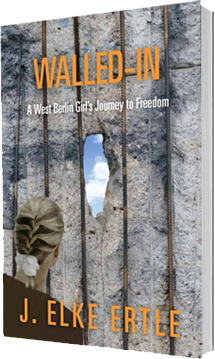
For a sneak peek at the first 20+ pages of my memoir, Walled-In: A West Berlin Girl’s Journey to Freedom, click “Download a free excerpt” on my home page and feel free to follow my blog about anything German: Historical or current events, people, places or food.

Walled-In is my story of growing up in Berlin during the Cold War. Juxtaposing the events that engulfed Berlin during the Berlin Blockade, the Berlin Airlift, the Berlin Wall, and Kennedy’s Berlin visit with the struggle against my equally insurmountable parental walls, Walled-In is about freedom vs. conformity, conflict vs. harmony, domination vs. submission, loyalty vs. betrayal.


Miss Stinnes circumnavigates the world by car

Thursday, September 11th, 2014

Miss Stinnes, the iron-willed daughter of the successful German industrialist, Hugo Stinnes, was an independent thinker and doer long before women achieved equal rights. As a child she played with spark plugs rather than dolls, and as a teen she knew all known automobile engine types by heart.

Miss Stinnes plans her expedition

Born in 1901, Clärenore Stinnes obtained her drivers’ license at age 18 and participated in her first car race at age 24. When her father, head of no less than 1,500 thriving companies, invited her brothers to join the family business but excluded her because of her gender, Clärenore moved to Berlin to race automobiles on the AVUS under a fictitious name. http://walled-in-berlin.com/j-elke-ertle/rocket-fritz-conquers-the-avus/ Disappointed in her father’s decision, she announced at age 26 that she wanted to discover the world by automobile and proceeded to plan her 29,825-mile expedition. She had become the most successful racecar drive in Europe by then. But her family did not support this “trip around the world” (the circumference of the earth is only 24,860 miles) and Miss Stinnes was forced to look for sponsors. When she had amassed a total of 100,0000 Reichsmark, she planned her route, including ships’ passages and stops to resupply. When the Adlerwerke, a German car manufacturing company formed in 1900, agreed to provide her with an automobile in March 1927, Miss Stinnes was ready to go. Two months later, she launched her expedition and took two technicians and the Swedish cameraman, Carl-Axel Söderström, along. The trip was to take the group through 23 countries. Clärenore hoped to finance the majority of her expedition by shooting travel documentaries. http://www.3sat.de/page/?source=/ard/thementage/175133/index.html

Miss Stinnes Discovers the World

The two technicians quit on the first leg of the trip when the car got stuck in the mud in Russia. They went home. Söderström stayed. Miss Stinnes and Söderström negotiated engine trouble, holdups and sickness together. There were few roads. Streets existed only in Europe and North America. A motorcar had never been to many of the areas the pair traversed. The stretch through Asia and the Gobi dessert turned particularly treacherous when the twosome had to use their pistols to keep savage tribesmen at bay. Afterwards, they continued via Japan and Hawaii to the Americas. In Peru, they had to hire workers to build a makeshift “road” over the Andes. Some days, they were only able to progress less than 500 feet because the car had to be pulled over steep slopes. Miss Stinnes’ expedition took a little over two years and ended in Berlin in June of 1929. The following year, Carl-Axel Söderström and Clärenore Stinnes married. Their many films, diaries and 1400 photos were used to shoot the docudrama “Fräulein Stinnes fährt um die Welt.”


For a sneak peek at the first 20+ pages of my memoir, Walled-In: A West Berlin Girl’s Journey to Freedom, click “Download a free excerpt” on my home page and feel free to follow my blog about anything German: historic and current events, people, places and food.

Walled-In is my story of growing up in Berlin during the Cold War. Juxtaposing the events that engulfed Berlin during the Berlin Blockade, the Berlin Airlift, the Berlin Wall and Kennedy’s Berlin visit with the struggle against my equally insurmountable parental walls, Walled-In is about freedom vs. conformity, conflict vs. harmony, domination vs. submission, loyalty vs. betrayal.


Stumbling Block or Stepping-Stone?

Monday, September 8th, 2014

The difference between a stumbling block and a stepping-stone is what you make of it.

–Anonymous


For a sneak peek at the first 20+ pages of my memoir, Walled-In: A West Berlin Girl’s Journey to Freedom, click “Download a free excerpt” on the home page of http://www.walled-in-berlin.com. Walled-In is a story of growing up in Berlin during the Cold War.


Rocket-Fritz conquers the AVUS

Thursday, September 4th, 2014

The AVUS (Automobil Verkehrs- und Uebungsstrecke – motorcar traffic and test road) is the earliest precursor to the Autobahn that we know today. It was an intersection-free race and test track in Berlin, Germany.

AVUS History

Construction of two 26-foot wide lanes, separated by a 30-foot median strip, began in 1912 and was completed in 1921. Initially, the AVUS was 7 miles long and funded by private automobile and racing interests. When the group fell into financial difficulties, the hugely successful German industrialist and auto enthusiast, Hugo Stinnes, purchased the race track. Under his ownership, the test road was expanded to four lanes and lengthened to just over 12 miles. Stinnes had seven children. His daughter, Clärenore, was the first person to circumnavigate the world with an automobile. The year was 1929. That is worth a story in itself. Stay tuned for more.

Rocket-Fitz

The 1920s were the glory days of the AVUS. Some races drew crowds of 300,000. In one of the most spectacular races of that time, Fritz von Opel had test-driven his own invention, the rocket-powered RAK2. That was in 1928.

http://www.3sat.de/page/?source=/ard/sendung/176629/index.html  Fritz von Opel was the outrageous grandson of Adam Opel, founder of the Opel car manufacturing company. Fritz’s race car was sleek, black and cigar-shaped, had truncated wings, enormous tail pipes, and was driven by 24 solid-fuel rockets. In the race, the RAK2 reached a record speed of 143mph, which earned him the nickname, “Rocket-Fritz.”

The RAK2 driven by Fritz von Opel in a 1928 race on Berlin's AVUS (Opel Classic Archiv)

The RAK2 driven by Fritz von Opel in a 1928 race on Berlin’s AVUS
(Opel Classic Archiv)

AVUS Today

AVUS-Races came to a halt during WWII and slowly resumed in the 50’s. The last event I vaguely remember was the 1959 Grand Prix race. In 1998, following reunification, the AVUS was put out of commission. Only the historic grand stands remind of its earlier grandeur. Today the AVUS is part of the public Autobahn network. My only other memory of the AVUS goes back to the time before the fall of the Berlin Wall. At that time, motorist returning from West Germany were forced to observe the 60mph speed limit on their transit through East Germany. It was always a liberating feeling to be able to press the pedal to the metal once Berlin Ring was behind us and we had entered the outskirts of West Berlin. During those last few miles we were always glad to be back in the West again. “No speed limit” became a symbol for the West for us.


For a sneak peek at the first 20+ pages of my memoir, Walled-In: A West Berlin Girl’s Journey to Freedom, click “Download a free excerpt” on my home page and feel free to follow my blog about anything German: historic and current events, people, places and food.

Walled-In is my story of growing up in Berlin during the Cold War. Juxtaposing the events that engulfed Berlin during the Berlin Blockade, the Berlin Airlift, the Berlin Wall and Kennedy’s Berlin visit with the struggle against my equally insurmountable parental walls, Walled-In is about freedom vs. conformity, conflict vs. harmony, domination vs. submission, loyalty vs. betrayal.

 

Meeting each other halfway

Monday, September 1st, 2014

Most people are willing to meet each other halfway; trouble is, most people are pretty poor judges of distance.

–Anonymous


For a sneak peek at the first 20+ pages of my memoir, Walled-In: A West Berlin Girl’s Journey to Freedom, click “Download a free excerpt” on my home page and feel free to follow my blog about anything German: historic or current events, people, places or food.

Walled-In is my story of growing up in Berlin during the Cold War. Juxtaposing the events that engulfed Berlin during the Berlin Blockade, the Berlin Airlift, the Berlin Wall and Kennedy’s Berlin visit with the struggle against my equally insurmountable parental walls, Walled-In is about freedom vs. conformity, conflict vs. harmony, domination vs. submission, loyalty vs. betrayal.


Two Common Autobahn Fallacies

Thursday, August 28th, 2014

I just have to mention the word “Autobahn,” and the eyes of my male friends light up instantly. “Still no speed limit, right?” Their question sounds like a curious mix of awe and envy because Germany’s Autobahnen (motorways) are famous for their absence of speed limits.

Autobahn Fallacy # 1

“True,” I want to tell my friends, “but also a bit misleading. There is hardly a significant stretch of Autobahn that allows you to press the pedal to the metal.” But I usually just let it go. Why not let them feel the excitement of the wind in their hair. If only for a brief moment. In reality, German motorways have no posted speed limit, UNLESS…. and that one little word changes everything. There is no speed limit for cars and motorbikes UNLESS the motorway traverses an urbanized area or unless the stretch is accident-prone or under construction. And since German summers are short, construction zones are ubiquitous. There are few stretches that allow a motorist to test the car’s muscle.

Autobahn by Langsdorf Credit: Wikipedia

Autobahn by Langsdorf
Credit: Wikipedia

Autobahn Fallacy # 2

Generally, Adolf Hitler is credited with the planning, design and construction of the German Autobahn. Another half-truth. The Nazis initially rejected the Autobahn as a “luxury road.” But after coming to power in 1933, Hitler embraced the Autobahn project as his idea. His propaganda machines called it Strassen des Fuehrers – roads of the Leader. Although about a quarter of Germany’s current motorway network was originally constructed during the Third Reich, the initial planning and design work had been done much earlier. Stufa (Studiengesellschaft fuer den Automobilstrassenbau – study group for road construction) began planning a German highway network as early as 1924, long before Hitler. Next, a private initiative (HaFraBa) designed and partially built a “car only road” from Hamburg via Frankfurt am Main to Basel in Switzerland. HaFraBa completed parts of that road in the late 1930s and early 1940’s prior to the start of World War II. And the very first stretch of today’s Autobahn was completed in 1932, also prior to Hitler’s ascent to power. It stretched between Cologne and Bonn and was inaugurated on 6 August 1932 by Konrad Adenauer, then Mayor of Cologne and later Chancellor of West Germany. http://german.about.com/library/blgermyth08.htm The stretch of Autobahn was initially known as Kraftfahrstrasse (motor vehicle road). Today, that same stretch is called Bundesautobahn (Federal motorway) 555.


For a sneak peek at the first 20+ pages of my memoir, Walled-In: A West Berlin Girl’s Journey to Freedom, click “Download a free excerpt” on my home page and feel free to follow my blog about anything German: historic and current events, people, places and food.

Walled-In is my story of growing up in Berlin during the Cold War. Juxtaposing the events that engulfed Berlin during the Berlin Blockade, the Berlin Airlift, the Berlin Wall and Kennedy’s Berlin visit with the struggle against my equally insurmountable parental walls, Walled-In is about freedom vs. conformity, conflict vs. harmony, domination vs. submission, loyalty vs. betrayal.


Guide to being happy

Monday, August 25th, 2014

Just think how happy you would be if you lost everything you now have, and then suddenly got it back.

–Anonymous


For a sneak peek at the first 20+ pages of my memoir, Walled-In: A West Berlin Girl’s Journey to Freedom, click “Download a free excerpt” on the home page of http://www.walled-in-berlin.com. Walled-In is a story of growing up in Berlin during the Cold War.


The Strandkorb – Distinctly German

Thursday, August 21st, 2014

August is beach season, and a “sun-sand-sea-and-wind holiday”on Germany’s North Sea and Baltic beaches almost always involves renting a Strandkorb. These distinctly German beach baskets allow their occupants to soak up the sun while avoiding the scouring sand that frequently travels the windswept beaches. Besides, a Strandkorb quickly becomes “home away from home” when beachgoers build a low wall of sand–called a castle–around their basket and decorate it with seashells. For generations, Germany’s beaches have been dotted with legions of these beach baskets each summer.

What is a Strandkorb?

A Strandkorb is a sturdy, adjustable armchair for two, made from wicker, cane and/or wood and allows its occupants to curl up in the basket’s interior or to soak up the sun’s last rays while all stretched out. A small built-in table makes it possible to lunch or dine at water’s edge. But the Strandkorb is much more than a utilitarian piece of furniture. It is a uniquely constructed piece of art that comes with many options, such as drawers at the base that serve as foot rests and storage, backward-tilting roofs, armrests with foldaway trays, heated seats and rainproof covers. There are even special models for children and pets.

Strandkorb around 1950 , Photo © J. Elke Ertle 2014, www.walled-in-berlin.com

Strandkorb around 1950 Photo © J. Elke Ertle 2014, www.walled-in-berlin.com

Strandkorb History

In 1882, the noble woman Elfriede von Maltzahn asked Wilhelm Bartelmann, chief basket maker to the Imperial Court of Emperor Wilhelm I, to built her a beach chair.  She asked for protection from excessive sun and wind while accommodating her rheumatism. Mr. Bartelmann designed a large, canopied, single-seated armchair. Considering that beach furniture was unheard of prior to 1882, Mrs. von Maltzahn’s Strandkorb became the envy of beachgoers in Warnemuende that year, the sea resort on the Baltic Sea she frequented. Encouraged by the enthusiastic reception of his armchair, Bartelmann designed a two-seater the following year, and his wife opened a beach basket rental service. Since then, the Strandkorb hasn’t left the German beach scene.

The Strandkorb Today

Todays Baltic and North Sea beaches are dotted with more than 70,000 of these covered wicker beach baskets. Two distinct variations have evolved: The straight angular North Sea Strandkorb and the rounded Baltic Sea model. But these beach baskets are no longer relegated exclusively to the beach. You also see them on balconies and patios. A friend of mine received a Strandkorb as a retirement present and uses it to relax in her garden. Despite their weight (up to 200 lbs), the baskets are shipped all over the world. It takes around $700-$3,000 plus shipping costs to become the proud owner of a Strandkorb.


For a sneak peek at the first 20+ pages of my memoir, Walled-In: A West Berlin Girl’s Journey to Freedom, click “Download a free excerpt” on my home page and feel free to follow my blog about anything German: historic and current events, people, places and food.

Walled-In is my story of growing up in Berlin during the Cold War. Juxtaposing the events that engulfed Berlin during the Berlin Blockade, the Berlin Airlift, the Berlin Wall and Kennedy’s Berlin visit with the struggle against my equally insurmountable parental walls, Walled-In is about freedom vs. conformity, conflict vs. harmony, domination vs. submission, loyalty vs. betrayal.


On taking responsibility

Monday, August 18th, 2014

As a rule, you will find that those who complain about the way the ball bounces are usually the ones who dropped it.

–Anonymous

The Skinny on Nude Bathers in Germany

Thursday, August 14th, 2014

For decades, summers in Germany have attracted scores of nude bathers to beaches, parks and lakes. Between eight and twelve million Germans enjoy clothes-free sunbathing, says French geographer Emmanuel Jaurand, author of “A comparative study on the naked cult in Germany.” One reason for the desire to go naked is that German summers tend to be short, and sun worshippers want to assure an all-over bronze tan. Another is the longing to reconnect with nature. Foreign tourists are often caught by surprise when they take a stroll through a park and suddenly bump into a man or a woman in the buff.

FKK- Freikoerperkultur

The first Freikoerperkultur club, FKK for short and literally translated “free body culture,” was established in Essen, Germany, as far back as 1898. Two years later, a number of Swedish bathhouses sprung up in Berlin and at the North and Baltic seas. The first nude beach in Germany was established in 1920 on the island of Sylt. Freikoerperkultur still endorses a naturalistic approach to sports and community living. Nude bathers enjoy the experience of reconnecting with nature without sexual connotation.

Declining FKK membership

Despite the German love for clothes-free sunbathing, membership in FKK clubs has decreased by about 2% per year since the fall of the Berlin Wall in 1989. The clubs’ largest contingent is currently 50 to 60 years old. Members under 25 have become rare. However, the decline in membership does not seem to connote a decrease in the German affinity for nude bathing in public. It only seems to indicate that nude bathers prefer to do so without the constraints of club membership. In fact, nude hiking is the newest wave. The first German “nude hiking trail” was established in 2010.

Expedia Study on Nude Bathers

The 2014 Expedia Flip Flop Report examines the most prevalent joys and anxieties among beachgoers worldwide. The study was conducted among 11,165 adults 18 years of age and older, across 24 countries on five continents. For the third year running, Germans were the likeliest to be nude bathers. However, this year – for the first time – Austrians tied their German peers.

Nude Bathers – Another Perspective

On a carriage ride through the Wadden Sea http://www.walled-in-berlin.com/j-elke-ertle/wattwagenfahrt-endless-discovery/ our couch woman cautioned, “… at a FKK Beach, you’ll see the human body the way God created it and McDonald’s shaped it.” Keep that in mind!


For a sneak peek at the first 20+ pages of my memoir, Walled-In: A West Berlin Girl’s Journey to Freedom, click “Download a free excerpt” on my home page and feel free to follow my blog about anything German: historic and current events, people, places and food.

Walled-In is my story of growing up in Berlin during the Cold War. Juxtaposing the events that engulfed Berlin during the Berlin Blockade, the Berlin Airlift, the Berlin Wall and Kennedy’s Berlin visit with the struggle against my equally insurmountable parental walls, Walled-In is about freedom vs. conformity, conflict vs. harmony, domination vs. submission, loyalty vs. betrayal.