Archive for the ‘J. Elke Ertle’ Category

Approach to Problem Solving

Monday, February 9th, 2015

The best angle from which to approach any problem is the try-angle.


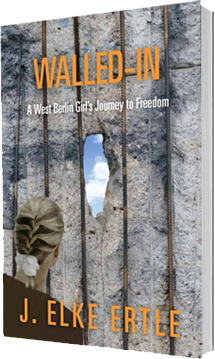
For a sneak peek at the first 20+ pages of my memoir, Walled-In: A West Berlin Girl’s Journey to Freedom, click “Download a free excerpt” on the home page of http://www.walled-in-berlin.com. Walled-In is a story of growing up in Berlin during the Cold War.


8 ways to fight a cold the German way

Thursday, February 5th, 2015

Have you been catching too many colds lately? Were you able to stop that developing sore throat in its tracks? What about bringing down that nasty fever? If you haven’t been successful, why not add some new approaches to your repertoire? Here are eight ways the Germans fight these minor calamities. Maybe some of their approaches will work for you, too.

  1. Germans fight the common cold by drinking boiled beer. They believe that the antiviral properties in hops knock down a cold. That sounds like a good reason to have a beer, doesn’t it?


  1. Germans fight a fever by wrapping a damp, lukewarm cloth around their calves. They swear it reduces the body temperature faster than a damp cloth on the forehead. Sounds logical, doesn’t it? Why not try it?


  1. Germans fight a sore throat by wearing a warm scarf around the neck. However, scarfs, worn by women as well as men, also happen to be the current haute couture. That makes it a little tricky to tell a sick person from a fashion-conscious one.


  1. Germans try to stave off colds, influenza and a sore neck by avoiding drafts. Drafts are a big deal. I remember my mother yelling almost on a daily basis, “close the door, the window is open!” Outdoor gusts are healthy. A draft is a killer. You figure.


  1. Germans fight the queasiness that follows diarrhea or vomiting by eating pretzel sticks or twice-baked biscuits, called “Zwieback.” They are filling and tasty. Give them a try.


  1. Germans fight congestion by taking a hot water bath, laced with salts of chamomile. A hot bath in any way, shape or form sounds always good to me.


  1. Germans soothe a cough by drinking a cup of warm milk with honey.


  1. Germans fight viral infections by drinking the juice of boiled onions. That one I could probably do without.


To find out whether these approaches are based on hard science or anecdotal folk medicine, check out Conor Dillon http://www.dw.de/top-stories/germany/s-1432


For a sneak peek at the first 20+ pages of my memoir, Walled-In: A West Berlin Girl’s Journey to Freedom, click “Download a free excerpt” on my home page and feel free to follow my blog about anything German: historic and current events, people, places and food.

Walled-In is my story of growing up in Berlin during the Cold War. Juxtaposing the events that engulfed Berlin during the Berlin Blockade, the Berlin Airlift, the Berlin Wall and Kennedy’s Berlin visit with the struggle against my equally insurmountable parental walls, Walled-In is about freedom vs. conformity, conflict vs. harmony, domination vs. submission, loyalty vs. betrayal.


Path to the goal

Monday, February 2nd, 2015

People think of the path to the goal in terms of a straight line. In reality, that path is probably twisted, indirect and quite possibly much longer than anticipated. Stick with it anyway!

J. Elke Ertle

The imaginary vs. the realistic path to the goal

The imaginary vs. the realistic path to the goal


For a sneak peek at the first 20+ pages of my memoir, Walled-In: A West Berlin Girl’s Journey to Freedom, click “Download a free excerpt” on the home page of http://www.walled-in-berlin.com. Walled-In is a story of growing up in Berlin during the Cold War.


What happened to the East German Mark?

Thursday, January 29th, 2015

What happened to the East German Mark following German reunification? The obsolete coins were melted down. But the obsolete banknotes underwent a far more interesting death.

Life of the East German Mark

It all started in 1948. Three days after the Western Allies introduced the West German Deutsche Mark in the American, British and French sectors, the Soviets issued an East German version of the Deutsche Mark in their sector. Although the two currencies bore the same name – Deutsche Mark – they differed in appearance and value. Then, in 1964, the East German government changed the name of their currency to Mark der Deutschen Notenbank. In 1968, they changed that name again to Mark der DDR or simply “Mark.” It remained the East German currency until German reunification in 1990.

Mark der DDR - 1968 to 1989, photo by J. Elke Ertle © 2014

Mark der DDR – 1968 to 1989, Photo by J. Elke Ertle © 2914

The Mark following Reunification

Political unification also meant the end of the East German Mark. On 1 July 1990, the Mark was officially demonetized, and East Germany adopted the West German Deutsche Mark. East German citizens were allowed to convert up to 4,000 Mark into Deutsche Mark at a ratio of 1:1. A smaller amount applied to children and a larger one to pensioners. Savings in excess of 4,000 Mark, company debts and housing loans could be converted at a rate of 2:1. Funds acquired shortly before reunification were considered “speculative” and could only be converted at a rate of 3:1.

Destruction of the Mark

Following reunification, the obsolete East German currency became the property of the Kreditanstalt fuer Wiederaufbau – KfW – (Credit Institute for Reconstruction). About 4,500 tons of obsolete coins were recycled by selling a portion of them to the auto industry and melting down the rest. The obsolete banknotes, however, (about 620 million Mark) http://www.spiegel.de/einestages/vergessene-orte-a-946505.html were placed into storage in two sandstone caverns in the mountains near Halberstadt in Saxony-Anhalt. There they were left to rot. During the slow process of decomposition, however, two youths broke into the caves and made off with some of the money. Following the theft in 2001, the KfW opted to burn the remaining out-of-date East German paper currency. Thus in 2002, the last obsolete Marks were burned.


For a sneak peek at the first 20+ pages of my memoir, Walled-In: A West Berlin Girl’s Journey to Freedom, click “Download a free excerpt” on my home page and feel free to follow my blog about anything German: historic and current events, people, places and food.

Walled-In is my story of growing up in Berlin during the Cold War. Juxtaposing the events that engulfed Berlin during the Berlin Blockade, the Berlin Airlift, the Berlin Wall and Kennedy’s Berlin visit with the struggle against my equally insurmountable parental walls, Walled-In is about freedom vs. conformity, conflict vs. harmony, domination vs. submission, loyalty vs. betrayal.


Stasi files online now

Thursday, January 22nd, 2015

“East German Stasi files open to public online for the first time,” states Justin Huggler’s in an article in the Telegraph on January 9, 2015.

http://www.telegraph.co.uk/news/worldnews/europe/germany/11336288/East-German-Stasi-files-open-to-public-online-for-first-time.html

Who is the Stasi?

The term *Stasi” refers to the East German Ministry for State Security (Ministerium fuer Staatssicherheit – MfS for short). The Stasi has been called the most repressive secret police agency ever. One of its tasks was to spy on its own population through agents but also through a vast network of citizen-informants. The Stasi countered opposition by overt and covert means, often involving psychological techniques.

Stasi files since German reunification

Following the Fall of the Berlin Wall in 1989, the Stasi tried to destroy the almost 70 miles of documents it had on file. It was stopped by ordinary citizens who stormed and occupied the agency’s offices. As a result, the Stasi was able to destroy only about 5% of all documents. Following a declassification ruling by the new German government in 1992, the remaining files were opened. According to the Telegraph, almost 7 million applications to view these files have been registered since then.

What Stasi files are available online?

Available for viewing online are 161 documents, 29 photos, 6 audios and 18 videos. They include information on the 1953 East German uprising against communist rule, the 1960 execution of defected border officer Manfred Smolka, Stasi chief Erich Mielke’s comments on the shoot-to-kill policy (read also: http://www.walled-in-berlin.com/j-elke-ertle/erich-mielke-master-of-fear/, the 1983 concert of West German rock star Udo Lindenberg and the 1989 fall of the Berlin Wall. For privacy reasons, the website does not include files on living individuals.

To access the online information, currently available only in German, go to http://www.stasi-mediathek.de/sammlungen/.


For a sneak peek at the first 20+ pages of my memoir, Walled-In: A West Berlin Girl’s Journey to Freedom, click “Download a free excerpt” on my home page and feel free to follow my blog about anything German: historic and current events, people, places and food.

Walled-In is my story of growing up in Berlin during the Cold War. Juxtaposing the events that engulfed Berlin during the Berlin Blockade, the Berlin Airlift, the Berlin Wall and Kennedy’s Berlin visit with the struggle against my equally insurmountable parental walls, Walled-In is about freedom vs. conformity, conflict vs. harmony, domination vs. submission, loyalty vs. betrayal.


Forty is the old age of youth

Monday, January 19th, 2015

Forty is the old age of youth; fifty the youth of old age.

–Victor Hugo


For a sneak peek at the first 20+ pages of my memoir, Walled-In: A West Berlin Girl’s Journey to Freedom, click “Download a free excerpt” on my home page and feel free to follow my blog about anything German: historic and current events, people, places and food.

Walled-In is my story of growing up in Berlin during the Cold War. Juxtaposing the events that engulfed Berlin during the Berlin Blockade, the Berlin Airlift, the Berlin Wall and Kennedy’s Berlin visit with the struggle against my equally insurmountable parental walls, Walled-In is about freedom vs. conformity, conflict vs. harmony, domination vs. submission, loyalty vs. betrayal.


Germany’s Fascination With the American Wild West

Thursday, January 15th, 2015

My early fascination with the American Wild West was probably due to books by Karl May. This prolific German writer had published many adventure novels in the late 1800s and early 1900s. In the mid-1900s, his books were still extremely popular. Even Albert Einstein, Kaiser Wilhelm II, Franz Kafka, filmmaker Fritz Lang, and Hermann Hesse loved Karl May stories. http://www.goethe.de/ins/gb/lp/prj/mtg/typ/win/en4769564.htm

This writer influenced my image of Native Americans so much that growing up in Germany, I dressed up as an American Indian at many of our annual Fasching (carnival) parties.

Karl Friedrich May (1842-1912)

Karl May published over 70 novels. The plots were set in the Orient, Middle East or the American Wild West. To date, more than 200 million copies of his books have been printed. Such a large number is “otherwise associated with dictators or the founders of religions — or J. K. Rowling with her Harry Potter series.” http://www.spiegel.de/international/germany/marking-the-100th-anniversary-of-german-cult-author-karl-may-s-death-a-824566.html.

Karl Friedrich May (1842-1912) authored books about the American Wild West

Karl Friedrich May (1842-1912) authored books about the American Wild West

Winnetou and Old Shatterhand

Karl May is best known for creating the characters of the noble Apache chief, Winnetou, and his honorable German blood brother, Old Shatterhand. The plot takes the reader to the American Wild West, where the life of the Native Americans is threatened due to the construction of the transcontinental railroad. Old Shatterhand (a German immigrant whose birthday name is Karl) works as a surveyor for paleface bosses. His job is to plot the rail line through Arizona. His superiors never consulted the Apaches before grabbing their land. Winnetou captures Old Shatterhand and threatens to execute him unless he can beat an Apache warrior in hand-to-hand combat. Old Shatterhand takes on Winnetou’s father, wins the fight, but spares the man’s life. From then on, Winnetou and Old Shatterhand are fast friends and team up to fight white man’s exploitation.

Winnetou is portrayed as brave, loyal, humble and generous while Native Americans are depicted as innocent victims of white law-breakers. Old Shatterhand gives the impression of a German super-cowboy. This image ran so deep in Germany in the 1960s that we played “Robbers and Indians,” not “Cowboys and Indians.”

Did Karl May write from experience?

An interesting aside to Karl May’s adventure novels about the American Wild West is that he never actually visited the Southwest. Years after having written his popular books, he finally travelled to America. But on that brief trip he visited only typical tourist attractions and carried only standard guidebooks. Karl May must have possessed lots and lots of imagination because he created a world that fascinated scores of young and mature adults for many years, using nothing more than maps, travel accounts and guidebooks, anthropological and linguistic studies to do it.


For a sneak peek at the first 20+ pages of my memoir, Walled-In: A West Berlin Girl’s Journey to Freedom, click “Download a free excerpt” on my home page and feel free to follow my blog about anything German: historic and current events, people, places and food.

Walled-In is my story of growing up in Berlin during the Cold War. Juxtaposing the events that engulfed Berlin during the Berlin Blockade, the Berlin Airlift, the Berlin Wall and Kennedy’s Berlin visit with the struggle against my equally insurmountable parental walls, Walled-In is about freedom vs. conformity, conflict vs. harmony, domination vs. submission, loyalty vs. betray 


Garden of your mind

Monday, January 12th, 2015

Your mind is a garden. Your thoughts are the seeds. You can grow flowers or you can grow weeds.


For a sneak peek at the first 20+ pages of my memoir, Walled-In: A West Berlin Girl’s Journey to Freedom, click “Download a free excerpt” on my home page and feel free to follow my blog about anything German: historic and current events, people, places and food.

Walled-In is my story of growing up in Berlin during the Cold War. Juxtaposing the events that engulfed Berlin during the Berlin Blockade, the Berlin Airlift, the Berlin Wall and Kennedy’s Berlin visit with the struggle against my equally insurmountable parental walls, Walled-In is about freedom vs. conformity, conflict vs. harmony, domination vs. submission, loyalty vs. betrayal.


Kneipp Cold Water Cure

Thursday, January 8th, 2015

In 1855, Father Sebastian Kneipp, a Catholic priest, became known as a man who could cure illness with applications of ice-cold water. Having cured himself of severe tuberculosis with cold water applications, he applied the principle to curing other diseases as well. He became well-known throughout Europe. His clients included the Archduke Franz Ferdinand of Austria and Pope Leo XIII. In America, Kneipp Societies became the forerunners of today’s AANP (American Association of Neuropathic Physicians).

The Life of Father Kneipp

Sebastian Kneipp was born in 1821 in a small town in Bavaria, Germany, approximately 50 miles west of Munich. Like his father, he was to become a weaver. By age 12 years, he already worked full-time in his father’s business, but in his heart he wanted to become a priest. His father said, “We have no money to send you to university. If God had wanted you to become a priest, he surely would have given us the money to send you to school.” But the young Kneipp did not give in. With the help of a mentor he managed to enter preparatory school at age 23 and university four years later. While a student, he contracted severe tuberculosis, a disease thought to be incurable. Applying the principles of the healing powers of water, as discussed in a book by Johann Sigmund Hahn, Kneipp cured himself of the disease. He did so by immersing his body in the ice-cold water of the Danube River for a few seconds several times a week. In 1852 Father Kneipp was ordained, and three years later he settled in Bad Woerishofen.

Father Kneipp settles in Bad Woerishofen

When Kneipp began an intensive study of the healing powers of cold water and certain plants Bad Woerishofen was a small village with 969 residents in 1855. Upon conclusion of his studies, Sebastian Kneipp was certain that in order to be healthy the human body needed physical exercise, a healthy diet and in balance of body, mind and soul. http://www.kneipp.com. To achieve health in his patients, he started a humble practice. Initially, his sole implements for affecting cures consisted of a wooden tub, a ladle and a watering can. He had many successes and his fame grew. In 1886, Father Kneipp published a book, entitled, “My Water Cure” which has been republished many times and translated into many languages.

Statue of Father Sebastian Kneipp in Bad Woerishofen, Photo by J. Elke Ertle © 2014

Statue of Father Sebastian Kneipp in Bad Woerishofen Photo by J. Elke Ertle © 2014

The Town of Bad Woerishofen

Germany has 378 spa towns. Sixty-eight of them offer the Kneipp method of healing. Today, Bad Woerishofen has 14,000 inhabitants,165 clinics and hotels, 160 miles of foot- and bicycle baths, thermal pools, herb and aroma gardens, a barefoot and a forest trail, tennis courts and golf courses. The town’s thermal pools, which include water-rich in sulphur, iodine and salt, are said to help alleviate chronic joint pain and circulatory disorders. I have only visited a few of Germany’s spa towns, but Bad Woerishofen has a special spot in my heart. It is beautifully manicured and a low-key and peaceful place to decompress and regenerate while taking long walks and listening to open-air afternoon concerts.


For a sneak peek at the first 20+ pages of my memoir, Walled-In: A West Berlin Girl’s Journey to Freedom, click “Download a free excerpt” on my home page and feel free to follow my blog about anything German: historic and current events, people, places and food.

Walled-In is my story of growing up in Berlin during the Cold War. Juxtaposing the events that engulfed Berlin during the Berlin Blockade, the Berlin Airlift, the Berlin Wall and Kennedy’s Berlin visit with the struggle against my equally insurmountable parental walls, Walled-In is about freedom vs. conformity, conflict vs. harmony, domination vs. submission, loyalty vs. betrayal.



Hard work and talent

Monday, January 5th, 2015

Hard work without talent is a shame, but talent without hard work is a tragedy.

–Robert Half


For a sneak peek at the first 20+ pages of my memoir, Walled-In: A West Berlin Girl’s Journey to Freedom, click “Download a free excerpt” on the home page of http://www.walled-in-berlin.com. Walled-In is a story of growing up in Berlin during the Cold War.