Let’s Make Sauerkraut Great Again!

January 23rd, 2017


Until recently, the unpretentious Sauerkraut has been a laughing stock among food aficionados. http://www.walled-in-berlin.com/j-elke-ertle/love-it-or-leave-it-sauerkraut/ It has a hard time standing up to more sophisticated produce, such as romanescu, white asparagus and fiddleheads. But a closer look reveals that the unassuming Sauerkraut is packed with dietary fiber, Vitamin C, Vitamin K, Vitamin B6, Folate, Iron, Potassium, Copper and Manganese. It is also low in saturated fat, very low in cholesterol, packed with probiotics and a good source of calcium and magnesium.

Fermented Foods Throughout History

Sauerkraut is a fermented food, along with Tempeh, Miso, Yogurt, Kefir, Kombucha, Kimchi, Natto, Lassi and others. Fermented foods have been a dietary staple for thousands of years. Before Christ, the Greeks already wrote about the health benefits of fermented cabbage. The Romans treated and prevented intestinal infections with Sauerkraut. Captain Cook used Sauerkraut and lime juice to prevent scurvy on his three-year journey around the world. The Chinese ate acid-fermented vegetables while building the Great Wall of China. Centuries ago, the Koreans developed Kimchi by acid-fermenting cabbage and other vegetables. http://www.drdavidwilliams.com/gut-health-and-the-benefits-of-traditional-fermented-foods/

Why Sauerkraut is good for you

During fermentation, bacteria feed on the natural sugars in foods. These microorganisms create lactic acid, which in turn helps preserve the food. Fermented food is full of “friendly bacteria” (probiotics) and helpful enzymes, which “predigest” certain food components, making them easier for the gut to digest and for nutrients to be absorbed. Because the gut is the largest component of our immune system, probiotics in the digestive system may not only improve digestion but also boost immunity and help stave off illnesses. Evidence suggests that gut health may positively affect inflammation, allergies and autoimmune disorders.

Home-made Sauerkraut is lacto-fermented

When it comes to fermentation, most people think about beer or wine, which use yeasts to convert the sugars in grape and or grains into alcohol. Bacteria, on the other hand, are responsible for lacto-fermentation. “Lacto” refers to a specific type of bacteria, namely Lactobacillus. Various strains of Lactobacillus bacteria live on the surface of plants and also inside the gastrointestinal tract. They convert sugar into lactic acid, a natural preservative that inhibits the growth of harmful bacteria. Lacto-fermentation increases or at least preserves vitamin and enzyme levels and aids digestion.

Commercially Fermented Foods

Since industrialization has given us commercially preserved food, fermenting foods at home, such as Sauerkraut, has largely fallen out of favor. Buying a jar or can off the supermarket shelve is so much easier. However, most of these commercially available foods have been pasteurized and cooked at high heat, or they have been acid-pickled. Although the results are predictable, heat and acid destroy the friendly bacteria so that the gut health-promoting lactic acid cannot be produced. High sodium levels tend to be another drawback in commercially fermented foods.

Make your Own Sauerkraut

One way of finding gut-healthy Sauerkraut is to make it at home. Home fermentation insures that the friendly Lactobacillus bacteria stay in tact and that the salt content can be controlled. The process of making Sauerkraut is actually quite easy, and the results are far superior to store-bought products. Here is how I make Sauerkraut:

ELKE’S SAUERKRAUT RECIPE

Ingredients: 3 1/2 lbs shredded cabbage, 5 1/4 teaspoons non-iodized salt. (You may want to add some kale for color).

Process: Massage the salt into the finely shredded cabbage for about 10 minutes. Then pound the cabbage with a wooden spoon or potato masher for another 5 minutes until it produces some brine. Place cabbage and brine into a large jar and pound down firmly with your wooden spoon or potato masher. Cover the jar with a coffee filter and secure it with a rubber band. Let the jar rest at room temperature for up to 24 hrs. The cabbage will produce its own brine. Once the brine totally covers the cabbage, insert piece of plastic wrap into the jar and cover the cabbage completely. No oxygen should reach the Sauerkraut. Should there not be enough brine to cover the cabbage, add distilled water until the Sauerkraut is totally covered. Top the plastic wrapt with a zip lock bag filled half full with water. This will keep the cabbage weighed down to further prevent exposure to oxygen. Store the jar in a cool place, away from sunlight, for 3-4 weeks. The cabbage has now turned into delicious Sauerkraut. Fill the Sauerkraut into smaller jars, seal tightly with lids and store in the refrigerator until ready to use.


Sauerkraut ready to start the facto-fermentation process. Photo © J. Elke Ertle, January 2017. www.walled-in-berlin.com

Sauerkraut ready to start the lacto-fermentation process. Photo © J. Elke Ertle, January 2017. www.walled-in-berlin.com


Enjoy and let’s make Sauerkraut great again!


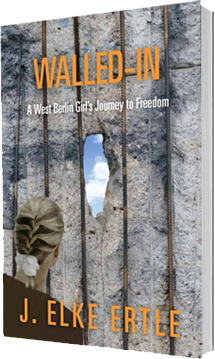
For a sneak peek at the first 20+ pages of my memoir, Walled-In: A West Berlin Girl’s Journey to Freedom, click “Download a free excerpt” on my home page and feel free to follow my blog about anything German: historic or current events, people, places or food.

Walled-In is my story of growing up in Berlin during the Cold War. Juxtaposing the events that engulfed Berlin during the Berlin Blockade, the Berlin Airlift, the Berlin Wall and Kennedy’s Berlin visit with the struggle against my equally insurmountable parental walls, Walled-In is about freedom vs. conformity, conflict vs. harmony, domination vs. submission, loyalty vs. betrayal.


How to Handle Great Treasures

January 19th, 2017

Some of our greatest treasures we place with curators in museums; others we take for walks.

— Roger Caras


The real treasures in our lives. Photo © J. Elke Ertle, 2013. www.walled-in-berlin.com

The real treasures in our lives. Photo © J. Elke Ertle, 2013. www.walled-in-berlin.com


For a sneak peek at the first 20+ pages of my memoir, “Walled-In: A West Berlin Girl’s Journey to Freedom,” click “Download a free excerpt” on the home page of http://www.walled-in-berlin.com

How Prussian Virtues Came About

January 16th, 2017


Prussian virtues (Preussische Tugenden) are behaviors of high moral standards that are said to once have been the hallmark of the inhabitants of Prussia. Some of these values are still attributed to the German people today. The list of Prussian virtues depends on the author but can be condensed to the core values of discipline, self-control, punctuality, thriftiness, service and hard work.

Brief History of Prussia

Between 1925 and 1947, Prussia was a state that centered in the area of today’s Germany, but with boundaries extending far beyond Germany’s current borders. The House of Hohenzollern ruled Prussia and expanded its size with the help of an extremely well organized army. Initially, the Prussian capital was Koenigsberg. In 1701 Friedrich I (Frederick I) became the first King of Prussia and chose Berlin as the capital. In 1871, the German states united under the leadership of Otto von Bismarck. http://www.walled-in-berlin.com/j-elke-ertle/otto-von-bismarck-visionary-or-villain/ Unification created a German Empire under Prussian leadership. In the aftermath of World War I, in 1918, the monarchy was abolished, and the Kingdom of Prussia became a republic, known as the Weimar Republic.  In 1933, the Nazi regime seized control of the Prussian government. Following World War II, Germany was divided into Allied occupation zones, and Prussia ceased to exist. On 25 February 1947, the Allied Control Council http://www.walled-in-berlin.com/j-elke-erte/allied-control-council-governs-germany/ formally proclaimed the dissolution of Prussia.

Origin of Prussian Virtues

When Prussia became a kingdom under Friedrich I over 300 years ago, it was a poor state with fragmented territories. In 1713, his son, Friedrich Wilhelm I (Frederick William I) became King of Prussia. http://www.walled-in-berlin.com/j-elke-ertle/frederick-william-i-a-troubled-ruler/ Friedrich Wilhelm was known as the “Soldier King” because he made considerable reforms to the Prussian army’s training, tactics and conscription. He demanded discipline, efficiency and good work ethics from his soldiers. During the “Soldier King’s” reign, Prussian discipline and Prussian virtues became accepted concepts. Today’s interpretation of Prussian discipline tends to be one in which the soldier blindly follows orders. But under Friedrich Wilhelm’s reign, discipline was a two-way street. Soldiers and their superiors were subject to the same rigorous rules.

In civilian society, Prussian virtues were initially frowned upon. With time, however, they began to seep in, particularly in light of the fact that Prussia had risen from nothing to greatness based on its Prussian discipline and Prussian virtues.

Prussian Virtues today

Even though the state of Prussia doesn’t exist anymore, Prussian virtues have not totally disappeared. In 2001, the German government proclaimed a “Prussian year” with celebrations of its Prussian heritage. Tolerance, reform, selflessness and modesty were highlighted to point out that during Prussian rule Jewish citizens were emancipated, feudalism and serfdom were eliminated, immigration was encouraged, the arts and sciences were celebrated and education of the young was made available and mandatory. In my own family, Prussian orderliness, sense of duty, honesty, punctuality, thriftiness, hard work, restraint and dependability were always stressed and expected.


For a sneak peek at the first 20+ pages of my memoir, Walled-In: A West Berlin Girl’s Journey to Freedom, click “Download a free excerpt” on my home page and feel free to follow my blog about anything German: historic and current events, people, places and food.

Walled-In is my story of growing up in Berlin during the Cold War. Juxtaposing the events that engulfed Berlin during the Berlin Blockade, the Berlin Airlift, the Berlin Wall and Kennedy’s Berlin visit with the struggle against my equally insurmountable parental walls, Walled-In is about freedom vs. conformity, conflict vs. harmony, domination vs. submission, loyalty vs. betrayal.


Open a Door to Allow in more Light

January 12th, 2017


Whenever you read a good book, somewhere in the world a door opens to allow in more light.

– Vera Nazarian


Open a door to allow in more light. Photo © J. Elke Ertle, 2013. www.walled-in-berlin.com

Open a door to allow in more light. Photo © J. Elke Ertle, 2013. www.walled-in-berlin.com


For a sneak peek at the first 20+ pages of my memoir, “Walled-In: A West Berlin Girl’s Journey to Freedom,” click “Download a free excerpt” on the home page of http://www.walled-in-berlin.com


November 9 – a weighty date in Germany

January 9th, 2017


November 9 is a weighty date in German history. Depending on the year, it conjures up acts of brutality or widespread euphoria. In 1938, Nazis in Germany and Austria plundered Jewish homes and businesses, torched synagogues and killed and deported Jews during the night of 9 November to 10 November. The night became known as Kristallnacht (crystal night).

On 9 November 1989, the Berlin Wall fell after having separated family and friends for 28 years, which prompted a jubilant celebration. http://walled-in-berlin.com/j-elke-ertle/who-really-opened-the-berlin/wall/, http://www.walled-in-berlin.com/j-elke-ertle/schabowski-sparks-the-fall-of-the-wall/, http://www.walled-in-berlin.com/j-elke-ertle/brinkmann-or-ehrman-the-crucial-question/

Events preceding Kristallnacht

In the 1920s, most German Jews were fully integrated into German society. When Adolf Hitler became Chancellor of Germany in 1933, the situation changed. Hitler branded the 500,000 Jews living in Germany (about 0.86% of the total German population) as enemies of the State. He blamed the Jews for Germany’s defeat in World War I and for the hyperinflation in the 1920s and quickly introduced policies that restricted their rights. Jewish citizens lost the ability to work in civil service, to get accepted into university and to marry non-Jewish Germans. Many Jews left Germany, but as the number of Jews wanting to leave increased, so did the restrictions against them.

In August 1938, authorities revoked residence permits for foreigners, including those of German-born Jews of foreign origin. In the so-called Polenaktion on 28 October 1938, more than 12,000 Polish-born Jews were expelled from Germany. The deportees were put on trains to the Polish border. But Polish border guards sent them back to Germany because Poland no longer accepted “Jews of former Polish origin.” The deportees ended up walking back and forth between Germany and Poland for days. Among those expelled were the Grynszpans, Polish Jews who had emigrated to Germany in 1911 and settled in the north of Germany. Their teenage son Herschel was living in Paris when he received a postcard from his parents on 3 November 1938, describing their expulsion. Four days later, Herschel went to the German embassy in Paris with a revolver in his pocket. He was directed to the office of Ernst vom Rath, a German embassy official. Young Grynszpan fired five bullets at vom Rath who succumbed to his wounds two days later.

What happened during Kristallnacht in 1938?

When news of the death of Ernst vom Rath reached Nazi officials, they decided that the Jews would have to pay for vom Rath’s death. During the night of 9 November to 10 November, Nazi storm troopers destroyed 7,000 Jewish businesses, set fire to more than 900 synagogues, killed 91 Jews and deported some 30,000 Jewish men to concentration camps. http://www.pbs.org/wgbh/amex/holocaust/peopleevents/pandeAMEX99.html

The sounds of breaking glass shattered the air and littered the streets throughout Germany and parts of Austria, which gave rise to the term “Kristallnacht.”

Kristallnacht had also provided an opportunity for Hitler to totally remove Jews from German public life. He ordered that henceforth Jews would be prohibited from practicing most professions in the private sector; Jewish businesses could not be reopened unless non-Jews managed them; Jewish children would be barred from attending school and Jews would lose the right to hold a driver’s licenses or own an automobile. The Nazis held the Jewish community liable for the damages caused during Kristallnacht and imposed a fine of one-billion Reichsmark. In the ten months following Kristallnacht, more than 115,000 Jews emigrated from the Reich. The majority went to other European countries, the US and Palestine. At least 14,000 went to Shanghai.

Kristallnacht and the Fall of the Berlin Wall in 1989

Decades later after the fall of the Berlin Wall, Germany chose to declare 3 October 1990 – the day of German reunification – a national holiday rather than 9 November 1989. The main reason cited was the association of the latter date with the anniversary of Kristallnacht, which had occurred more than 50 years earlier.


For a sneak peek at the first 20+ pages of my memoir, Walled-In: A West Berlin Girl’s Journey to Freedom, click “Download a free excerpt” on my home page and feel free to follow my blog about anything German: historic and current events, people, places and food.

Walled-In is my story of growing up in Berlin during the Cold War. Juxtaposing the events that engulfed Berlin during the Berlin Blockade, the Berlin Airlift, the Berlin Wall and Kennedy’s Berlin visit with the struggle against my equally insurmountable parental walls, Walled-In is about freedom vs. conformity, conflict vs. harmony, domination vs. submission, loyalty vs. betrayal.


Seeing with new eyes

January 5th, 2017


The real voyage of discovery consists not in seeking new landscapes, but in having new eyes.

–Marcel Proost


Seeing the World with New Eyes, photo © J. Elke Ertle, 2014, www.walled-in-berlin.com

Seeing the World with New Eyes, photo © J. Elke Ertle, 2014, www.walled-in-berlin.com


Sanssouci – modest king’s retreat

January 2nd, 2017


Palace Sanssouci, located in the city of  Potsdam, not far from Berlin, Germany, was built to serve as the summer residence of Frederick the Great (Friedrich der Grosse), King of Prussia. The Hohenzollern king was known for his discipline and modesty. He is said to have been so unpretentious that he once alleged, “A crown is just a hat that lets in the rain.”

The name, Sanssouci, comes from the French “sans souci,” and roughly translates into “without worry.” Sanssouci Palace was King Frederick’s favorite retreat where he would relax without having to observe the formalities of the royal court in Berlin. Here he could philosophize and play music, which were his favorite pastimes. No women were allowed in Sanssouci, not even Frederick the Great’s wife. https://www.spottinghistory.com/view/4476/sanssouci-palace/ Following the king’s death in 1786, Sanssouci remained mostly unoccupied and neglected until the mid-19th century when it became the residence of King Frederick William IV (Friedrich Wilhelm IV). Sanssouci and its extensive gardens became a UNESCO World Heritage Site in 1990.

History of Palace Sanssouci

In 1744, Frederick ordered the hillside of an orchard to be transformed into three terraced vineyards. Against the brickwork he planted vines from Portugal, Italy, France and Neuruppin. Fig trees were placed in the niches. Then, between 1745 and 1747, Georg Wenzeslaus von Knobelsdorff designed and built Palace Sanssouci on the ridge of that terraced hillside.

Palace Sanssouci atop of a terraced hillside, planted with grapes and fig trees. Photo © J. Elke Ertle, 2013. www.walled-in-berlin.com

Palace Sanssouci atop a terraced hillside planted with grapes and fig trees. Photo © J. Elke Ertle, 2013. www.walled-in-berlin.com

The design of the small rococo chateau was based on a sketch made by the king himself. In 1748, a large fountain was constructed in the center of the garden and marble statues were placed around its basin. They include include Venus, Mercury, Apollo, Diana, Juno, Jupiter, Mars and Minerva, as well as the four elements Fire, Water, Air and Earth.

Statue at Sanssouci depicting Earth. Photo © J. Elke Ertle, 2013. www.walled-in-berlin.com

Statue at Sanssouci depicting Earth. Photo © J. Elke Ertle, 2013. www.walled-in-berlin.com

In 1750, Frederick the Great commissioned construction of the baroque New Palace (Neues Palais), but construction did not begin until 1763. In contrast to the single-story Sanssouci Palace, which is rather modest in size and has only ten key rooms, the two-story New Palace contains more than two hundred lavishly decorated rooms, including several ballrooms.

New Palace (Neues Palais). Photo © J. Elke Ertle, 2013. www.walled-in-berlin.com

New Palace (Neues Palais). Photo © J. Elke Ertle, 2013. www.walled-in-berlin.com

One hundred years later, King Frederick William IV built the orangery (Orangerie). Some of the rooms in the 984-foot-long structure house a collection of paintings by Raphael. However, they are copies. The originals were looted by Napoleon.

Also located in Park Sanssouci is the Chinese teahouse (Chinesisches Teehaus), constructed in 1756. It currently holds a collection of porcelain. Gilded sandstone sculptures sit at the feet of the columns and stand along the walls of the rooms. Locals stood as models, which explains the statues’ European features.

Chinese Teahouse in Park Sanssouci. Photo © J. Elke Ertle, 2013. www.walled-in-berlin.com

Chinese Teahouse in Park Sanssouci. Photo © J. Elke Ertle, 2013. www.walled-in-berlin.com

Frederick the Great wished to be buried at Sanssouci

Frederick the Great died in his study in the Palace of Sanssouci in 1786 and had requested to be buried next to his greyhounds on the vineyard terrace. But his successor Frederick William II (Friedrich Wilhelm II) ordered to have the body entombed in the Potsdam Garrison Church, next to Frederick the Great’s father. Toward the end of World War II, Hitler ordered the coffin to be hidden in a salt mine. The U.S Army relocated the remains to Marburg. In 1953, the coffin was moved to Burg Hohenzollern, the ancestral seat of the House of Hohenzollern. Not until 1991, on the 205th anniversary of the death of Frederick the Great, was Frederick’s body finally laid to rest – in accordance with his will – in the terrace of the vineyard of Sanssouci .


For a sneak peek at the first 20+ pages of my memoir, Walled-In: A West Berlin Girl’s Journey to Freedom, click “Download a free excerpt” on my home page and feel free to follow my blog about anything German: historic and current events, people, places and food.

Walled-In is my story of growing up in Berlin during the Cold War. Juxtaposing the events that engulfed Berlin during the Berlin Blockade, the Berlin Airlift, the Berlin Wall and Kennedy’s Berlin visit with the struggle against my equally insurmountable parental walls, Walled-In is about freedom vs. conformity, conflict vs. harmony, domination vs. submission, loyalty vs. betrayal.


It Takes Attitude

December 29th, 2016

Attitude is a little thing that makes a BIG difference.

— Sir Winston Churchill


That's attitude! www.walled-in-berlin.com

That’s attitude! www.walled-in-berlin.com


For a sneak peek at the first 20+ pages of my memoir, “Walled-In: A West Berlin Girl’s Journey to Freedom,” click “Download a free excerpt” on the home page of http://www.walled-in-berlin.com


Alexandrowka – Russian Colony in Potsdam

December 26th, 2016


The Russian colony Alexandrowka is located in the northern part of the city of Potsdam, not far from Berlin. Karlo Rossi, a Russian architect of Italian origin, designed the village in the 19th century. It resembles Glosovo in appearance, a settlement near Petersburg in Russia. In 1996, Alexandrowka was included UNESCO’s Potsdam World Heritage Site.


One of 12 houses in Alexandrowka, a Russian Colony in Potsdam, near Berlin. Photo © J. Elke Ertle, 1213. www.walled-in-berlin.com

One of 12 houses in Alexandrowka, a Russian Colony in Potsdam, near Berlin. Photo © J. Elke Ertle, 1213. www.walled-in-berlin.com

History of the Alexandrowka Colony

Alexandrowka was built between 1826 and 1827. King Friedrich Wilhelm III who ruled Prussia during the Napoleonic Wars and the end of the Holy Roman Empire ordered construction of the colony. Historical and personal circumstances motivated him to create the colony.

In 1806 the French had invaded and defeated Prussia in the Battle of Jena-Auerstedt. In 1812 they had invaded Russia. This time, however, they were badly defeated themselves so that the great French dominion collapsed. Following the 1812 war, sixty-two Russian soldiers remained in Potsdam. From this group a choir was formed to entertain the Prussian troops. In 1825, Tsar Alexander I died, and King Friedrich Wilhelm III ordered the construction of Alexandrowka to memorialize his kinship and friendship with the Romanov family. He built the colony for the last twelve Russian singers of the former soldiers choir who were still living in Potsdam at the time. He named the village Alexandrowka after the Tsarina.

Construction of the Alexandrowka Houses

King Friedrich Wilhelm III had 12 one-and two-story wooden houses constructed on small homesteads. Military artisans, belonging to Prussian guard regiments, built the half-timbered houses (having walls with a timber frame and a brick or plaster filling) with semicircular logs, to make them look like log cabins. In Russia, the homes would have been covered with straw. In Prussia, a Holzverbretterung (timber cladding) was chosen, which was replaced with slate at the end of the 19th century. Each homestead consisted of a house with a balcony and a loggia. A loggia is a covered exterior corridor with an outer wall that is open to the elements and supported by a series of columns. Through a roofed gate the loggia was connected to a small stable building. Every house had a garden. Every household was given a cow. All houses were fully furnished.


Kaiser Friedrich Wilhelm III of Prussia built the houses for twelve singers who belonged to a choir, made up of former Russian soldiers. Photo © J. Elke Ertle, 2013. www.walled-in-berlin.com

Kaiser Friedrich Wilhelm III of Prussia built the houses for twelve singers who belonged to a choir, made up of former Russian soldiers. Photo © J. Elke Ertle, 2013. www.walled-in-berlin.com

In 1827, the twelve singers and their families moved in. They neither purchased the properties, nor did they lease or mortgage them. Instead, each homestead was handed down to male descendants. In 1861, the last singer died. By 1927, only two families in Alexandrowka were direct descendants of the original Russian soldiers who had settled there. And in 2008, the last of these direct descendants died. His family name was Schischkoff.

Since the German reunification in 1990 most of the houses in the settlement are privately owned. Since 2005, the museum of Alexandrowka provides insight into the history and architecture of the log cabins and provides information on their construction method.


For a sneak peek at the first 20+ pages of my memoir, Walled-In: A West Berlin Girl’s Journey to Freedom, click “Download a free excerpt” on my home page and feel free to follow my blog about anything German: historic and current events, people, places and food.

Walled-In is my story of growing up in Berlin during the Cold War. Juxtaposing the events that engulfed Berlin during the Berlin Blockade, the Berlin Airlift, the Berlin Wall and Kennedy’s Berlin visit with the struggle against my equally insurmountable parental walls, Walled-In is about freedom vs. conformity, conflict vs. harmony, domination vs. submission, loyalty vs. betrayal.


Age can be a good thing

December 22nd, 2016

Age appears to be best in three things: old wood to burn, old wine to drink and old friends to trust.

— Anonymous


For a sneak peek at the first 20+ pages of my memoir, “Walled-In: A West Berlin Girl’s Journey to Freedom,” click “Download a free excerpt” on the home page of http://www.walled-in-berlin.com