Dutch Treat at the Dutch Quarter

December 19th, 2016


The Dutch Quarter (Hollaendisches Viertel) is a neighborhood in the city of Potsdam, about 15 miles southwest of Berlin. Its 134 three-story red brick houses with Dutch style gables were constructed between 1733 and 1740. Originally, all of the buildings had front yards, but the last garden gave way in 1928. Today, the Dutch Quarter in Potsdam is Europe’s greatest collection of Dutch-style houses outside of the Netherlands. Mittlestrasse no. 8, the Johann-Boumann-Haus, is open to the public and details the history of the Dutch Quarter.


The Dutch Quarter (Hollaendisches Viertel) in Potsdam near Berlin, photo © J. Elke Ertle, 2013. www. walled-in-berlin.com

The Dutch Quarter (Hollaendisches Viertel) in Potsdam near Berlin, photo © J. Elke Ertle, 2013. www. walled-in-berlin.com

History of the Dutch Quarter

Construction of the Dutch Quarter began during the reign of Friedrich Wilhelm I of Prussia, the “Soldier King.” To expand and upgrade the garrison town of Potsdam, Friedrich Wilhelm needed a large number of skilled craftsmen. Partial to the skillfulness of Dutch tradesman, he hoped to entice Dutch immigrants to Potsdam by offering them a home, freedom of conscience to follow their own beliefs in matters of religion and morality and the promise of plenty of work.

Eagerly, Friedrich Wilhelm asked the Dutch designer/builder, Jan Bouman, to construct four blocks of red brick houses, reminiscent of the Netherlands. Unfortunately, the Dutch tradesmen did not arrive in the anticipated numbers so that many soldiers and their families, French and Prussian artists and travelling salesmen moved into the settlement instead. At some point, one third of the inhabitants were French.

Until 1878, the second battalion of the Prussian first Foot Guard Regiment was stationed in the Dutch Quarter. In 1906, the Hauptmann von Koepenick http://www.walled-in-berlin.com/j-elke-ertle/the-captain-from-koepenick-ruse/ purchased his uniform in Mittelstrasse no. 3. from second-hand dealer Bertold Remlinter.

The Dutch Quarter in the 20th Century

The Dutch Quarter miraculously escaped major damage during World War II. Following the Second World War, the settlement became part of Soviet Occupation Zone. It was left to decay until the city council voted in the 1970s to begin restoration. Following German reunification in 1990, and with the help of the Dutch Monarchy, property owners, artists, conservationists and private investors, restoration took a major step forward and is completed by now.

The Dutch Quarter Today

Today, the Dutch Quarter’s picturesque mix of residential, small shops, galleries, artisan workshops, small backyard taverns, antique dealers, tempting restaurants and cozy cafés give it a unique charm that is popular with locals and tourists alike. The opportunity to Dutch Treat at the Dutch Quarter presents itself around every corner. Three times during the year, the Dutch Quarter celebrates: There is the tulip festival in April, the pottery market in September and the Dutch Christmas Market, called Sinterklaas.


The Dutch Quarter with its cozy taverns, small restaurants and cafes, photo © J. Elke Ertle, 2013. www.walled-in-berlin.com

The Dutch Quarter with its cozy taverns, small restaurants and cafes, photo © J. Elke Ertle, 2013. www.walled-in-berlin.com


Locals and tourists enjoy the charm of the Dutch Quarter on a sunny afternoon, photo © J. Elke Ertle, 2013. www.walled-in-berlin.com

Locals and tourists enjoy the charm of the Dutch Quarter on a sunny afternoon, photo © J. Elke Ertle, 2013. www.walled-in-berlin.com


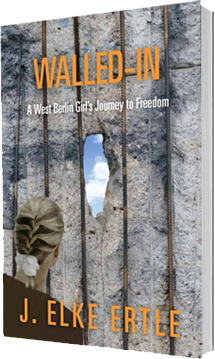
For a sneak peek at the first 20+ pages of my memoir, Walled-In: A West Berlin Girl’s Journey to Freedom, click “Download a free excerpt” on my home page and feel free to follow my blog about anything German: historic or current events, people, places or food.

Walled-In is my story of growing up in Berlin during the Cold War. Juxtaposing the events that engulfed Berlin during the Berlin Blockade, the Berlin Airlift, the Berlin Wall and Kennedy’s Berlin visit with the struggle against my equally insurmountable parental walls, Walled-In is about freedom vs. conformity, conflict vs. harmony, domination vs. submission, loyalty vs. betrayal.


Life is what we make it

December 15th, 2016

So goes the saying, but according to Tehyi Hsieh

“Life is partly what we make it and partly what is made by the friends whom we choose.”


For a sneak peek at the first 20+ pages of my memoir, Walled-In: A West Berlin Girl’s Journey to Freedom, click “Download a free excerpt” on my home page and feel free to follow my blog about anything German: historic or current events, people, places or food.

Walled-In is my story of growing up in Berlin during the Cold War. Juxtaposing the events that engulfed Berlin during the Berlin Blockade, the Berlin Airlift, the Berlin Wall and Kennedy’s Berlin visit with the struggle against my equally insurmountable parental walls, Walled-In is about freedom vs. conformity, conflict vs. harmony, domination vs. submission, loyalty vs. betrayal.


Iconic Kaiser Wilhelm Memorial Church

December 12th, 2016


There are many memorials in Berlin that hark back to the city’s long and colorful history. But none touched me more than the protestant Kaiser Wilhelm Memorial Church (Kaiser Wilhelm Gedaechtniskirche) in the heart of the former West Berlin. Its damaged church tower is a reminder of the destructiveness of war.

aiser Wilhelm Memorial Church, Berlin, Germany, photo © J. Elke Ertle, 2014. www.walled-in-berlin. com

Kaiser Wilhelm Memorial Church, Berlin, Germany, photo © J. Elke Ertle, 2014. www.walled-in-berlin. com

History of the Kaiser Wilhelm Memorial Church

The Kaiser Wilhelm Memorial Church was originally built between 1891 and 1895. The last German Emperor and King of Prussia, Kaiser Wilhelm II, named it in honor of his grandfather Kaiser Wilhelm I. The foundation stone was laid on 22 March 1891, Wilhelm I’s birthday. With its 371-foot spire, the church was the tallest building in Berlin at the time. Inside it was decorated with stained glass windows and a large mosaic portraying the history of Prussia up to Emperor Wilhelm.

In 1943, the Neo-Romanesque church was largely destroyed during a bombing attack and the resulting fire. The subsequent air raids of 1945 leveled it almost completely. By the end of World War II, only the heavily damaged west tower of the Kaiser Wilhelm Memorial Church was left standing. Berliners dubbed it Hohler Zahn (hollow tooth).

Close-up view of the "Hohler Zahn", photo © J. Elke Ertle, 2015. www.walled-in-berlin.com

Close-up view of the “Hohler Zahn”, photo © J. Elke Ertle, 2015. www.walled-in-berlin.com

However, when the West Berlin government wanted to demolish the hollow spire in the 1950s, the public protested. In the end, the tower was left standing in its crippled state while a new church was constructed around it. The first floor of the damaged tower of the old church is now home to a memorial hall.

Reconstruction of the Kaiser Wilhelm Memorial Church

The entire church stood heavily damaged until a new, octagonal church was built alongside the damaged tower between 1957 and 1963. A freestanding hexagonal bell tower was constructed next to the church, on the site of the former main nave of the destroyed church. Egon Eiermann designed the new construction.

The modern church bears little resemblance to its predecessor. Inside the octagonal nave of the new church, an enormous statue of Jesus, suspended above the altar, catches the eye. But the most striking feature of the new church is the intense blue light that pervades throughout the building, created by 21,000 colored blocks of glass. They were blown by hand in a French workshop. The predominant color is blue with small flecks of ruby red, emerald green and yellow.

21,000 blue glass blocks create an introspective atmosphere inside the reconstructed Kaiser Wilhelm Memorial Church, photo © J. Elke Ertle. www.walled-in-berlin.com

21,000 blue glass blocks create an introspective atmosphere inside the reconstructed Kaiser Wilhelm Memorial Church, photo © J. Elke Ertle. www.walled-in-berlin.com


Candles in memory of the victims of the 19 December 2016 terrorist attack in the Christmas Market next to the Kaiser Wilhelm Memorial Church. Photo © J. Elke Ertle, 2017. www.walled-in-berlin.com

Candles in memory of the victims of the 19 December 2016 terrorist attack in the Christmas Market next to the Kaiser Wilhelm Memorial Church. Photo © J. Elke Ertle, 2017. www.walled-in-berlin.com


For a sneak peek at the first 20+ pages of my memoir, Walled-In: A West Berlin Girl’s Journey to Freedom, click “Download a free excerpt” on my home page and feel free to follow my blog about anything German: historic and current events, people, places and food.

Walled-In is my story of growing up in Berlin during the Cold War. Juxtaposing the events that engulfed Berlin during the Berlin Blockade, the Berlin Airlift, the Berlin Wall and Kennedy’s Berlin visit with the struggle against my equally insurmountable parental walls, Walled-In is about freedom vs. conformity, conflict vs. harmony, domination vs. submission, loyalty vs. betrayal.


The Shortest Words

December 8th, 2016

The shortest words, like yes and no, require the most thought.

— Pythagoras


For a sneak peek at the first 20+ pages of my memoir, “Walled-In: A West Berlin Girl’s Journey to Freedom,” click “Download a free excerpt” on the home page of http://www.walled-in-berlin.com

Schloss Charlottenburg – Urban Gem

December 5th, 2016


Schloss Charlottenburg (Charlottenburg Palace) is one of the few remaining examples of the grand Hohenzollern palaces in the city of Berlin. The Hohenzollern ruled Prussia for nearly four centuries. During a British air raid in 1943, a bomb caused a fire, and the baroque and rococo palace burned to the ground. Demolition of Schloss Charlottenburg was planned, but after the East German government demolished the Berliner Stadtschloss, the city palace of the Hohenzollern in 1950, http://www.walled-in-berlin.com/j-elke-ertle/berliner-stadtschloss-to-humboldt-forum/ West German authorities decided to rebuild Charlottenburg Palace. The project took more than sixty years to complete.


Schloss Charlottenburg (Charlottenburg Palace) in Berlin, photo © J. Elke Ertle, 2014. www.walled-in-berlin.com

Schloss Charlottenburg (Charlottenburg Palace) in Berlin, photo © J. Elke Ertle, 2014. www.walled-in-berlin.com

Brief History of Schloss Charlottenburg

Construction of Schloss Charlottenburg started in 1695. At that time it was known as Lietzenburg. The palace was built as a summer residence for Sophie Charlotte, wife of the Elector of Brandenburg, Friedrich III. In 1701, after crowning himself Friedrich I, King of Prussia, the palace saw a significant expansion. After Sophie Charlotte’s death, the palace was renamed Schloss Charlottenburg. Architecture did not interest Friedrich’s son, Friedrich Wilhelm I, so that all construction stopped when he ascended the throne in 1713. In 1740 Friedrich II, also known as Friedrich the Great, commissioned an expansion of the New Wing (east wing) to complement the larger west wing.

Don’t miss when visiting Schloss Charlottenburg

At the entrance to the palace, a large equestrian statue of the Friedrich Wilhelm III, the Great Elector of Brandenburg, greets the visitor. The bronze was originally located on the Kurfuerstenbruecke, a bridge near the city palace. But during World War II, the statue was submerged in Tegeler See, a large lake in Berlin. Upon recovery in 1952, it was moved to the entrance of Schloss Charlottenburg. The four chained warriors at the base of the statue symbolize the four temperaments.


Statue of the Great Elector of Brandenburg, Friedrich Wilhelm III, at the entrance to Schloss Charlottenburg, photo © J. Elke Ertle, 2014. www.walled-in-berlin.com

Statue of the Great Elector of Brandenburg, Friedrich Wilhelm III, at the entrance to Schloss Charlottenburg, photo © J. Elke Ertle, 2014. www.walled-in-berlin.com

Altes Schloss

The central and oldest part of the palace is the domed Altes Schloss (Old Palace). It is topped with a statue of the goddess Fortuna. Among the treasures inside are the apartments of Friedrich I and Queen Sophie Charlotte, the Oak Gallery with family portraits of members of the House of Hohenzollern and the Porcelain Chamber with over two thousand pieces of Chinese porcelain.

 Neuer Fluegel (New Wing)

The Neuer Fluegel contains the private living quarters of Friedrich the Great and the apartments of Friedrich Wilhelm II. The two most striking rooms in the New Wing are the Weisser Saal (White Hall), a magnificent dining room, and the Goldene Galerie (Golden Gallery). The latter is a 138 foot-long ballroom decorated with mirrors and gilded rococo ornaments.

Schlossgarten

The extensive park behind Schloss Charlottenburg was created between 1697 and 1701 and designed by Simeon Godeau who also created the gardens of Versailles.

Belvedere

Towards the northern end of the Schlossgarten, near the river Spree, is Belvedere, originally a teahouse. It was built between 1788 and 1790, destroyed during World War II, reconstructed in the late 1950s and now houses a collection of eighteenth-century porcelain produced by Berlin manufacturers.

Belvedere in the gardens of Schloss Charlottenburg, photo © J. Elke Ertle, 2016. www.walled-in-berlin.com

Belvedere in the gardens of Schloss Charlottenburg, photo © J. Elke Ertle, 2016. www.walled-in-berlin.com

Mausoleum

The Mausoleum is on the western side of the Schlossgarten. It is a Doric temple that was built in 1810 as the burial place for Queen Luise. The mausoleum was later expanded to include the sarcophagi of other members of the royal family, including Frederick William II, Emperor William I and Queen Augusta.


For a sneak peek at the first 20+ pages of my memoir, Walled-In: A West Berlin Girl’s Journey to Freedom, click “Download a free excerpt” on my home page and feel free to follow my blog about anything German: historic and current events, people, places and food.

Walled-In is my story of growing up in Berlin during the Cold War. Juxtaposing the events that engulfed Berlin during the Berlin Blockade, the Berlin Airlift, the Berlin Wall and Kennedy’s Berlin visit with the struggle against my equally insurmountable parental walls, Walled-In is about freedom vs. conformity, conflict vs. harmony, domination vs. submission, loyalty vs. betrayal.


To Hear the Truth

December 1st, 2016

Sometimes people don’t want to hear the truth because they don’t want their illusions destroyed.

–Friedrich Nietzsche


For a sneak peek at the first 20+ pages of my memoir, “Walled-In: A West Berlin Girl’s Journey to Freedom,” click “Download a free excerpt” on the home page of http://www.walled-in-berlin.com


Ludwig Erhard and the Economic Miracle

November 28th, 2016


Ludwig Erhard was a West German statesman who is credited with West Germany’s spectacular economic recovery following World War II. The recover is often referred to as the “German economic miracle” http://www.walled-in-berlin.com/j-elke-ertle/west-german-economic-miracle-secret. Erhard advocated a social market economy, combining open market competition with a strong central bank and a social safety net to protect the disadvantaged. He opposed planned economies with price controls and high taxes.

Early Life of Ludwig Erhard

Ludwig Erhard came from modest circumstances. He attended school only to the junior secondary level, entered an apprenticeship program at age 16 and was drafted to serve in World War I. He was seriously wounded in 1918. Following the war, Ludwig Erhard attended college in Nuernberg and studied marketing, management, political economy and sociology at the University of Frankfurt/Main. After obtaining a doctorate, he became a consumer market researcher at the Institute of Restaurant Economics.

Ludwig Erhard becomes known as an economic expert

While the first German democracy collapsed in the aftermath of World War I and the Nazis established themselves, Ludwig Erhard maintained a low profile. But he also wrote a memo in 1944 on war financing and debt consolidation. That memo began with the assumption that Germany would lose the war. The document found its way to the Western Allies who saw in him a man who could help rebuild a democratic Germany. Erhard’s lack of compromising political ties and his reputation as an economic expert got him appointed as the Director of the Economic Council for the joint Anglo-American occupation zone.

At the same moment that the Allies introduced a new German currency, Ludwig Erhard abolished price controls. These were the darkest days of the postwar economic crisis. This decision became the foundation of Germany’s economic rebirth. The Black Market disappeared, shortages ended, and inflation halted.


Ludwig Erhard, "Father of the Economic Miracle"

Ludwig Erhard, “Father of the Economic Miracle”


Ludwig Erhard leads West Germany

When West Germany was established, Ludwig Erhard became Minister of Economics. The “Father of the Economic Miracle” held this post for 14 years and guided the West German economy through a recovery that outpaced the growth of the European countries that had won the war.

https://www.pbs.org/wgbh/commandingheights/shared/minitext/prof_ludwigerhard.html In 1963, Ludwig Erhard became chancellor. He resigned in 1966 and died in Bonn, West Germany, in 1977.


For a sneak peek at the first 20+ pages of my memoir, Walled-In: A West Berlin Girl’s Journey to Freedom, click “Download a free excerpt” on my home page and feel free to follow my blog about anything German: historic and current events, people, places and food.

Walled-In is my story of growing up in Berlin during the Cold War. Juxtaposing the events that engulfed Berlin during the Berlin Blockade, the Berlin Airlift, the Berlin Wall and Kennedy’s Berlin visit with the struggle against my equally insurmountable parental walls, Walled-In is about freedom vs. conformity, conflict vs. harmony, domination vs. submission, loyalty vs. betrayal.


The Importance of the Newspaper

November 24th, 2016

If you don’t read the newspaper, you are uninformed.

If you do read the newspaper you are misinformed.

— Mark Twain

The newspaper - yes or no? www.walled-in-berliln.com

The newspaper – yes or no?
www.walled-in-berlin.com

For a sneak peek at the first 20+ pages of my memoir, Walled-In: A West Berlin Girl’s Journey to Freedom, click “Download a free excerpt” on the home page of http://www.walled-in-berlin.com

Recreation of Hitler Bunker

November 21st, 2016


In October 2016, more than 71 years after Adolf Hitler committed suicide, Historiale, an organization which runs the Berlin Story Bunker Museum, recreated part of the Hitler Bunker (Fuehrerbunker) for the public’s benefit. The privately funded museum vows that it will not allow the exhibit to become a neo-Nazi shrine. It says it is merely responding to tourist demand. Tourists are curious where the Hitler Bunker was located and what it looked like inside Historiale claims. But the nearby state-funded Topography of Terror Museum, built on the site of the former Gestapo headquarters, blasts the museum’s bunker recreation as a Disneyland-style approach to Berlin’s past. http://www.theaustralian.com.au/news/world/the-times/berlin-museum-recreates-bunker-where-hitler-committed-suicide/news-story/a793376164c498bf651362b90bbe6c90

History of the Hitler Bunker

The Hitler bunker was the last air raid shelter used by Adolf Hitler during World War II. It was located beneath the garden of the Chancellery (Reichskanzlei) near Berlin’s Brandenburg Gate. The bunker consisted of about 30 small rooms that were protected by 13 feet of concrete.

Hitler moved into the Fuehrerbunker in January 1945. By 19 April 1945, the Soviets began to encircle the city. On 20 April, Hitler made his last trip to the surface. As fierce street fighting raged outside, Hitler married Eva Braun in a small civil ceremony inside the bunker. On 30 April, the day following the wedding, he is said to have shot himself while Braun took cyanide.

The Hitler bunker was discovered by Red Army and Allied troops in the spring of 1945. The Soviets leveled both Chancellery buildings between 1945 and 1949, but the underground bunker complex largely survived until 1988–89 when the East German government ripped out the interior and filled the site with rubble.

What does the actual Hitler Bunker site look like today?

To keep the Hitler Bunker site from attracting attention, the government of the reunited Germany built apartment buildings and a parking lot where the emergency exit for the Fuehrerbunker was once located. In 2006, an information board was installed to mark the location of the former Hitler Bunker. The board is located at the corner of In den Ministergaerten and Gertrud-Kolmar-Strasse near Potsdamer Platz.

Site of former Hitler Bunker in 2014, photo © J. Elke Ertle, www.walled-in-berlin.com

Site of former Hitler Bunker in 2014, photo © J. Elke Ertle, www.walled-in-berlin.com

Information Board at the formerl Hitler Bunker site in 2014, photo © J. Elke Ertle, www.walled-in-berlin.com

Information Board at the former Hitler Bunker site in 2014, photo © J. Elke Ertle, www.walled-in-berlin.com

Where is the recreated Hitler Bunker located?

The recreated Hitler Bunker is located in a former underground air raid bunker at the Anhalter Bahnhof, about one mile from the actual bunker site. The permanent exhibit contains a life-sized recreation of Hitler’s underground living and workrooms (although the furniture is not original). There is a picture of Friedrich der Grosse (Frederick the Great) on the wall, a grandfather clock in one corner and an oxygen canister in the other. The bunker is filled with black and white photographs of Hitler and his entourage.


For a sneak peek at the first 20+ pages of my memoir, Walled-In: A West Berlin Girl’s Journey to Freedom, click “Download a free excerpt” on my home page and feel free to follow my blog about anything German: historic and current events, people, places and food.

Walled-In is my story of growing up in Berlin during the Cold War. Juxtaposing the events that engulfed Berlin during the Berlin Blockade, the Berlin Airlift, the Berlin Wall and Kennedy’s Berlin visit with the struggle against my equally insurmountable parental walls, Walled-In is about freedom vs. conformity, conflict vs. harmony, domination vs. submission, loyalty vs. betrayal.


Three Things are Needed

November 17th, 2016

We need three things when we wake up in the morning: something to do, somewhere to do it and someone to do it with.

–Anonymous


We need three things when we wake up in the  morning: Something to do, somewhere to do it and someone to do it with, photo © J. Elke Ertle, 2016, www.walled-in-berlin.com

We need three things when we wake up in the morning: Something to do, somewhere to do it and someone to do it with, photo © J. Elke Ertle, 2016, www.walled-in-berlin.com


For a sneak peek at the first 20+ pages of my memoir, Walled-In: A West Berlin Girl’s Journey to Freedom, click “Download a free excerpt” on my home page and feel free to follow my blog about anything German: historic or current events, people, places or food.

Walled-In is my story of growing up in Berlin during the Cold War. Juxtaposing the events that engulfed Berlin during the Berlin Blockade, the Berlin Airlift, the Berlin Wall and Kennedy’s Berlin visit with the struggle against my equally insurmountable parental walls, Walled-In is about freedom vs. conformity, conflict vs. harmony, domination vs. submission, loyalty vs. betrayal.