Archive for the ‘J. Elke Ertle’ Category

some people appear bright…

Monday, July 7th, 2014

We all know that light travels faster than sound. That’s why certain people appear bright until you hear them speak. — Albert Einstein


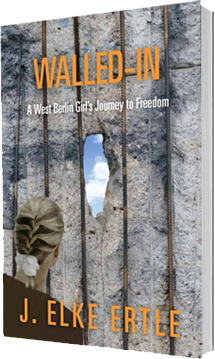
For a sneak peek at the first 20+ pages of my memoir, Walled-In: A West Berlin Girl’s Journey to Freedom, click “Download a free excerpt” on my home page and feel free to follow my blog about anything German: historic and current events, people, places and food.

Walled-In is my story of growing up in Berlin during the Cold War. Juxtaposing the events that engulfed Berlin during the Berlin Blockade, the Berlin Airlift, the Berlin Wall and Kennedy’s Berlin visit with the struggle against my equally insurmountable parental walls, Walled-In is about freedom vs. conformity, conflict vs. harmony, domination vs. submission, loyalty vs. betrayal.


Christian Führer – Fall of the Berlin Wall

Thursday, July 3rd, 2014

Christian Führer passed away last Monday, June 30, 2014, at age 71. His name and that of the Nikolaikirche–St. Nicholas Church–in Leipzig will forever be linked to East Germany’s peaceful revolution against communist rule. As Pastor, Führer led weekly Monday night Friedensgebete–peace prayers. These meetings became the foundation of the demonstrations that ultimately brought down the German Democratic Republic (East Germany) and led to German reunification.

Rev. Christian Führer

Rev. Christian Führer

Nikolaikirche

The church was built around the time that Leipzig was founded in 1165. It became a Protestant seat in 1539 and has not changed much since the 16th century. Johann Sebastian Bach played the organ here in the 18th century. In 1980 Rev. Führer became pastor at the Nikolaikirche. At that time the Cold War divided the world into East and West, and a wall split Germany into the DDR (East Germany) and the BRD (West Germany). Religion was frowned upon by communism so that atheism was the norm in East Germany. Churches like the Nikolaikirche were spied upon.

St. Nikolaikirche in Leipzig, photo © J. Elke Ertle, 2015

St. Nikolaikirche in Leipzig, photo © J. Elke Ertle, 2015

Peaceful revolution of 1989

“In the DDR, the church provided the only free space,” Führer said in an interview with Religion & Ethics News Weekly. “Everything that could not be discussed in public could be discussed in church.” http://www.pbs.org/wnet/religionandethics/2009/11/06/november-6-2009-the-rev-christian-fuhrer-extended-interview/4843/. To encourage a dialogue on topics that were otherwise taboo, Christian Führer established the Monday night prayer meetings. The gatherings gained in popularity and attendance soon exceeded the church’s 2,000-seat capacity. By early 1989 the East German authorities tried to stop Führer’s Friedensgebete by arresting random “suspects” inside and outside the church. But the meetings continued. To the contrary, the number of participants grew even larger. In September 1989, the prayers turned into peaceful demonstrations. Thousands of people held candles and carried banners. Although the police tried to keep the demonstrations in check, the number of demonstrators continued to grow.

October Showdown

On 9 October 1989, 100,000 demonstrators gathered in the center of Leipzig. They were met by 8,000 armed police with orders to shoot. Demonstrators shouted, “We are the people” and “No violence.” A blood bath seemed likely, but organizers appealed to the demonstrators to remain peaceful. They complied. Miraculously, not one shot fell. Quickly, protests swept through the rest of East Germany and led to the opening of the borders on 9 November 1989. Christian Führer had provided the cradle for this peaceful revolution. His name will remain inextricably entwined with the fall of the Berlin Wall.


For a sneak peek at the first 20+ pages of my memoir, Walled-In: A West Berlin Girl’s Journey to Freedom, click “Download a free excerpt” on my home page and feel free to follow my blog about anything German: historic and current events, people, places and food.

Walled-In is my story of growing up in Berlin during the Cold War. Juxtaposing the events that engulfed Berlin during the Berlin Blockade, the Berlin Airlift, the Berlin Wall and Kennedy’s Berlin visit with the struggle against my equally insurmountable parental walls, Walled-In is about freedom vs. conformity, conflict vs. harmony, domination vs. submission, loyalty vs. betrayal.


Truth versus Myth

Monday, June 30th, 2014

The great enemy of truth is very often not the lie–deliberate, contrived and dishonest–but the myth–persistent, persuasive and unrealistic. Too often we hold fast to the cliches of our forebears. We subject all facts to a prefabricated set of interpretations. We enjoy the comfort of opinion without the discomfort of thought.

–John F. Kennedy – Commencement Address at Yale University, June 11 1962


For a sneak peek at the first 20+ pages of my memoir, Walled-In: A West Berlin Girl’s Journey to Freedom, click “Download a free excerpt” on my home page and feel free to follow my blog about anything German: Historical or current events, people, places or food.

Walled-In is my story of growing up in Berlin during the Cold War. Juxtaposing the events that engulfed Berlin during the Berlin Blockade, the Berlin Airlift, the Berlin Wall, and Kennedy’s Berlin visit with the struggle against my equally insurmountable parental walls, Walled-In is about freedom vs. conformity, conflict vs. harmony, domination vs. submission, loyalty vs. betrayal.


Currywurst – German Cousin of the Hot Dog

Thursday, June 26th, 2014

Currywurst is a German national Schnell-Imbiss, a fast food. It is the German cousin of the American hot dog. In the beginning, Currywurst was an inexpensive, filling meal purchased from street vendors. Today, it is also available in many upscale restaurants from Germany to New York.

What is Currywurst?

Currywurst is a grilled sausage that is cut into slices (when I grew up, it was split lengthwise) and dowsed with a sauce. The secret lies in the sauce, which in essence consists of stewed tomatoes, curry, and spices. Depending on the vendor, the sauce may be flavored with sweet Indian curry, powdered mustard, hot chili, lemongrass, paprika, or chopped onions.

Currywurst success story

Made from grilled pork or beef, this quick meal originated in the bare-bones kitchen of a Berlin woman during the Berlin Blockade and Airlift of 1948/1949. Herta Heuwer was a hands-on woman. When Berlin lay in shambles at the end of World War II, Heuwer did her part by becoming a Truemmerfrau (rubble woman). She became one of the many women who are credited with putting Germany’s war-torn cities back together by separating reusable building materials from tons of useless debris so that reconstruction could begin. http://walled-in-berlin.com/j-elke-ertle/legacy-of-rubble-women. Herta Heuwer became a Truemmerfrau who helped to put Berlin’s district of Charlottenburg–the district I grew up in–back on its feet in 1946. A couple of years later, during the Berlin Blockade, she bartered with her British occupiers for a few spices. Condiments were largely unattainable in those days. After she had traded spirits for a little Worcester sauce and ketchup, she experimented with these spices at home and ended up with a sauce that she poured over boiled pork sausage. The dish caught on with the working class. Soon Heuwer opened a street side stand and sold Currywurst with a slice of whole grain bread on the side. Her business took off. Six years later, her sales amounted to 10,000 servings a week. After patenting her sauce under the name of “Chillup,” Heuwer opened a fast food restaurant at Kaiser-Friedrich-Strasse 57 in Charlottenburg, not far from where I grew up. Ms. Heuwer never disclosed her original recipe and never sold out to mass-production food companies.

Herta Heuwer plaque installed at Kaiser-Friedrich-Str. 57 at the corner of Kantstrasse, photo © J. Elke Ertle, 2015

Herta Heuwer plaque installed at Kaiser-Friedrich-Str. 57 at the corner of Kantstrasse, photo © J. Elke Ertle, 2015

Currywurst consumption today

The Deutsche Currywurst Museum estimates that 800 million Currywursts are consumed in Germany every year, 70 million in Berlin alone. Even the Volkswagen car manufacturing plant in Wolfsburg produces 3.5 million Currywursts per year in its own butcher shop.


For a sneak peek at the first 20+ pages of my memoir, Walled-In: A West Berlin Girl’s Journey to Freedom, click “Download a free excerpt” on my home page and feel free to follow my blog about anything German: historic and current events, people, places and food.

Walled-In is my story of growing up in Berlin during the Cold War. Juxtaposing the events that engulfed Berlin during the Berlin Blockade, the Berlin Airlift, the Berlin Wall and Kennedy’s Berlin visit with the struggle against my equally insurmountable parental walls, Walled-In is about freedom vs. conformity, conflict vs. harmony, domination vs. submission, loyalty vs. betrayal.


How to live life

Monday, June 23rd, 2014


Live life each day as you would climb a mountain. An occasional glance toward the summit keeps the goal in mind, but many beautiful scenes are to be observed from each new vantage point. Climb slowly, steadily, enjoying each passing moment; and the view from the summit will serve as a fitting climax for the journey.

–Harold B. Melchart


For a sneak peek at the first 20+ pages of my memoir, Walled-In: A West Berlin Girl’s Journey to Freedom, click “Download a free excerpt” on my home page and feel free to follow my blog about anything German: Historical or current events, people, places or food.

Walled-In is my story of growing up in Berlin during the Cold War. Juxtaposing the events that engulfed Berlin during the Berlin Blockade, the Berlin Airlift, the Berlin Wall, and Kennedy’s Berlin visit with the struggle against my equally insurmountable parental walls, Walled-In is about freedom vs. conformity, conflict vs. harmony, domination vs. submission, loyalty vs. betrayal.


100 percent Tempelhof Field Referendum

Thursday, June 19th, 2014

Last month, Berliners voted in a referendum, called “100% Tempelhof Field” to keep the former airport site permanently open to the public. http://www.dw.de/berlin-voters-claim-tempelhof/a-17663944. Tempelhof Airport, centrally located and roughly the size of New York’s Central Park, was closed in 2008 and recently slated for construction of housing units and public buildings.

Tempelhof Field History

Tempelhof Field had once been a parade ground for the Prussian army. In 1909, the American aviation pioneer, Orville Wright, managed to stay in the air over Berlin for one full hour. http://www.berlin-airport.de/en/company/about-us/history/tempelhof-airport/. In the 1920s, Zeppelins lifted off this field, and in 1926, German Airlines, Lufthansa, got their start in here. In the mid-1930s, Hitler decided to build a world-class airport on this site, planning to rename it “Germania.” In only two years, the symmetrical complex was completed and consisted of 49 buildings, 7 hangars, and 9,000 offices, amounting to a total of 3,067,000 square feet of space. In 1945, US Forces took control of the airport, expanded the complex, and used it as a base for the next five decades. During the 1948/49 Berlin Blockade, Tempelhof Field served as a major takeoff and landing site for the Berlin Airlift. In 1951, the US Forces released the airport for civil air and freight traffic, but within a decade it had reached its capacity. After Tegel Airport opened in 1975, Tempelhof Airport operations were suspended, and in 2008 the historic landmark was closed altogether.

Tempelhof Field Controversy

In 1996, the city decided to build a new mega-airport, Berlin Brandenburg International (BBI). As the opening of BBI got delayed several times, controversy over the use of Tempelhof Field ensued. Some wanted to see the grounds preserved as a commercial airport; others wanted them turned into a museum, residences, and park land.In an attempts to ease Berlin’s housing crises, city fathers proposed to build 4,700 apartments and commercial spaces and a public library on the former airport site.

100% Tempelhof Field

Almost 65 percent of those who voted on this citizens’ initiative gave their support to “100% Tempelhof Field.” Since the closure of Tempelhof Airport, Berliners had used the field for a variety of festivals, music events, art exhibitions, barbecues, kite flying, wind skating (surfing on skateboards), gardening, and football. The area also has a six-kilometer cycling, skating and jogging trail, a dog-walking field, and an enormous picnic area.

Tempelhof Airport with Tempelhof Field in background, photo © J. Elke Ertle, 2015

Tempelhof Airport with Tempelhof Field in background, photo © J. Elke Ertle, 2015


For a sneak peek at the first 20+ pages of my memoir, Walled-In: A West Berlin Girl’s Journey to Freedom, click “Download a free excerpt” on my home page and feel free to follow my blog about anything German: historic and current events, people, places and food.

Walled-In is my story of growing up in Berlin during the Cold War. Juxtaposing the events that engulfed Berlin during the Berlin Blockade, the Berlin Airlift, the Berlin Wall and Kennedy’s Berlin visit with the struggle against my equally insurmountable parental walls, Walled-In is about freedom vs. conformity, conflict vs. harmony, domination vs. submission, loyalty vs. betrayal.



Setting out on a Journey

Monday, June 16th, 2014

Just because we cannot see clearly the end of the road, that is no reason for not setting out on the essential journey.

–John F. Kennedy


For a sneak peek at the first 20+ pages of my memoir, Walled-In: A West Berlin Girl’s Journey to Freedom, click “Download a free excerpt” on the home page of http://www.walled-in-berlin.com. Walled-In is a story of growing up in Berlin during the Cold War.


Tips for thirsty Germany-travellers

Thursday, June 12th, 2014

When thirsty in Germany, the ‘In-the-Know’ traveller orders beer in the north and south of the country and wine in the Palatinate region, right? Wrong. If you want to look like you are a native, you might ask for a Schorle, a Spritzer, a Radler, a Spezi or a Berliner Weisse instead. (Berliner Weisse only in the capital, of course.) All of these beverages are mixed drinks, contain fewer calories and less alcohol than their more intoxicating cousins, and are popular alternatives to straight beer and wine.

Schorle – an alternative for the thirsty

A Schorle, also called a Spritzer, is a mixed drink of half fruit juice or wine and half carbonated mineral water or soda. There are two varieties of this beverage: the Saftschorle (fruit juice) and the Weinschorle or Spritzer (Wine). The Saftschorle comes as a Suesse (sweet)or a Saure (sour) Schorle. The sweet variety is mixed with lemon soda; the sour one is combined with sparkling mineral water. The most popular Schorle in Germany is the Apfelschorle, which is made from apple juice and carbonated mineral water. The Weinschorle or Spritzer is a mixed drink consisting of wine and carbonated sparking water. Spritzer comes from the German word “spritzen,” meaning, “to squirt.”

Radler, Spezi, or Berliner Weisse as alternatives

But if neither Schorle appeals to you, there are other options. Try a Radler, a Spezi, or a Berliner Weisse. A Radler is the result of mixing beer with lemonade. A Spezi consists of Coke and Orange Fanta. And a cooling Berliner Weisse is achieved when raspberry or woodruff syrup are mixed with wheat beer. Raspberry syrup makes for a red Berliner Weisse; woodruff syrup (Waldmeister) for a green drink. Both are popular summertime beverages in Berlin and are typically served in bowl-shaped glasses. Berliner Weisse dates back to the 16th century and has about 3% alcohol. Rumor has it that Napoleon dubbed the drink the “Champagne of the North.” Now you know. If you find yourself thirsty in Germany, don’t limit yourself to beer and wine. Try their less alcoholic cousins.

Red and Green Berliner Weisse - a popular beverage for the thirsty

Red and Green Berliner Weisse a popular beverage for the thirsty

Prosit!


For a sneak peek at the first 20+ pages of my memoir, Walled-In: A West Berlin Girl’s Journey to Freedom, click “Download a free excerpt” on the home page of http://www.walled-in-berlin.com. Walled-In is a story of growing up in Berlin during the Cold War.


Idealist, Cynic and Realist at Odds

Monday, June 9th, 2014

Here is the difference between an idealist, a cynic and a realist: An idealist believes the short run doesn’t count. A cynic believes the long run doesn’t matter. A realist believes that what is done or left undone in the short run determines the long run.

–Sydney J. Harris

Which description fits you?


For a sneak peek at the first 20+ pages of my memoir, Walled-In: A West Berlin Girl’s Journey to Freedom, click “Download a free excerpt” on the home page of http://www.walled-in-berlin.com. Walled-In is a story of growing up in Berlin during the Cold War.


1000-Bomber Raid over Cologne

Thursday, June 5th, 2014

In 1942, the middle of World War II, the British Royal Air Force (RAF) chose a 90-minute window to bomb the German city of Koelln (Cologne). Founded in the first century AD as the Roman Colonia Claudia Ara Agrippinensium, today’s Cologne straddles both sides of the Rhine River and is Germany’s forth-largest city.

Famous Cologne Cathedral

In 1996, the Koellner Dom (Cologne Cathedral), Germany’s most visited landmark, was declared one of UNESCO’s 759 cultural World Heritage Sites. Construction of the renowned Catholic Church began in 1248 and was completed in the early 19th century. http://en.wikipedia.org/wiki/World_Heritage_Site. Today, visitors can climb the 509 stone steps of the cathedral’s spiral staircase to reach a viewing platform that offers a magnificent scenic view of the city and the Rhine River 300 feet below.

World War II Bomber Stream Tactic

During World War II, Cologne was bombed in 262 separate Allied air raids. The first bombing took place on 12 May 1940. But the RAF 1,000-bomber-raid of 1942 caused the biggest destruction. Two-and-a-half times more bombers took part in this raid than in any prior RAF raid. It was codenamed “Operation Millennium” and introduced a new practice, called the “bomber stream” tactic. Instead of converging on their target from different airfields, the fighter planes now gathered in one stream prior to attacking their target.

1000-Bomber Raid over Cologne

Just after midnight on 30 May 1942, the city along the Rhine River was awakened to the wailing of air-raid sirens. A squadron of 1,046 RAF bombers was approaching. Although, the city of Hamburg had been the intended target, bad weather over northern Germany had caused Cologne to be selected instead. The fighter planes passed over the city at a rate of one every six seconds, dropping a total of almost 1,500 tons of high-explosive and incendiary bombs.

Damage to Cologne

Two-thirds of the bombs dropped had been incendiary bombs. Within a period of 90 minutes, close to 2.5 square miles of the city center were flattened and in flames. About 30,000 houses and 3,330 non-residential buildings were damaged or destroyed and 45,000 people became homeless. It was estimated that from 135,000 to 150,000 of Cologne’s population of nearly 700,000 fled the city after the raid. https://dirkdeklein.net/2016/05/30/the-bombing-of-cologne-90-minutes-that-changed-the-city/


Cologne after the 1000-bomber raid in 1942 - the Cologne Cathedral is only superficially damaged

Cologne after the 1000-bomber raid in 1942 – the Cologne Cathedral is only superficially damaged

Fate of the Cologne Cathedral

The intent of the 1000-bomber raid had been to shatter German civilian morale. But when the survivors emerged from their shelters, they saw the twin spires of their much-loved cathedral towering more or less intact against the moonlit sky. The cathedral had only been superficially damaged. Instead of demoralizing the citizens of Cologne, this inexplicable sight had the opposite effect. It strengthened the citizens’ resolve, similar to that of British civilians after the London Blitz.


For a sneak peek at the first 20+ pages of my memoir, Walled-In: A West Berlin Girl’s Journey to Freedom, click “Download a free excerpt” on my home page and feel free to follow my blog about anything German: historic and current events, people, places and food.

Walled-In is my story of growing up in Berlin during the Cold War. Juxtaposing the events that engulfed Berlin during the Berlin Blockade, the Berlin Airlift, the Berlin Wall and Kennedy’s Berlin visit with the struggle against my equally insurmountable parental walls, Walled-In is about freedom vs. conformity, conflict vs. harmony, domination vs. submission, loyalty vs. betrayal.