Archive for the ‘J. Elke Ertle’ Category

Listening to excuses or to talk?

Thursday, July 2nd, 2015

One learns more about people by listening to their excuses than by listening to their talk.

–Peter Tille


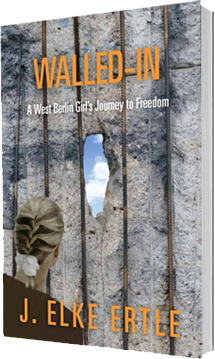
For a sneak peek at the first 20+ pages of my memoir, Walled-In: A West Berlin Girl’s Journey to Freedom, click “Download a free excerpt” on the home page of http://www.walled-in-berlin.com. Walled-In is a story of growing up in Berlin during the Cold War.

St. Thomas Boys Choir – 800 years

Monday, June 29th, 2015

The  world-famous St. Thomas Boys Choir of Leipzig, Germany, is first mentioned in 1254. But most likely, the choir is as old church itself. The St. Thomas Church came into being in 1212 when Margrave Dietrich of Meissen founded an Augustinian Monastery on this spot. Toward the end of the 15th century, the church’s Romanesque nave was razed and replaced by the late-Gothic “Hall-Church” that we see today. In fact, the architecture of today’s church has not changed much since the end of the 15th century.

St. Thomas Church, Leipzig Photo © J. Elke Ertle. www.walled-in-berlin.com

St. Thomas Church, Leipzig
Photo © J. Elke Ertle. www.walled-in-berlin.com

Choir Director Johann Sebastian Bach

From 1723 to 1750, the renowned composer and musician of the Baroque period, Johann Sebastian Bach, led the St. Thomas Boys Choir. At that time, the chorus consisted of 54 boys. Today, about 100 boys and young men sing in the choir. Their primary focus is the preservation of Bach’s choral music. For that reason, weekly Friday and Saturday motets have become a permanent musical tradition at St. Thomas. Bach Passion Concerts and the Christmas Oratorio draw thousands of visitors each year. The present leader of the choir is, Daniel Hyde, the church’s 36th cantor. https://www.saintthomaschurch.org/music/choir

During a recent visit, I was able to enjoy a Friday motet with the St. Thomas Boys Choir. The church was packed, and we were not disappointed. Music and setting succeeded in linking us emotionally to a long-forgotten time period.

Statue of Johann Sebastian Bach in front of the St. Thomas Church in Leipzig Photo © J. Elke Ertle

Statue of Johann Sebastian Bach in front of the St. Thomas Church in Leipzig
Photo © J. Elke Ertle

The Bach Organ

The organ from Bach’s days no longer exists. In 2000, for the 250th anniversary of Bach’s death, St. Thomas acquired a new organ. This new instrument, with its 61 registers and 4 manuals with pedal, looks and sounds similar to an organ of the 18th century.

Historic events at St. Thomas

The Lutheran St. Thomas Church has a long and eventful history. Not only has the St. Thomas Boys Choir sung here for the last 800 years. Many other important events took place in this church as well: In 1409, the University of Leipzig was founded in the monastery. In 1539, Martin Luther preached at St. Thomas, introducing the Reformation to Leipzig’s citizens. From 1723 until his death, Johann Sebastian Bach was Cantor of the Thomas school. In 1789 Wolfgang Amadeus Mozart played the organ here. Mendelssohn performed at St. Thomas, and in 1813 Richard Wagner was baptized here. Since 1950 the St. Thomas Church is the location of Johann Sebastian Bach’s remains. Originally buried in an unmarked grave outside the Johanniskirche in Leipzig, Bach was moved to his final resting place at the foot of the church’s altar.


For a sneak peek at the first 20+ pages of my memoir, Walled-In: A West Berlin Girl’s Journey to Freedom, click “Download a free excerpt” on my home page and feel free to follow my blog about anything German: historic and current events, people, places and food.

Walled-In is my story of growing up in Berlin during the Cold War. Juxtaposing the events that engulfed Berlin during the Berlin Blockade, the Berlin Airlift, the Berlin Wall and Kennedy’s Berlin visit with the struggle against my equally insurmountable parental walls, Walled-In is about freedom vs. conformity, conflict vs. harmony, domination vs. submission, loyalty vs. betrayal.


Two ways of spreading light

Thursday, June 25th, 2015

There are two ways of spreading light: To be the candle or the mirror that reflects it.

–Edith Wharton


For a sneak peek at the first 20+ pages of my memoir, Walled-In: A West Berlin Girl’s Journey to Freedom, click “Download a free excerpt” on my home page and feel free to follow my blog about anything German: historic or current events, people, places or food.

Walled-In is my story of growing up in Berlin during the Cold War. Juxtaposing the events that engulfed Berlin during the Berlin Blockade, the Berlin Airlift, the Berlin Wall, and Kennedy’s Berlin visit with the struggle against my equally insurmountable parental walls, Walled-In is about freedom vs. conformity, conflict vs. harmony, domination vs. submission, loyalty vs. betrayal.

Goethe writes Faust, a closet drama

Monday, June 22nd, 2015

Johann Wolfgang von Goethe (1749 -1832) was a prolific German writer whose extensive work included epic and lyric poetry, memoirs, treatises on botany, anatomy and color, an autobiography, prose and verse dramas, four novels, 10,000 letters and nearly 3,000 drawings. His poems were set to music throughout the eighteenth and nineteenth centuries by a number of composers. His best-known work is Faust, a two-part drama, which he wrote over a period of 57 years. It is a hybrid between a play and an extended poem. Performances of the two-part tragedy are still performed today at the Goetheanum in Switzerland.

John Wolfgang von Goethe (1749-1832)

Johann Wolfgang von Goethe (1749-1832)

Goethe’s Youth

By the age of eight, Goethe already spoke some Greek, Latin, French, English, Hebrew and Italian. His passion at that time was drawing, and he soon became interested in literature. By age sixteen he was sent to the University of Leipzig to study law. http://www.imagi-ation.com/moonstruck/clsc20.html Because he hated having to memorize judicial rules by heart, he often attended poetry lectures instead. While in Leipzig, he became a regular patron at Auerbachs Cellar (Auerbachs Keller in German). http://www.walled-in-berlin.com/j-elke-ertle/auerbachs-cellar-5th-in-world-fame/ The folk legend of Faust’s wine barrel ride at Auerbach’s made such an impression on him that he turned it into a closet drama.

Closet Dramas

Closet dramas ares not intended to be performed onstage. They are plays that are read out loud by a reader. Closet dramas written in verse became very popular in Western Europe after 1800. Nonetheless, Faust Part One and Faust Part Two are often performed onstage.

Faust plot

Faust, the main character, is an aging scholar. Frustrated with the limits to his knowledge, power, and enjoyment of life, he agrees to a pact with Mephisto, the devil. Faust agrees to exchange his soul for unlimited knowledge and worldly pleasures during his lifetime. On earth Faust will be master. In hell, Faust will be the devils’ servant for the rest of eternity.

Faust Part One

Mephisto leads Faust through a number of adventures that culminate in a lustful relationship with an innocent young girl. It ends in tragedy for Faust. The girl is saved but Faust is left to grieve in shame. Faust Part One was published in 1808 and created a sensation.

Faust Part Two

Part two begins with the spirits of the earth forgiving Faust. Mephisto tries to seize Faust’s soul when he dies, but angels intervene due to God’s grace. Faust Part Two was only finished shortly before his death and was published posthumously.


For a sneak peek at the first 20+ pages of my memoir, Walled-In: A West Berlin Girl’s Journey to Freedom, click “Download a free excerpt” on my home page and feel free to follow my blog about anything German: historic and current events, people, places and food.

Walled-In is my story of growing up in Berlin during the Cold War. Juxtaposing the events that engulfed Berlin during the Berlin Blockade, the Berlin Airlift, the Berlin Wall and Kennedy’s Berlin visit with the struggle against my equally insurmountable parental walls, Walled-In is about freedom vs. conformity, conflict vs. harmony, domination vs. submission, loyalty vs. betrayal.



Parallels or Something New?

Thursday, June 18th, 2015

An educated man sees parallels while a simpleton sees something altogether new.

–Sigmund Graff


For a sneak peek at the first 20+ pages of my memoir, Walled-In: A West Berlin Girl’s Journey to Freedom, click “Download a free excerpt” on the home page of http://www.walled-in-berlin.com. Walled-In is a story of growing up in Berlin during the Cold War.

Matters of Principle vs. Style

Monday, June 15th, 2015

In matters of style, swim with the current; in matters of principle, stand like a rock.

–Thomas Jefferson


For a sneak peek at the first 20+ pages of my memoir, Walled-In: A West Berlin Girl’s Journey to Freedom, click “Download a free excerpt” on the home page of http://www.walled-in-berlin.com. Walled-In is a story of growing up in Berlin during the Cold War.

Auerbachs Cellar in Leipzig since 1525

Thursday, June 11th, 2015

Auerbachs Cellar (Auerbachs Keller in German) is located in the heart of Leipzig, Germany, a city that celebrated its 1000th anniversary in 2015 http://www.walled-in-berlin.com/j-elke-ertle/1000-years-city-of-leipzig/. As the locals like to explain, “Wer nach Leipzig zur Messe gereist ohne auf Auerbachs Hof zu gehen, der schweige still, denn das beweist: Er hat Leipzig nicht gesehen.” (If you have travelled to a Leipzig trade show without visiting Auerbachs, keep it quiet because it proves that you haven’t seen Leipzig.)

Auerbachs could have been Stromer’s

Auerbachs Cellar has been in continuous operation since 1525. It is located in the basement of the Maedler Passage, a shopping arcade in Leipzig’s historic district. Its original owner, Dr. Heinrich Stromer, sat on the Leipzig city council, was a professor of medicine at the University of Leipzig and personal physician to members of the nobility. In appreciation for Stromer’s services, the Prince-Elector of Saxony granted him the privilege of establishing a wine bar. The bar was first mentioned in 1438. Because Stromer was born in the city of Auerbach, Leipzig’s citizens liked to call him Dr. Auerbach. The name stuck. But the wine bar did not last long. In 1528, Dr. Stromer had the original structure razed and replaced with a larger one that included a large vaulted cellar (Grosser Keller), a Cask Cellar (Fasskeller), Old Leipzig (Alt-Leipzig), the Luther Room (Lutherzimmer) and the Goethe Room (Goethezimmer). The Mephisto Bar was constructed on the floor above. All of the rooms are still standing today. However, in the early 20th century – when the Maedler Passage was built – much of Auerbachs was reconstructed and expanded.

Grosser Keller, Auerbachs Cellar, Leipzig, Photo © J. Elke Ertle. 2014

Grosser Keller, Auerbachs Cellar, Leipzig
Photo © J. Elke Ertle, 2014

Auerbachs and the Goethe connection

While Johann Wolfgang von Goethe, a German writer, studied in Leipzig in the 1700s, he liked to frequent Auerbachs Cellar. It was here that he got the inspiration for “Faust,” his two-part play in which Faust sells his soul to the devil, Mephisto. Faust and Mephisto carouse here with students before riding off on a barrel. The scene is depicted on a carved tree trunk in the Goethe Room. Two large bronze sculptures at the cellar’s entrance depict Dr. Faust, Mephisto and the students.

Sculpture of Faust and Mephisto at the entrance of Auerbachs Cellar, Photo © J. Elke Ertle, 2014

Sculpture of Faust and Mephisto at the entrance of Auerbachs Cellar, Leipzig, Photo © J. Elke Ertle, 2014

Rubbing Faust’s shoe for good luck

After dining in Auerbachs large vaulted cellar recently, we admired the painted ceiling and enjoyed the traditional German food. That day’s special – Sauerbraten with red cabbage and dumplings – tasted as good as it looked. Upon leaving, we made sure we gave Dr. Faust’s shoe a rub. It is supposed to bring good luck. There must be some truth to the legend because we noticed that Dr. Faust’s shoe gleamed golden, the dark bronze patina having been rubbed away by scores of good-luck-seekers before us.

Dr. Faust's shoe, polished by scores of Auerbachs visitors, Leipzig, Photo © J. Elke Ertle, 2014

Dr. Faust’s shoe, polished by scores of Auerbachs visitors, Leipzig, Photo © J. Elke Ertle. 2014

For a sneak peek at the first 20+ pages of my memoir, Walled-In: A West Berlin Girl’s Journey to Freedom, click “Download a free excerpt” on my home page and feel free to follow my blog about anything German: historic and current events, people, places and food.

Walled-In is my story of growing up in Berlin during the Cold War. Juxtaposing the events that engulfed Berlin during the Berlin Blockade, the Berlin Airlift, the Berlin Wall and Kennedy’s Berlin visit with the struggle against my equally insurmountable parental walls, Walled-In is about freedom vs. conformity, conflict vs. harmony, domination vs. submission, loyalty vs. betrayal.


Challenges make life interesting

Monday, June 8th, 2015

Challenges are what makes life interesting and overcoming them is what makes life meaningful.

–Joshua J. Marine


For a sneak peek at the first 20+ pages of my memoir, Walled-In: A West Berlin Girl’s Journey to Freedom, click “Download a free excerpt” on the home page of http://www.walled-in-berlin.com. Walled-In is a story of growing up in Berlin during the Cold War.

Corner hugging Nante – Eckensteher Nante

Thursday, June 4th, 2015

“Corner hugging Nante (Eckensteher Nante in German),” along with painter Heinrich Zille (http://walled-in-berlin.com/j-elke-ertle/heinrich-zille-and-his-milieu/) and street singer “Harfenjule”, were Berlin archetypes of the 19th and early 20th century. Each is credited with a good dose of the legendary spirit, so unique to the Berliner character: Big heart and big mouth. These Berlin originals were good-natured, quick-witted, exceedingly self-confident, flippant, and sometimes even a little coarse. They came from all walks of life and commented on life around them with the appropriate joke. The figure of Nante became a timeless classic on account of Adolf Glassbrenner’s folksy theater piece, “Eckensteher Nante im Verhoer (The Interrogation of Corner hugging Nante), which premiered in 1833.

Corner hugging Nante

The real name of the historic Eckensteher Nante was Ferdinand ‘Nante’ Strumpf. He was born in 1803, had little education and performed casual work when he ran out of beer money. Once he had earned enough change, he headed for the nearby distillery Eulner. http://www.in-berlin-brandenburg.com/Berliner/Eckensteher-Nante.html It is said that Corner hugging Nante spent more time in the distillery than at work. To earn beer money, Nante positioned himself on Berlin’s ritzy boulevard, Unter den Linden (then called Koenigstrasse – King Street) and waited for an opportunity to make himself useful. He always stood in the same spot at the corner of Koenigstrasse and Neue Friedrichstrasse. With a strap slung over his shoulder to carry heavy loads, Nante usually stood resting against a post or house wall. For a few pennies, he offered to carry the purchases or luggage of well-to-do passers-by. But don’t think that Corner hugging Nante was loitering. Not at all. He was duly registered as a serviceman with the Berlin police department and wore an official brass armband that identified him as work permit holder number 22. Standing there, waiting, Nante made fun of the world around him. With typical Prussian humor, he commented on the hustle and bustle on the streets of Berlin. His earthy sayings were characterized by sarcasm, a distrust of “those above” and delivered in the grammatical style that is unique to Berlin. Over time, his cheeky proverbs became literary legend.

The archetype of the Berliner

According to “Meyers Konversations-Lexikon des 19. Jahrhunderts” 37 percent of the inhabitants of Berlin during Nante’s time had Germanic origins, 39 percent had Romanesque roots and 24 percent had Slavic blood. This mix and the prevailing circumstances evolved over time into an archetype that pooled the good and the bad qualities of the different nationalities, races and tribes. It resulted in a character that combined the toughness, endurance and obstinacy of their Germanic ancestors; the courage, laissez-faire spirit and hot-bloodedness of the French; and the quick grasp, language skills and moodiness of the Slavs. This mix made the Berliner good-natured and capable of great sacrifices. It also made him short-tempered and opinionated. Above all, it spawned the dry Berlin humor.

Nante Eck

If you wish to catch a bit of the spirit of Eckensteher Nante, drop by the Nante Eck on Unter den Linden at the corner of Friedrichstrasse. This Old-Berlin Restaurant serves traditional German food and offers plenty of ambiance. A statue of Corner hugging Nante greets you outside.

ckensteher Nante (Corner hugging Nante) in front of Nante Eck, Berlin © Photo by J. Elke Ertle. 2014

Eckensteher Nante (Corner hugging Nante) in front of Nante Eck, Berlin
© Photo by J. Elke Ertle, 2014


For a sneak peek at the first 20+ pages of my memoir, Walled-In: A West Berlin Girl’s Journey to Freedom, click “Download a free excerpt” on my home page and feel free to follow my blog about anything German: historic and current events, people, places and food.

Walled-In is my story of growing up in Berlin during the Cold War. Juxtaposing the events that engulfed Berlin during the Berlin Blockade, the Berlin Airlift, the Berlin Wall and Kennedy’s Berlin visit with the struggle against my equally insurmountable parental walls, Walled-In is about freedom vs. conformity, conflict vs. harmony, domination vs. submission, loyalty vs. betrayal.


Value versus price

Monday, June 1st, 2015

The setting of a gemstone increases its price, not its value.

Ludwig Boerne


For a sneak peek at the first 20+ pages of my memoir, Walled-In: A West Berlin Girl’s Journey to Freedom, click “Download a free excerpt” on the home page of http://www.walled-in-berlin.com. Walled-In is a story of growing up in Berlin during the Cold War.