Archive for the ‘J. Elke Ertle’ Category

To do something “as much as possible”

Thursday, August 6th, 2015

I have learned that the limitation/restriction “as much as possible” provides an opportunity for avoidance. To do something as much as possible means to succumb to the first temptation.

–Mahatma Gandhi


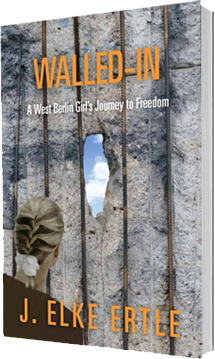
For a sneak peek at the first 20+ pages of my memoir, Walled-In: A West Berlin Girl’s Journey to Freedom, click “Download a free excerpt” on my home page and feel free to follow my blog about anything German: historic or current events, people, places or food.

Walled-In is my story of growing up in Berlin during the Cold War. Juxtaposing the events that engulfed Berlin during the Berlin Blockade, the Berlin Airlift, the Berlin Wall and Kennedy’s Berlin visit with the struggle against my equally insurmountable parental walls, Walled-In is about freedom vs. conformity, conflict vs. harmony, domination vs. submission, loyalty vs. betrayal.


Boesebruecke – a bridge with history

Monday, August 3rd, 2015

Between 1961 and 1990, the Boesebruecke at the Bornholmer Strasse border crossing in Berlin, Germany, was one of seven former East/West crossings in Berlin. It made history when it became the first crossing to be opened during the events of 9 November 1989 – the day of the fall of the Berlin Wall. The riveted steel arch bridge spans crosses the tracks of long-distance and suburban trains and connects Berlin’s districts of Pankow and Gesundbrunnen. The actual border between East and West Berlin ran along the rail lines, crossed by the Boesebruecke. The checkpoint at Bornholmer Strasse was the most northern border crossing in the city and was to be used by West Germans crossing into East Berlin.

Boesebruecke - one of seven former border crossings in Berlin. It became the first crossing to be opened during the events of 9 November 1989 Photo © J. Elke Ertle

Boesebruecke – one of seven former border crossings in Berlin. It became the first crossing to be opened during the events of 9 November 1989
Photo © J. Elke Ertle

History of the Boesebruecke

The riveted steel arch bridge was opened in 1916 and originally named Hindenburgbruecke, after Paul von Hindenburg, the second President of Germany. In 1948, the bridge was renamed Boesebruecke in honor of Wilhelm Boese, who had fought against the Nazi regime and was executed by the Nazis in 1944 for his involvement.

Most of the Boesebruecke was located in the former East Berlin. Less than 100 feet were in West Berlin. When construction of the Berlin Wall began on 13 August 1961, bridge traffic came to a halt.

The Fall of the Wall

At 8:00 p,m. on 9 November 1989, East German politburo member Guenter Schabowski announced a change in travel regulations for East German citizens at a press conference. East and West German stations reported the announcement live. Within minutes a trickle of East Berliners arrived at the Bornholmer Strasse border crossing. They wanted to take advantage of their new right to travel. Soon their numbers increased to thousands. The guards were unable to contain the crowds and raised the barrier. Around 20,000 people crossed the Boesebruecke bridge into West Berlin that night. It was the beginning of the fall of the Berlin Wall. http://www.berlin.de/mauer/

Historic Reminders

On the north side of Bornholmer Strasse, you can still see a 650-foot-long section of the Hinterlandsicherungsmauer (inner security wall) that once marked the East/West boundary. Commemorative plaques at both ends of the Boesebruecke call attention to the former checkpoint, and information boards have been put up.


For a sneak peek at the first 20+ pages of my memoir, Walled-In: A West Berlin Girl’s Journey to Freedom, click “Download a free excerpt” on my home page and feel free to follow my blog about anything German: historic and current events, people, places and food.

Walled-In is my story of growing up in Berlin during the Cold War. Juxtaposing the events that engulfed Berlin during the Berlin Blockade, the Berlin Airlift, the Berlin Wall and Kennedy’s Berlin visit with the struggle against my equally insurmountable parental walls, Walled-In is about freedom vs. conformity, conflict vs. harmony, domination vs. submission, loyalty vs. betrayal.


Hope is like a balloon

Thursday, July 30th, 2015

Hope is like a balloon, it can’t soar to the heavens if you hold it by the string.

–Lindsey Boucherly


For a sneak peek at the first 20+ pages of my memoir, Walled-In: A West Berlin Girl’s Journey to Freedom, click “Download a free excerpt” on my home page and feel free to follow my blog about anything German: historic or current events, people, places or food.

Walled-In is my story of growing up in Berlin during the Cold War. Juxtaposing the events that engulfed Berlin during the Berlin Blockade, the Berlin Airlift, the Berlin Wall and Kennedy’s Berlin visit with the struggle against my equally insurmountable parental walls, Walled-In is about freedom vs. conformity, conflict vs. harmony, domination vs. submission, loyalty vs. betrayal.


Cold War Spy Tunnel under Berlin

Monday, July 27th, 2015

During the height of the Cold War, US and British Intelligence Services constructed a secret spy tunnel under Berlin, just twenty feet beneath the surface. The project was known as “Operation Gold” in US Intelligence circles and as “Operation Stopwatch” among their British counterparts. The plan involved tapping into Eastern Europe’s communication cables. The spy tunnel was to serve the western Allies as an early warning system by keeping them abreast of Soviet military intentions in Europe. Spying operations were far from unusual during the Cold War. The Soviets were tapping a cable that served the American garrison in Berlin. It was located near Potsdam.

Spy Tunnel Construction

To be able to listen in on Soviet conversations, US and British Intelligence Services constructed a 1,476-foot long spy tunnel from a point in the West Berlin district of Rudow to Altglienicke in East Berlin’s district of Treptow. Construction of the tunnel was a major engineering feat. One of the cables was located only 27 inches beneath the surface and along the edge of a major highway.

The tunnel tube segments were constructed in the British sector of the divided city, at Airport Gatow . By May 1955 the first cable tap took place. Wire-tapping continued for eleven months. During that time, the Western Allies listened to close to 443,000 calls, which were recorded on 50,000 tapes. http://www.faqs.org/espionage/Ba-Bl/Berlin-Tunnel.html – ixzz3cz0f2d1YThree hundred specialists were involved in transcribing the tapes in London and Washington.

Spy Tunnel Discovery

Then the big surprise! The Soviets had known about this top-secret operation since inception. A mole in the British Secret Intelligence, who had been involved in the project from the beginning, had alerted the KGB of the CIA’s plans. The double agent’s name was George Blake. To protect his identity, the KGB kept knowledge of the tunnel close to their vests and did not even alert Soviet authorities of its existence.

Eleven months into the wire tapping, the Soviets claimed to have discovered the spy tunnel and turned its “discovery” into a successfully orchestrated propaganda blitz. Over the next six months, they carted around 30,000 “deserving” East German citizens to the entrance of the tunnel (Geheime Orte in Berlin by Claus-Dieter Steyer, © 2014) and pointed to America as a nation of warmongers and to West Berlin as a breeding ground for espionage. The Soviets used the discovery of the spy tunnel to demonstrate the effectiveness of socialist security.

Spy Tunnel Segment in Allied Museum

A 7-foot segment of Berlin’s spy tunnel can still be seen in the Allied Museum at Clayallee 135 in Berlin’s District of Zehlendorf. The segment was unearthed in 1997.


For a sneak peek at the first 20+ pages of my memoir, Walled-In: A West Berlin Girl’s Journey to Freedom, click “Download a free excerpt” on my home page and feel free to follow my blog about anything German: historic and current events, people, places and food.

Walled-In is my story of growing up in Berlin during the Cold War. Juxtaposing the events that engulfed Berlin during the Berlin Blockade, the Berlin Airlift, the Berlin Wall and Kennedy’s Berlin visit with the struggle against my equally insurmountable parental walls, Walled-In is about freedom vs. conformity, conflict vs. harmony, domination vs. submission, loyalty vs. betrayal.


Being happy means what?

Thursday, July 23rd, 2015

Being happy doesn’t mean that everything is perfect. It means that you’ve decided to look beyond the imperfections.

–Unknown


For a sneak peek at the first 20+ pages of my memoir, Walled-In: A West Berlin Girl’s Journey to Freedom, click “Download a free excerpt” on the home page of http://www.walled-in-berlin.com. Walled-In is a story of growing up in Berlin during the Cold War.


Berlin Television Tower

Monday, July 20th, 2015

At 1,207 feet, the Berlin Television Tower (Fernsehturm) is the tallest structure in Germany. With a million visitors a year, it is one of the most popular tourist attractions in Berlin. The Berlin Television Tower is located at the Alexanderplatz in the city’s center. An exhibition center and restaurant surround its base. The Neptune fountain, which used to stand in front of the Berlin City Palace, adorns the large plaza in front of it. The fountain’s four cascades represent Prussia’s main rivers at the time of the fountain’s construction: the Rhine, Elbe, Oder and Weichsel.

Berlin Television Tower Photo © J. Elke Ertle

Berlin Television Tower
Photo © J. Elke Ertle

History of the Berlin Television Tower

The Berlin Television Tower was constructed between 1965 and 1969. In 1964, Walter Ulbricht, then leader of East Germany until 1971, decided that East Berlin needed its own television broadcasting system. He decided to build it right in the center of the city. To this day, the Berlin Television Tower remains the only city television tower in Europe. Its dome is modeled after Sputnik, the first artificial Earth satellite. It is said that Walter Ulbricht wanted the Berlin Television Tower to be exactly 365 meters (1,197 feet) in height so that even a child would remember its height – as many meters as there are days in a year. http://www.berlin.de/en/attractions-and-sights/3560707-3104052-berlin-tv-tower.en.html

Indeed, the original Fernsehturm was 365 meters high. But in 1990, an antenna was added increasing its height to 368 meters.

God’s Revenge

The Berlin Television Tower’s design had an unexpected consequence. When the sun shines on its tiled stainless steel dome, the reflection looks like a cross. Since East Germany’s secular had aimed at removing crucifixes from churches, Berliners quickly nicknamed the cross “Gottes Rache” (God’s Revenge). And they nicknamed the tower “St. Walter”, after East Germany’s former leader, Walter Ulbricht.

Telecafé and observation deck

Similar to the Berlin Radio Tower http://www.walled-in-berlin.com/j-elke-ertle/berlin-radio-tower-the-beanpole/, the Berlin Television Tower includes an observation deck and a restaurant. On a clear day, the view from the deck can extend 26 miles into surrounding Brandenburg. The observation deck is located 666 feet above ground. Just a few feet higher, the restaurant – Telecafé – rotates once every 30 minutes and offers coffee, snacks and full meals.


For a sneak peek at the first 20+ pages of my memoir, Walled-In: A West Berlin Girl’s Journey to Freedom, click “Download a free excerpt” on my home page and feel free to follow my blog about anything German: historic or current events, people, places or food.

Walled-In is my story of growing up in Berlin during the Cold War. Juxtaposing the events that engulfed Berlin during the Berlin Blockade, the Berlin Airlift, the Berlin Wall and Kennedy’s Berlin visit with the struggle against my equally insurmountable parental walls, Walled-In is about freedom vs. conformity, conflict vs. harmony, domination vs. submission, loyalty vs. betrayal.


The ultimate measure of a man

Thursday, July 16th, 2015

The ultimate measure of a man is not where he stands in moments of comfort and convenience, but where he stands at times of challenge and controversy.

–Martin Luther King, Jr.


For a sneak peek at the first 20+ pages of my memoir, Walled-In: A West Berlin Girl’s Journey to Freedom, click “Download a free excerpt” on the home page of http://www.walled-in-berlin.com. Walled-In is a story of growing up in Berlin during the Cold War.

Berlin Radio Tower – the “Beanpole”

Monday, July 13th, 2015

The Berlin Radio Tower (Funkturm) is a former West Berlin broadcasting tower. It is located on the exhibition grounds (Messegelaende) and lovingly called “Langer Lulatsch” (beanpole) by Berliners. The tower is close to 500 feet high with a restaurant at the 167-foot level and an observation deck at just over 400 feet. Growing up in Berlin, I took the elevator to the observation deck at least once a month during the summer and marveled at the panoramic views of the city and its surrounding woods and lakes.

Berlin Radio Tower Photo © J. Elke Ertle, www.walled-in-berlin.com

Berlin Radio Tower
Photo © J. Elke Ertle, www.walled-in-berlin.com

Prior to German reunification, the Berlin Radio Tower counted among West Berlin’s top attractions. Since then, many tourists choose to visit the Berlin Television Tower instead. It is located in the city center, the former East Berlin. Today, the Berlin Radio Tower no longer serves as a transmitting tower but is protected monument due to its special architectural interest.

History of the Berlin Radio Tower

Similar to the Eiffel Tower in Paris, the Berlin Radio Tower was constructed as one large steel framework. It was inaugurated in 1926 for the opening of the third Great German Radio Exhibition (Grosse Deutsche Funkausstellung). This exhibition, now known as the Internationale Funkausstellung (IFA), is one of the oldest industrial trade fairs in Germany. Originally, the exhibition concentrated solely on medium wave radio, but included television two years later. In 1929, the Berlin Radio Tower broadcast Germany’s first televised images and in 1935 the world’s first regular TV program http://www.funkturm-messeberlin.de/en/ During the Battle for Berlin, one of the Funkturm’s main braces was hit by shellfire at 125 feet above ground. It left the beanpole standing on only three feet and nearly caused the entire structure to collapse.

Function of the Berlin Radio Tower

In 1962, the tower stopped being used for West German television transmissions. In 1973, all regular broadcast transmissions from the Berlin Radio Tower came to an end although the last transmitters were not disassembled until 1989. Today, the Berlin Radio Tower is still used as relay station for amateur and police radio and mobile phone services.

The Berlin Radio Tower Restaurant

The interior of Radio Tower Restaurant recreates the atmosphere of the twenties with its inlaid wood panels and art nouveau decor. Up to 116 guests can dine à la carte or enjoy a themed buffet, which changes monthly.


For a sneak peek at the first 20+ pages of my memoir, Walled-In: A West Berlin Girl’s Journey to Freedom, click “Download a free excerpt” on my home page and feel free to follow my blog about anything German: historic and current events, people, places and food.

Walled-In is my story of growing up in Berlin during the Cold War. Juxtaposing the events that engulfed Berlin during the Berlin Blockade, the Berlin Airlift, the Berlin Wall and Kennedy’s Berlin visit with the struggle against my equally insurmountable parental walls, Walled-In is about freedom vs. conformity, conflict vs. harmony, domination vs. submission, loyalty vs. betrayal.


Unexpressed Gratitude doesn’t count

Thursday, July 9th, 2015

Feeling gratitude and not expressing it is like wrapping a present and not giving it.

–William Arthur Ward


For a sneak peek at the first 20+ pages of my memoir, Walled-In: A West Berlin Girl’s Journey to Freedom, click “Download a free excerpt” on the home page of http://www.walled-in-berlin.com. Walled-In is a story of growing up in Berlin during the Cold War.


Gewandhaus – Garment Hall to Concert Hall

Monday, July 6th, 2015

The renowned Gewandhaus Orchestra performs in a grand structure overlooking the Augustusplatz in Leipzig, Germany. Its name translates into “garment hall” because the city’s first concert hall was located in a textile-trading house. Completed in 1981, today’s hall can accommodate close to 2000 visitors and is known for its excellent acoustics. I had the good fortune of attending a recent concert at the Gewandhaus. It was directed by guest conductor Omer Meir Wellber. The performance of musicians and conductor was truly beyond words. What a treat for ears and eyes!

The current Gewandhaus was an East German cultural project. It is built in the style of an amphitheater. Its organ is the biggest musical instrument ever built in East Germany. The Gewandhaus Orchestra performs in the Gewandhaus, in the Leipzig Opera and, together with the Thomanerchor, in the St. Thomas Church. http://www.walled-in-berlin.com/j-elke-ertle/st-thomas-boys-choir-800-years/

According to Claudius Boehm (translated by Tom Greenleaves) the earliest roots of the Gewandhaus Orchestra can be traced to 1479. https://www.gewandhausorchester.de/en/gewandhaus/history/ At that time, Leipzig’s City Council hired three artistic pipers (Kunstpfeifer) to provide musical accompaniment at church services, theater productions and concerts.

First Gewandhaus

Leipzig’s earliest concerts took place in private homes. Then an inn hosted the events. As the concerts increased in popularity, a larger space became essential, and in 1781, the City of Leipzig constructed a concert hall. Because the textile merchants had no use for a substantial part of the upper floor in the Garment Hall between the Gewandgaesschen and the Kupfergasse, the space was converted into a concert hall. It accommodated up to 500 patrons. Mozart played in this hall. So did Carl Maria von Weber and Franz Liszt. Hector Berlioz, Johannes Brahms, and Richard Wagner conducted here. The popularity of Gewandhaus concerts increased beyond all expectation so that the auditorium was modified several times to increase audience capacity. Unfortunately, the acoustics suffered each time, and a new concert hall was discussed.

Second Gewandhaus

In 1884, the Second Gewandhaus opened its doors on the south side of the Augustusplatz. It was designed by Martin Gropius and consisted of a main concert hall and a chamber music hall. While the City of Leipzig owned the First Gewandhaus, the Gewandhaus Concert Board owned the Second Gewandhaus. Anton Bruckner performed here at the organ, Paul Hindemith on the viola, Igor Stravinsky at the piano. Johannes Brahms, Edvard Grieg, Pyotr Ilyich Tchaikovsky and Richard Strauss all conducted the Gewandhaus Orchestra at one time or another. The Second Gewandhaus was destroyed during bombings in 1944. For a while, the Gewandhaus orchestra performed in various halls throughout the city and moved into the zoo in 1947.

Third Gewandhaus

The conductor Kurt Masur initiated the campaign for the construction of the Third Gewandhaus on Augustusplatz. It opened in 1981, two hundred years after the Leipzig Gewandhaus Orchestra had moved into the First Gewandhaus site.

The amphitheatrical Great Hall accommodates an audience of over 1,900; the Mendelssohn Hall approximately 500. The Great Hall is crowned by its imposing organ, with its four manuals, 92 stops and 6,638 pipes. Today’s Gewandhaus hosts approximately 800 events per year, which include its concert series, organ recitals, various chamber music series, conferences, symposia and lectures.

Inside the Gewandhaus, Photo © J. Elke Ertle. www.walled-in-berlin.com

Inside the Gewandhaus, Photo © J. Elke Ertle. www.walled-in-berlin.com


For a sneak peek at the first 20+ pages of my memoir, Walled-In: A West Berlin Girl’s Journey to Freedom, click “Download a free excerpt” on my home page or feel free to follow my blog about anything German: historic or current events, people, places or food.

Walled-In is my story of growing up in Berlin during the Cold War. Juxtaposing the events that engulfed Berlin during the Berlin Blockade, the Berlin Airlift, the Berlin Wall and Kennedy’s Berlin visit with the struggle against my equally insurmountable parental walls, Walled-In is about freedom vs. conformity, conflict vs. harmony, domination vs. submission, loyalty vs. betrayal.