Berlin’s KaDeWe

August 26th, 2013

Berlin’s KaDeWe is Europe’s second-largest department store. The upscale Kaufhaus des Westens (Department Store of the West) is located in Berlin, Germany, and generally referred to by its abbreviation, KaDeWe. The store is located along the Tauentzienstrasse, a major shopping boulevard near the center of the former West Berlin.

When Berlin’s KaDeWe first opened its doors in 1907, it immediately set new standards for product variety and service. Shoppers could find almost everything in the 260,000 square foot store – ranging from everyday necessities to luxury items. Arrival of the KaDeWe changed the Tauentzienstrasse from a quiet residential street to one of the most famous boulevards in the city.

By 1930, Berlin’s KaDeWe was doing so much business that the store was enlarged. But three years later, during the National Socialist era, the predominantly Jewish owners of Berlin’s KaDeWe were forced to sell the store because Jewish ownership had become illegal. Ten years later, during World War II, a shot-down American bomber crashed into the store, and the KaDeWe almost burned to the ground. In 1950, Berliners celebrated the reopening of the first two floors, and in the mid 50s, construction of all seven floors was complete. By now, Berlin’s KaDeWe also featured a gourmet floor, which quickly became a mecca for lovers of epicurean delights. The fall of the Berlin Wall in 1989 brought record-breaking numbers of shoppers and prompted the KaDeWe to add another floor. The sales area now expanded to over 645,000 square feet.

Main entrance to Berlin's KaDeWe along the Tauentzienstrasse

Main entrance of Berlin’s KaDeWe along the Tauentzienstrasse

Today, Berlin’s KaDeWe has eight floors, each one focused on a different type of merchandise. The ground floor holds beauty accessories, salons and spas. The 1st floor is dedicated to men’s apparel, the 2nd floor to women’s fashion. On the 3rd floor you find luxury shoes and leather goods. The 4th floor is dedicated to furniture and design items. The 5th floor contains arts, electronics, toys, and office supplies. And the 6th and 7th floors are entirely devoted to delicatessen and gourmet counters filling an area the size of two football fields. The top floor includes a winter garden with a 1000-seat restaurant.

Since 1907, the same morning ritual is followed. Shortly before 10 a.m. the original iron gate is lowered, allowing customers to embark on their exciting shopping adventure. Two thousand employees stand ready to fill each customer’s needs. When visiting Berlin, the KaDeWe is a must.


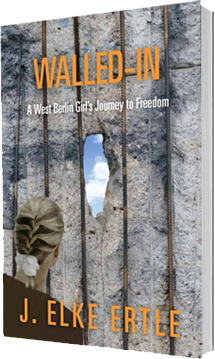
For a sneak peek at the first 20+ pages of my memoir, Walled-In: A West Berlin Girl’s Journey to Freedom, click “Download a free excerpt” on my home page and feel free to follow my blog about anything German: historic or current events, people, places or food.

Walled-In is my story of growing up in Berlin during the Cold War. Juxtaposing the events that engulfed Berlin during the Berlin Blockade, the Berlin Airlift, the Berlin Wall and Kennedy’s Berlin visit with the struggle against my equally insurmountable parental walls, Walled-In is about freedom vs. conformity, conflict vs. harmony, domination vs. submission, loyalty vs. betrayal.


Made in Germany

August 23rd, 2013

Did you know that the familiar “Made in Germany” trademark is not a German invention? It is a British idea. On 23 August 1887 – 126 years ago today – The United Kingdom passed a law, called the Merchandise Marks Act. This law required the labeling of all products of foreign origin. At a time when British industry dominated world market, its government wanted to reduce foreign competition. The new law required each foreign nation to stamp products shipped to Britain with a “MADE IN…” seal. The Merchandise Marks Act was particularly aimed at Germany because it was suspected that the Germans were copying British products. The new regulation intended to make foreign products more obvious, stigmatize them, and hopefully encourage British buyers to “buy British.”

Following World War II, "Made in Germany" became synonymous with quality, reliability, and longevity

“Made in Germany” trademark, first applied in 1887

At first the plan worked because, even before the new law had gone into effect, German products had had the reputation of being cheap and inferior. But the German Industrialist, Werner von Siemens, came to realize that German industry had to improve the quality of its products if it wanted to compete in world markets. Soon, German knifes, watches, beer, and pianos were of as good a quality as their British counterparts. Sometimes, they were even better while still remaining less expensive. But the real triumph of the “Made in Germany” trademark did not occur until after Word War I. By then, Germany had begun to offer custom-tailored, quality products rather than mass-produced items. The method worked well for Germany. Its “Made in Germany” trademark ultimately developed into a sign of quality. It stood for quality, reliability, and longevity.

Now the question – is there still a need for a trademark in the globalized markets of today? Airbus parts, for instance, are manufactured in four different countries. Individual components are installed worldwide. Which “Made in…” trademark should be stamped on an Airbus do you think? Your thoughts?


For a sneak peek at the first 20+ pages of my memoir, Walled-In: A West Berlin Girl’s Journey to Freedom, click “Download a free excerpt” on my home page and feel free to follow my blog about anything German: historic or current events, people, places or food.

Walled-In is my story of growing up in Berlin during the Cold War. Juxtaposing the events that engulfed Berlin during the Berlin Blockade, the Berlin Airlift, the Berlin Wall and Kennedy’s Berlin visit with the struggle against my equally insurmountable parental walls, Walled-In is about freedom vs. conformity, conflict vs. harmony, domination vs. submission, loyalty vs. betrayal.


Two Men Walking Abreast – English Language Peculiarities

August 19th, 2013

English language peculiarities can be tough to grasp, particularly for the non-native speaker. Although all languages have their idiosyncrasies, English provides a rare number of challenges. Its grammar is relatively easy to learn because nouns don’t have gender-related articles as they do in some other languages. That means verbs and adjectives don’t have to undergo gender-related changes. Instead, English language peculiarities result from the vast number of inconsistencies and exceptions to the rule. English is full of them, making it a difficult language to learn.

Take the phonetic aspect. There is one common pronunciation, but two different spellings for “cell” and “sell.” The sequence of letters “ough” is pronounced differently in “though” and “enough.” The plural of “box” is boxes, but “ox” becomes “oxen.” When I first came to the United States, I had eight years of English under my belt. Yet, the oddities of the language continued to stump me. One time, a colleague passed around a piece of paper. “What is this?” he asked. For all I could tell, the sketch showed two stick figures with outstretched arms, reaching for some kind of a wheel between them.

Two men walking abreast - English language peculiarities. J. Elke Ertle, www.walled-in-berlin.com

Two men walking abreast – English language peculiarities J. Elke Ertle, www.walled-in-berlin.com

To the hoots and hollers of my colleagues, he exclaimed, “Two men walking abreast.” I didn’t think his pronouncement was funny. Not one bit. In fact, I thought it was rather stupid.

A few days later, I retold the joke though, not because I thought it was so funny but because it had garnered such a good laugh. When no one responded to my question, what is this?” I called out, “Two men walking a woman’s breast.” I brought down the house. How could I have known? Yes, these English language peculiarities make it difficult for us non-native speakers. But hey, we’re catching on!


For a sneak peek at the first 20+ pages of my memoir, Walled-In: A West Berlin Girl’s Journey to Freedom, click “Download a free excerpt” on my home page and feel free to follow my blog about anything German: historic and current events, people, places and food.

Walled-In is my story of growing up in Berlin during the Cold War. Juxtaposing the events that engulfed Berlin during the Berlin Blockade, the Berlin Airlift, the Berlin Wall and Kennedy’s Berlin visit with the struggle against my equally insurmountable parental walls, Walled-In is about freedom vs. conformity, conflict vs. harmony, domination vs. submission, loyalty vs. betrayal.


First free West German Federal Elections

August 14th, 2013

The first free West German Federal elections took place on 14 August 1949. Following the end of World War II in 1945, the country had been divided into four occupation zones: American, British, French and Soviet. Only the people in the Federal Republic of Germany (the three West German zones) participated in the elections. The turnout was 78.5%. Earlier, Bonn had become the provisional capital of the new democratic state. As a territory under Allied supervision, Berlin’s deputies did not get to cast their votes in the elections.

Most West German parties at the time of the 1949 West German Federal elections were committed to democracy. However, they disagreed on the kind of democracy. The Christian Democratic (CDU) leader and former mayor of the city of Cologne, 73-year-old Konrad Adenauer, was party chairman in the British Zone. He wanted a moderate, non-denominational, humanist Christian democracy. The Social Democratic (SPD) leader, Kurt Schumacher, pushed for a left-wing, patriotic party. He strongly opposed the earlier merger of the SPD with the Communist Party (KPD) in the Soviet zone and called Adenauer “Chancellor of the Allies.”

CDU/CSU President Konrad Adenauer

Konrad Adenauer
First President of the Federal Republic of Germany

In the first free West German Federal elections, the Christian Democrats formed a coalition with the Free Democrats (FDP) and the Conservatives (DP). Together, they obtained 31% of the votes. The Social Democrats achieved 29.2%. Therefore, on 15 September 1949, Konrad Adenauer was elected the first Chancellor of the Federal Republic of Germany. He had made sure that the votes of the predominantly Social Democratic deputies from West Berlin did not count and later stated that he “naturally” had voted for himself. Adenauer held the office until 1963 and was re-elected three times. Schumacher assumed the chair as the minority leader of the SPD, ran for President of West Germany, but was defeated by FDP chairman Theodor Heuss.


For a sneak peek at the first 20+ pages of my memoir, Walled-In: A West Berlin Girl’s Journey to Freedom, click “Download a free excerpt” on my home page and feel free to follow my blog about anything German: historic or current events, people, places or food.

Walled-In is my story of growing up in Berlin during the Cold War. Juxtaposing the events that engulfed Berlin during the Berlin Blockade, the Berlin Airlift, the Berlin Wall and Kennedy’s Berlin visit with the struggle against my equally insurmountable parental walls, Walled-In is about freedom vs. conformity, conflict vs. harmony, domination vs. submission, loyalty vs. betrayal.


10 German Business Etiquette Tips

August 12th, 2013

The Job Talk section of The Local listed 10 German business etiquette tips that would be good additions to the repertoire of any foreign businessman or woman. I think the 25 March 2013 issue hits the nail on the head. If you want to make a good impression and be a successful negotiator in the German business world, consider the following:

1. PUNCTUALITY – Be on Time. Arriving late for an appointment suggests that you don’t value your associate’s time. That’s an insult.

2. FORMALITY – Unless you are invited to use first names, always address colleagues and business associates by their title and surnames.

3. HANDSHAKE – Shake hands before and after a meeting. Keep the handshake firm and brief. A weak one will suggest that you are unsure of your abilities.

A weak handshake suggests uncertainty

The handshake
Keep it brief and firm

4. DRESSCODE – German business attire is usually reserved and conservative. Men and women wear suits and few, if any, pieces of jewelry. Don’t try to outdo them.

5. SMALL TALK – Keep small talk to a minimum and don’t discuss your personal life.

6. PRIVACY – Respect your colleagues’ and associates’ privacy. Always knock before entering. Don’t call superiors and associates at home.

7. DISTANCE – Observe the personal space of others. Shake hands, but don’t get too folksy by touching their arms or shoulders.

8. NO HARD SELL – If you have something to sell, present the facts as thoroughly as you can so that the other person can reach their own conclusion. Don’t bother with a hard sell. It is only insulting.

9. PLAN AHEAD – Your contacts have a full calendar as well. Last minute cancellations and changes are inconsiderate.

10. MEALS – If attending a business meal, wait for your host to initiate when to eat, drink, and make conversation.

Too often, there is a tendency to think that German business people follow the same set of rules as their foreign counterparts. Not necessarily so. The German business world is still fairly structured. When in Rome, do as the Romans. And when in Germany, do as the Germans. Good luck with your next business meeting in Germany. For additional information, please visit www.thelocal.de.


For a sneak peek at the first 20+ pages of my memoir, Walled-In: A West Berlin Girl’s Journey to Freedom, click “Download a free excerpt” on my home page and feel free to follow my blog about anything German: historic or current events, people, places or food.

Walled-In is my story of growing up in Berlin during the Cold War. Juxtaposing the events that engulfed Berlin during the Berlin Blockade, the Berlin Airlift, the Berlin Wall and Kennedy’s Berlin visit with the struggle against my equally insurmountable parental walls, Walled-In is about freedom vs. conformity, conflict vs. harmony, domination vs. submission, loyalty vs. betrayal.


Otto Lilienthal’s Last Glider Flight

August 9th, 2013

This day in history marks Otto Lilienthal’s last glider flight. He was a German pioneer of aviation and became known as the Glider King and Father of Flight. The date of his last flight was 9 August 1896. It was a beautiful summer day in Stoelln, about 60 kilometers northwest of Berlin, when Otto Lilienthal stepped into his harness for the last time. He had already made three successful flights that day and had attained his usual flying distance of over 800 feet. On the fourth attempt, he was slowly gliding into the valley when an unexpected sudden gust caught him off guard. His glider pitched and stalled. The Glider King lost control and crashed to the ground.

Otto Lilienthal had piloted gliders since 1891. During those five years, he made over 3000 flights and built 18 different contraptions. His largest double decker glider had a wingspan of 23 feet. His designs were similar to today’s frames for hang gliders and ultralight aircraft. He and his younger brother Gustav had tinkered with strap-on wings, using willow switches and cotton fabric, since Otto was fourteen. The storks near their home along the River Peene had been their inspiration. The brothers proceeded to study the flight of birds and soon recognized that the principal of aerodynamics is involved in flight and that wings need to have a curvature.

Otto Lilienthal German Pionier of Aviation He crashed on 9 August 1896

Otto Lilienthal
German Pionier of Aviation
He crashed on 9 August 1896

On Otto Lilienthal’s last glider flight on 9 August, 1896, he dropped from a height of about 50 feet, still in his glider. As he was placed on a cot, he is reported to have said, “I hardly have any pain. I’m just going to rest a little bit.” He, in fact, had fractured his spine and died from the injuries the following day.


For a sneak peek at the first 20+ pages of my memoir, Walled-In: A West Berlin Girl’s Journey to Freedom, click “Download a free excerpt” on my home page and feel free to follow my blog about anything German: historic and current events, people, places and food.

Walled-In is my story of growing up in Berlin during the Cold War. Juxtaposing the events that engulfed Berlin during the Berlin Blockade, the Berlin Airlift, the Berlin Wall and Kennedy’s Berlin visit with the struggle against my equally insurmountable parental walls, Walled-In is about freedom vs. conformity, conflict vs. harmony, domination vs. submission, loyalty vs. betrayal.


Happiness and Growth

August 7th, 2013

“Everyone wants to live on top of the mountain, but all the happiness and growth occurs while you’re climbing it.”
–Andy Rooney


For a sneak peek at the first 20+ pages of my memoir, Walled-In: A West Berlin Girl’s Journey to Freedom, click “Download a free excerpt” on the home page of http://www.walled-in-berlin.com. Walled-In is a story of growing up in Berlin during the Cold War.


Tropical Islands Resort in Krausnick

August 5th, 2013

Since 2004 Germans can extend their traditionally short summers by checking into the Tropical Islands Resort in Krausnick. Located in a former airship hanger for zeppelins, the tropical theme park is located just 37 miles from Berlin’s city center. It stands on the site of the former Airfield Brand-Briesen. In 1938, the Nazis began development of the airfield. The Soviet Army occupied it after World War II. In 1992, following German reunification, the site was returned to the German Federal government.

Tropical Islands Resort in Krausnick

Former airship hanger turned into a Tropical Islands Resort

Turned into a theme park at a cost of cost approximately 78 million euros, the hanger is the biggest freestanding hall in the world. Its inside air temperature is held at 80°F, humidity at 64%. Tropical Islands Resort is open around the clock every day of the year and allows overnight stays. Visitors may choose a variety of admission options, which include lodges and guest rooms along with tent rentals and simply crashing on the beach with a mat and blanket. The maximum number of visitors the park can accommodate per day is 6,000.

Tropical Islands Resort in Krausnick

Tropical Islands Resort lodge with waterfall

The Tropical Islands Resort in Krausnick is home to the biggest indoor rainforest in the world with 50,000 plants and many birds. The park’s tropical sea is designed to look like the waters of a coral island and includes 660 feet of sandy beach. An indoor landscaped water park the size of four football fields contains pools, lagoons, water slides, waterfalls, whirlpools, and saunas. Visitors can enjoy replicas of buildings from Thailand, Borneo, Samoa and Bali, a number of bars, restaurants, and evening and day shows. A 43,000 square foot children’s play area is also available.

For more information, contact tropical-islands.de.


For a sneak peek at the first 20+ pages of my memoir, Walled-In: A West Berlin Girl’s Journey to Freedom, click “Download a free excerpt” on my home page and feel free to follow my blog about anything German: historic and current events, people, places and food.

Walled-In is my story of growing up in Berlin during the Cold War. Juxtaposing the events that engulfed Berlin during the Berlin Blockade, the Berlin Airlift, the Berlin Wall and Kennedy’s Berlin visit with the struggle against my equally insurmountable parental walls, Walled-In is about freedom vs. conformity, conflict vs. harmony, domination vs. submission, loyalty vs. betrayal.


Potsdam Agreement

August 2nd, 2013

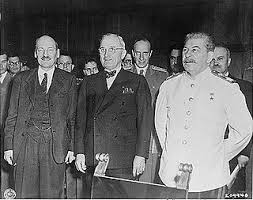
The Potsdam Agreement contains the details of the tripartite military occupation and reconstruction of Germany and the European Theatre following World War II. It was signed on this day in history in 1945. Shortly after midnight on 2 August 1945, the representatives of the three victorious WWII Allies, Clement Attlee (Great Britain), Harry S. Truman (United States), and Joseph Stalin (USSR) signed the Potsdam Agreement at Schloss Cecilienhof in Potsdam. The castle is located about 16 miles southwest of Berlin.

Potsdam Conference

The Big Three:
Clement Attlee, Harry S. Truman, Joseph Stalin

Relative to Germany, the Potsdam Agreement addressed mainly the “5D’s”: Denazification, Demilitarization, Democratization, Decentralization, and Disassemblement.
– DENAZIFICATION – eradication of the National Socialist Party and Nazi institutions to eliminate all Nazi influence. War criminals to be brought to swift justice.
– DEMILITARIZATION – disarmament and demilitarization of Germany and the elimination of all German industries that could be used for military production.
– DEMOCRATIZATION – formation of political parties and trade unions, freedom of speech, press, and religion.
– DECENRALIZATION – elimination of a concentration of powers by decentralizing the political structure.
– DISMANTLING – Reduction or destruction of all civilian heavy-industry with war-potential, such as shipbuilding, machine production, and chemical factories. Restructuring of German economy towards agriculture and light-industry. It was further agreed that reparations to the USSR should come from the Soviet zone of Germany; reparations to the United States, the United Kingdom, and other countries to come from the Western Zones. In addition, it was agreed that the USSR would be entitled to 10% of the industrial capacity (industrial capital equipment and industries) of the western zones. Dismantling was stopped in West Germany in 1951. In East Germany disassemblement continued.

The Potsdam Agreement was superseded by the “Treaty on the Final Settlement with Respect to Germany”, which was signed on 12 September 1990, following reunification.


For a sneak peek at the first 20+ pages of my memoir, Walled-In: A West Berlin Girl’s Journey to Freedom, click “Download a free excerpt” on my home page and feel free to follow my blog about anything German: historic and current events, people, places and food.

Walled-In is my story of growing up in Berlin during the Cold War. Juxtaposing the events that engulfed Berlin during the Berlin Blockade, the Berlin Airlift, the Berlin Wall and Kennedy’s Berlin visit with the struggle against my equally insurmountable parental walls, Walled-In is about freedom vs. conformity, conflict vs. harmony, domination vs. submission, loyalty vs. betrayal.


True Friends

July 31st, 2013

The most beautiful discovery that true friends can make is that they can grow separately without growing apart.
–Anonymous


For a sneak peek at the first 20+ pages of my memoir, Walled-In: A West Berlin Girl’s Journey to Freedom, click “Download a free excerpt” on the home page of http://www.walled-in-berlin.com. Walled-In is a story of growing up in Berlin during the Cold War.