Archive for the ‘Walled In Berlin’ Category

Paradigm Shift

Monday, April 22nd, 2013

A paradigm shift is an abrupt change in one’s point of view. All of a sudden, we interpret an event differently than moments earlier. Most of us have experienced altered perceptions at one time or another. I recall one in particular. I was making small talk with a colleague. After having occupied neighboring offices for many years and working on related projects, Robin and I had become friends. We often shared our joys and frustrations. A pretty brunette with soft brown eyes and an infectious smile, Robin was the kind of person who leaves chocolates on your desk when your day has gone south, and if you aren’t feeling well, she’ll try her best to cheer you up.

While Cindy, our coworker, was recovering from a foot operation at home, I asked Robin if she had heard anything about Cindy’s recuperation. “How’s she doing?” I wondered.

Robin looked at me wide-eyed. “Didn’t I tell you? She’s got big sores on her butt.”

I was taken back a notch. I had been unaware that the two of them were on such intimate terms.

“No, I haven’t heard,” I admitted.

Robin went on, “I got some stuff for her last night and put it on her butt. I hope it helps.”

An image wanted to unfold before my eyes, but I quickly squashed it by changing my vantage point. “Well, she’s been sitting a lot. Maybe that’s why she developed sores.”

“I don’t think so. She rarely sits. She usually lies down because of her arthritis,” Robin added.

Now I was completely flabbergasted. I hadn’t kept up with the details of Cindy’s medical condition, but neither had I ever noticed signs of arthritis in my interactions with her. And I certainly had never seen her lie down at work. “She has arthritis?” I wondered.

Without missing a beat, Robin added, “I took her to Petco last night and had her nails trimmed. They were getting really long.”

My mental wheels went into overdrive for several seconds. Then I broke out laughing.”Robin, I was talking about Cindy. You were talking about your dog, Cinder, weren’t you?”

Have you ever experienced a paradigm shift?


Wedding of the Century

Thursday, April 18th, 2013

On 18 April 1956, war-ravaged Europe celebrated the “Wedding of the Century” between the Prince of Monaco, Rainier III, and American actress Grace Kelly. With this marriage, Grace, known for her theatrical performances, live drama productions, and successful films, took on the title of Princess Consort Gracia Patricia of Monaco.

The couple first met during a photo session in May 1955. At that time, Prince Rainier was the wealthiest bachelor in the world. After the meeting, the pair continued to correspond, and when the prince toured America seven months later, he visited the Kelly family. Although he claimed not to have planned the trip around a rendezvous with the American actress, rumors had it that he was actively seeking a wife. It was said that due to a 1918 treaty with France, Monaco was to revert to France if Rainier did not produce an heir.

Three days into his visit, the prince proposed. He first bestowed upon his fiancé a friendship ring of diamonds and rubies, then a twelve-carat emerald-cut diamond engagement ring. Prior to the wedding, Grace was required to take a fertility test and to sign a contract relinquishing all rights to the couples’ children in case of a divorce. The Kelly family also agreed to a dowry of two million dollars.

The glamorous civil ceremony that followed was broadcast across Europe and watched by an estimated thirty million people on television. During the forty-minute ceremony the 142 official titles that Grace had acquired in the union were formally recited. Although there were only eighty guests at the civil ceremony, at the reception that followed, the citizens of Monaco could shake hands with the new princess. A religious ceremony followed the next day, after which the prince and princess left for a seven-week honeymoon cruise.

Prince Rainier and Princess Grace had three children: Caroline, Albert, and Stéphanie. The family resided in a 235-room hilltop palace overlooking the Mediterranean Sea. In September of 1982, Princess Grace suffered a stroke while driving, which caused her to lose control of the car and tumble to her death.


60 Years Refugee Camp Marienfelde

Wednesday, April 17th, 2013

The Marienfelde Notaufnahmelager (refugee camp Marienfelde) in former West Berlin once was the first haven of safety for many refugees from East Germany and Eastern Europe. Between 1949 and 1989 (the fall of the Berlin Wall) every fifth East German citizen left for the West.

Marienfelde opened its doors on April 14, 1953. During its operation, the camp saw more than one quarter of the four million refugees pass through its doors. Some came with a suitcase, others with even less. The camp supplied expatriates with temporary housing and provisions while starting residency permit applications. Meanwhile, the East German government considered Marienfelde an American enemy installation with the express purpose of assembling and arming criminal elements to disrupt life in the Peoples’ State. Although this was communist propaganda, a recent study, commissioned by the Stiftung Berliner Mauer and conducted by the American historian, Keith R. Allen, confirms that the refugee camp Marienfelde played an important role in the West’s information gathering efforts about East Germany.

East German refugees making due at the Marienfelde Refugee Center, photo J. Elke Ertle, 2015

East German refugees making due at the Marienfelde Refugee Center, photo J. Elke Ertle, 2015

Last week, on the 60th anniversary of Marienfelde, German Federal President Joachim Gauck said to those in attendance, “We are proud that our government was able to successfully integrate so many people.”
An ongoing exhibition at Gedenkort Marienfelde, called Escape within Divided Germany tells the story of the thousands who rather left their homes and families than to have their freedom curtailed. The display includes photos, films, and nine hundred original documents that portray daily life in the camp: the wait, the uncertainty, and the crowdedness. Some of the rooms, their original iron bunk beds intact, can also be visited.

Today, the buildings are filled with refugees from Syria, Bosnia, Chechnya, and Afghanistan. In 2012, approximately 8,200 refugees requested asylum.


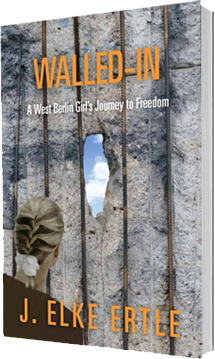
For a sneak peek at the first 20+ pages of my memoir, Walled-In: A West Berlin Girl’s Journey to Freedom, click “Download a free excerpt” on my home page and feel free to follow my blog about anything German: historic and current events, people, places and food.

Walled-In is my story of growing up in Berlin during the Cold War. Juxtaposing the events that engulfed Berlin during the Berlin Blockade, the Berlin Airlift, the Berlin Wall and Kennedy’s Berlin visit with the struggle against my equally insurmountable parental walls, Walled-In is about freedom vs. conformity, conflict vs. harmony, domination vs. submission, loyalty vs. betrayal.


Trouble

Tuesday, April 16th, 2013

You know you’re in trouble when you realize that the light at the end of the tunnel is an oncoming train.
–Author unknown


For a sneak peek at the first 20+ pages of my memoir, Walled-In: A West Berlin Girl’s Journey to Freedom, click “Download a free excerpt” on the home page of http://www.walled-in-berlin.com. Walled-In is a story of growing up in Berlin during the Cold War.


Reluctant Convert

Monday, April 15th, 2013

A skeptic by nature and by and large disinclined to buy into non-specific promises, I confidently stepped into one of those new designer churches a few weeks ago. Bright, airy, and inviting, with lots of glass and chrome, the sanctuary seemed to beg for a closer look. And before I knew it, I found myself standing on consecrated grounds.

In one swift scan I assessed my surroundings. The men and woman seated along one wall of this place of worship were heathens, I guessed. Each one had been paired with a church elder, wearing an eye-catching blue T-shirt with a logo on his chest. They were ubiquitous and easy to recognize. I had no doubt that these dyads were involved in one-on-one Bible Study. On the opposite side of the sanctuary, other prospective converts clustered around an elder in apparent group-study. I surmised that Sunday school was in full swing as well because children as young as two years of age were seemingly riveted in prayer. And in the front of this House of God, High Priests dispensed the Holy Sacrament from behind an altar.

A bit taken back by the intensity of the atmosphere around me, I was about to retreat when one of the elders greeted me warmly and invited me deeper into the sanctuary. I shook my head, “I’m a non-believer.”

“No problem,” the young man replied without the slightest hint of pressure and gently led me to the Tree of Knowledge. “I’m Trevor. Here, taste this fruit,” he tempted me. “It’s the fruit of wisdom. I’ll bet you’ve never tasted anything like it. Go ahead. Try it!”

Wary at first, I took a small bite. It was good. I took another bite.
“Once you tasted this fruit, you’ll never want anything else,” Trevor assured me.

I don’t recall what happened next, but before I knew it, I was scheduled for my first One-to-One at the Church of the Apple because I now, too, own a Mac.


Ellis Island

Thursday, April 11th, 2013

On 11 April 1890, Ellis Island was designated a federal immigration station. When it opened two years later, great changes in immigration patterns had become apparent. Arrivals from Northern and Western Europe (Scandinavia, Germany, Great Britain, and Ireland) were slowing while arrivals from Southern and Eastern Europe (Italy, Greece, Poland, Czechoslovakia, Hungary, Serbia, Slovenia, and Russia) were increasing. Most immigrants to the United States had left the Old World to escape war, drought, famine, or religious persecution and hoped for greater opportunities in the New World. Millions of these new arrivals passed through Ellis Island until the station closed its doors in 1954. Between 1900 and 1914, its peak years of operation, 5,000 to 10,000 people passed through Ellis Island on a daily basis. It has been estimated that close to 40% of all current U.S. citizens can trace at least one of their ancestors to coming through this station.

In 1976, Ellis Island was opened to the public. Visitors can now tour the Ellis Island Immigration Museum and trace their ancestors through arrival records that became available to the public in 2001.


The Perfect Ending

Tuesday, April 9th, 2013

I wanted a perfect ending.  Now I’ve learned the hard way that some poems don’t rhyme, and some stories don’t have a clear beginning, middle, and end. Life is about not knowing, having to change, taking the moment and making the best of it, without knowing what is going to happen next.

From Gild Radner’s Delicious Ambiguity


For a sneak peek at the first 20+ pages of my memoir, Walled-In: A West Berlin Girl’s Journey to Freedom, click “Download a free excerpt” on the home page of http://www.walled-in-berlin.com. Walled-In is a story of growing up in Berlin during the Cold War.


Field Station Teufelsberg

Monday, April 8th, 2013

The motto, In God we trust; all others we monitor, was never more applicable than in West Berlin during the Cold War. During those years, the US National Security Agency (NSA) erected a Field Station in the British sector of the city where I grew up. Located at the edge of Berlin’s largest forested area, the Grunewald, the post’s mission remained shrouded in secrecy. Rumors had it that the purpose of the station, used by both American and British personnel, was to eavesdrop on the communications of East Germany, the Soviet Union and Warsaw Pact countries.

The complex stood atop of the Teufelsberg (Devil’s Mountain), a hill that was man-made from close to 424 million cubic feet of World War II rubble. Between 1945 (the end of the war) and 1950, it had been the job of Truemmerfrauen (rubble women) to sift through tons of debris, pick out reusable bricks, chip away the mortar, and to load them onto carts and lories as reconstruction material. The leftover refuse was then lugged to the Grunewald and other locations in the city. It was from this rubble, that the 377-foot-highTeufelsberg was created; and on top of it, the NSA erected a 262 foot-high spy station.

The first intelligence units moved onto the mound in July 1961. More permanent buildings were erected in 1963. Three huge globes and two radomes topped the facilities. Over the years, the station grew into one of the West’s largest intelligence-gathering posts. Its secret mission continued until the fall of the Berlin Wall in 1989 after which the station was closed and the equipment removed. But the building shells remained, and they are still standing today.

The 1990s brought talks of preserving Field Station Teufelsberg as a spy museum. Six years later, the site was sold to developers with plans for a hotel, a restaurant, and a museum.  But the project was abandoned when funds ran out. In 2008, American filmmaker David Lynch tried to turn the site into a Transcendental Meditation Center but could not secure the city’s approval. More recently, there have been calls to preserve the site and turn it into a memorial.

Also visit http://walled-in-berlin.com/j-elke-ertle-/legacy-of-rubble-women/ to read about the work of the Truemmerfrauen (rubble women).


For a sneak peek at the first 20+ pages of my memoir, Walled-In: A West Berlin Girl’s Journey to Freedom, click “Download a free excerpt” on my home page and feel free to follow my blog about anything German: historic and current events, people, places and food.

Walled-In is my story of growing up in Berlin during the Cold War. Juxtaposing the events that engulfed Berlin during the Berlin Blockade, the Berlin Airlift, the Berlin Wall and Kennedy’s Berlin visit with the struggle against my equally insurmountable parental walls, Walled-In is about freedom vs. conformity, conflict vs. harmony, domination vs. submission, loyalty vs. betrayal.


Berlin Wall Controversy

Wednesday, April 3rd, 2013

Following unsuccessful negotiations earlier this month between city officials and investor, Maik Uwe Hinkel, construction crews moved in at 5 A.M. last Wednesday and removed four additional sections (15.75 feet) of one of the two remaining stretches of the Berlin Wall, called the East Side Gallery. Hinkel says the segments had to be removed to provide access for his luxury condominium project overlooking the River Spree, a site that was once part of the infamous deathstrip. Although BBC News reports that the stretch was heritage-listed in 1991, the protection apparently applies only to the wall itself, not the land it stands on.

A section of the East Side Gallery was removed to make room for these condos, photo © J. Elke Ertle, 2015

A section of the East Side Gallery was removed to make room for these condos, photo © J. Elke Ertle, 2015

The East Gallery was recently restored at a cost of more than 2 million euros to the city of Berlin, and about 120 International artists covered it with colorful murals. Scenes include an East German Trabant car and a fraternal kiss between Soviet leader Leonid Brezhnev and East German party chief Erich Honecker. Although Hinkel called the removal temporary on Wednesday, many Berliners worry that removal will turn out to be permanent, sacrificing history for profit.

“The Berlin Wall is the most significant symbol of the division of Berlin,” deputy director of the Berliner Mauer Stiftung, Maria Nooke said, according to the Huffington Post reports. “On the one hand it demonstrates the repression in East Germany, on the other hand it demonstrates how Germans peacefully overcame that repression. After a while there was a growing need to deal with that part of history and to preserve it for future generations.”

You may also want to visit http://walled-in-berlin.com/j-elke-ertle/save-the-berlin-wall/


For a sneak peek at the first 20+ pages of my memoir, Walled-In: A West Berlin Girl’s Journey to Freedom, click “Download a free excerpt” on my home page and feel free to follow my blog about anything German: historic and current events, people, places and food.

Walled-In is my story of growing up in Berlin during the Cold War. Juxtaposing the events that engulfed Berlin during the Berlin Blockade, the Berlin Airlift, the Berlin Wall and Kennedy’s Berlin visit with the struggle against my equally insurmountable parental walls, Walled-In is about freedom vs. conformity, conflict vs. harmony, domination vs. submission, loyalty vs. betrayal.


Life isn’t what happens

Tuesday, April 2nd, 2013

Life isn’t what happens to us.  It’s about how we perceive what happens to us.

–Author unknown


For a sneak peek at the first 20+ pages of my memoir, Walled-In: A West Berlin Girl’s Journey to Freedom, click “Download a free excerpt” on my home page and feel free to follow my blog about anything German: historic or current events, people, places or food.

Walled-In is my story of growing up in Berlin during the Cold War. Juxtaposing the events that engulfed Berlin during the Berlin Blockade, the Berlin Airlift, the Berlin Wall and Kennedy’s Berlin visit with the struggle against my equally insurmountable parental walls, Walled-In is about freedom vs. conformity, conflict vs. harmony, domination vs. submission, loyalty vs. betrayal.