
Archive for the ‘Walled In Berlin’ Category

It’s Asparagus Season!

Wednesday, May 8th, 2013

415px-Asparagus_NL

It’s “Spargelzeit” (asparagus season) in Berlin between April and June. This year, the unusually long winter delayed the opening of the season to April 25. But now, Spargelzeit is in full swing. The German love affair with white asparagus–not green–led to a consumption of 127,000 tons last year. You will hardly find a restaurant or roadside stand that does not feature this heavenly crop. Berlin’s finest white asparagus is grown in Beelitz, about 30 miles south of Berlin. Farmers set up huge tents along the growing fields, and carloads and busloads of asparagus aficionados enjoy the celebrated vegetable, dug fresh out of the ground.

Asparagus officinalis is native to most of Europe, northern Africa and western Asia. To cultivate it, the shoots are covered with soil as they grow. Not being exposed to sunlight, they retain their white color. Germans will tell you that the white version is more tender and less bitter than its green cousin. But it must be peeled before consumption.

The rest of Germany is crazy about asparagus as well. Many cities hold an annual “Spargelfest” (asparagus festival). Schwetzingen in the Rhein-Neckar-triangle crowns an Asparagus Queen every year. And in the Bavarian city of Nuernberg the fastest asparagus peelers of the region meet for annual competitions.

Asparagus is low in calories, low in sodium, a good source of vitamins and minerals, and an excellent source of dietary fiber. The easiest way to prepare it is to boil the peeled shoots briefly and to serve them with browned butter, cubed ham, and boiled potatoes.

Voila ! A delicious meal.


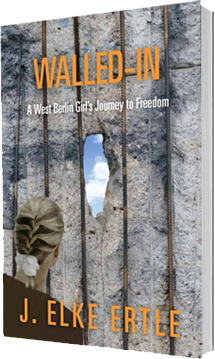
For a sneak peek at the first 20+ pages of my memoir, Walled-In: A West Berlin Girl’s Journey to Freedom, click “Download a free excerpt” on my home page and feel free to follow my blog about anything German: historic and current events, people, places and food.

Walled-In is my story of growing up in Berlin during the Cold War. Juxtaposing the events that engulfed Berlin during the Berlin Blockade, the Berlin Airlift, the Berlin Wall and Kennedy’s Berlin visit with the struggle against my equally insurmountable parental walls, Walled-In is about freedom vs. conformity, conflict vs. harmony, domination vs. submission, loyalty vs. betrayal.


Explore. Dream. Discover.

Tuesday, May 7th, 2013

Twenty years from now you will be more disappointed by the things you didn’t do than by the ones you did do. So throw off the bowlines. Sail away from the safe harbor. Catch the trade winds in your sail. Explore. Dream. Discover.

–Mark Twain


For a sneak peek at the first 20+ pages of my memoir, Walled-In: A West Berlin Girl’s Journey to Freedom, click “Download a free excerpt” on my home page and feel free to follow my blog about anything German: Historical or current events, people, places or food.

Walled-In is my story of growing up in Berlin during the Cold War. Juxtaposing the events that engulfed Berlin during the Berlin Blockade, the Berlin Airlift, the Berlin Wall, and Kennedy’s Berlin visit with the struggle against my equally insurmountable parental walls, Walled-In is about freedom vs. conformity, conflict vs. harmony, domination vs. submission, loyalty vs. betrayal.


Pet Peeve

Monday, May 6th, 2013

tandem image 

I have a pet peeve. I cringe every time I see a heterosexual tandem bike team. Why? How many tandems have you seen with the woman sitting in front? Watching for many years I have seen exactly one such pair. Invariably, the man pedals in front, has a 180º view, and controls the handlebars. He is usually also considerably larger and blocks his partner’s view. Whatever happened to equality of the sexes?

My husband and my male friends tell me that the man sits in front to protect the lady. “The back seat is much safer,” they say. “The heavier person should always sit in front. That’s the way bikes are designed.” Well, if safety is the only reason, then why do I see fathers sitting in the back with their teen son occupying the front?  Surely, they don’t want their child to get hurt. I fail to buy into the safety concern as the prime reason. Besides, if bikes are engineered in such a way that the front seat is unsafe, surely our engineers could come up with a better design. No, I suspect it has something to do with old-fashioned chauvinism. What do you think?

But let me tell you about the one instance in which I actually did see the woman sitting in the front seat of a tandem. That afternoon, my husband and I were taking a leisurely walk along Shelter Island when I spotted a heterosexual tandem team ahead of us. Clearly, it was a woman who was pedaling in the front and a man doing his part in the back of the bike. You can image my joy. Finally, there was a man who was willing to relinquish the front seat to his female bike partner. I squealed with delight as I pointed out the sight to my husband. Fifteen minutes later, the tandem returned. Barely able to control my excitement, I ran up to the two bikers. “Congratulations,” I shouted to the lady at the helm, “This is the first tandem I’ve ever seen with the lady in the front.  How did you do it?”

After a brief and uncomfortable silence the woman replied, “My husband is blind.”

Since then I just keep my pet peeves to myself.


For a sneak peek at the first 20+ pages of my memoir, Walled-In: A West Berlin Girl’s Journey to Freedom, click “Download a free excerpt” on the home page of http://www.walled-in-berlin.com. Walled-In is a story of growing up in Berlin during the Cold War.


History of the Euro

Thursday, May 2nd, 2013

On this day in history in 1998, during negotiations that lasted well past midnight, European Union members agreed to adopt a common currency: the euro.

Negotiations had been long and arduous, having begun almost three decades earlier when members of the European Economic Community (EEC) had met in Den Haag, Netherlands, to launch an economic and monetary union. Belgium, France, West Germany, Italy, Luxembourg, and the Netherlands were the original six members. Finally, in 1991, European leaders set up the European Union (EU) by signing the Maastricht Treaty. It took seven more years, before the European Union elected the eleven countries that would initially participate in the new currency. On May 2, 1998, Austria, Belgium, Finland, France, West Germany, Ireland, Italy, Luxembourg, Netherlands, Portugal, and Spain became the first member countries to adopt the euro. They had to meet strict criteria such as budget deficit limitations, debt ratio limitations, low inflation, and interest rate limitations. Greece failed to meet the criteria; Denmark, Sweden and Great Britain elected not to participate.

The May 2 accord almost faltered when most member countries voted for Wim Duisenburg of the Netherlands to become the first president of the European Central Bank. The French insisted on their own candidate, Jean-Claude Trichet. An agreement was finally reached when Mr. Duisenberg hinted that he might resign half way through his term in office. He cited his advanced age. Then, on midnight of January 1, 1999, the euro was launched as an electronic currency. It became legal tender on January 1, 2002.


For a sneak peek at the first 20+ pages of my memoir, Walled-In: A West Berlin Girl’s Journey to Freedom, click “Download a free excerpt” on my home page and feel free to follow my blog about anything German: Historical or current events, people, places or food.

Walled-In is my story of growing up in Berlin during the Cold War. Juxtaposing the events that engulfed Berlin during the Berlin Blockade, the Berlin Airlift, the Berlin Wall, and Kennedy’s Berlin visit with the struggle against my equally insurmountable parental walls, Walled-In is about freedom vs. conformity, conflict vs. harmony, domination vs. submission, loyalty vs. betrayal.


Nightingales Return

Wednesday, May 1st, 2013

Viele europäische Vogelarten auf dem Rückzug

Last week, once again, the nightingales returned to Berlin for their annual stopover that typically lasts six weeks. This year their arrival signaled the end of an exceptionally long and miserable winter that had plagued the city, and Berliners were delighted to greet their musical, feathered friends.

Every year, these small, brown migratory songbirds spend the winter in southwest Africa and fly to Central Europe to mate. Following their brief stay, they continue their flight to breeding grounds in forests and scrub in Northern Europe. Nightingales have reddish tails and do not naturally occur in the Americas. With up to 300 different songs they have the largest repertoire of any bird. Although their name implies that they sing only at night, they actually sing day and night. However, their song tends to be much more noticeable at night because few other birds compete during those hours.

Last week, the returning nightingales were spotted not far from Schloss Bellevue (castle Bellevue) in the Tiergarten, Berlin’s two-square-mile urban park. As an interesting side note–this neoclassical castle, first erected in 1786, severely damaged during World War II, and refurbished in the 50s, is now the official residence of the German president. But because it does not include living quarters, he doesn’t actually live there. The president lives in a villa in the southwestern district of Dahlem instead.


For a sneak peek at the first 20+ pages of my memoir, Walled-In: A West Berlin Girl’s Journey to Freedom, click “Download a free excerpt” on my home page and feel free to follow my blog about anything German: historic or current events, people, places or food.

Walled-In is my story of growing up in Berlin during the Cold War. Juxtaposing the events that engulfed Berlin during the Berlin Blockade, the Berlin Airlift, the Berlin Wall and Kennedy’s Berlin visit with the struggle against my equally insurmountable parental walls, Walled-In is about freedom vs. conformity, conflict vs. harmony, domination vs. submission, loyalty vs. betrayal.

 

Happiness

Tuesday, April 30th, 2013

Happiness lies ahead for those who cry; those who hurt; those who have searched, and those who have tried, for only they can appreciate the importance of people who have touched their lives.


For a sneak peek at the first 20+ pages of my memoir, Walled-In: A West Berlin Girl’s Journey to Freedom, click “Download a free excerpt” on the home page of http://www.walled-in-berlin.com. Walled-In is a story of growing up in Berlin during the Cold War.


Honey Bee Cluster

Monday, April 29th, 2013

bee-swarm

Having read about the losses of bee populations worldwide, I was astonished to see a huge honey bee cluster hanging from a branch of my neighbors’ small fruit tree the other day. The bees had literally appeared overnight. To my amazement, thousands of bees clung to each other in a cluster the shape of a giant pinecone. The next day I was even more surprised when a humming sound, akin to freeway noise,”rapidly arose in the backyard, intensified, and subsided, all within seconds. I looked up just long enough to witness thousands of bees speckle the sky as they headed southeast. Sure enough, my neighbors’ bees were gone.

The experience had just been remarkable enough for me to want to learn more about bees. Did you know that April to June is bee-swarming season in San Diego? From what I read, a bee colony has little incentive to swarm during the first year of a queen’s life. But during her second spring, she appears to be programmed to swarm. Spring bloom and longer days create a desire for the colonies to split and to create new ones. During that period, the queen bee and roughly 10,000-15,000 worker bees will leave their existing location to find a new home. Until they do, they may take up temporary residency, clustering on a tree branch, as they did in my neighbors’ yard.

While most of the bees remain clustered together on this intermediate stop, 20-50 scout bees will forage for a permanent location. Each scout then promotes the potential site she found by dancing in a specific way to indicate direction and distance. The more animated her dance, the more excited about her findings she is. Different scouts may promote different sites. When all scouts agree on a location the entire honey bee cluster flies to it. It was the swarming to their final location that I witnessed the other day. And it was a sight worth seeing.

One final piece of advice: If you encounter a cluster of bees, call a beekeeper. Do not kill or disturb the bees by spraying pesticides or water on them.


For a sneak peek at the first 20+ pages of my memoir, Walled-In: A West Berlin Girl’s Journey to Freedom, click “Download a free excerpt” on my home page and feel free to follow my blog about anything German: historic and current events, people, places and food.

Walled-In is my story of growing up in Berlin during the Cold War. Juxtaposing the events that engulfed Berlin during the Berlin Blockade, the Berlin Airlift, the Berlin Wall and Kennedy’s Berlin visit with the struggle against my equally insurmountable parental walls, Walled-In is about freedom vs. conformity, conflict vs. harmony, domination vs. submission, loyalty vs. betrayal.



The Suez Canal

Thursday, April 25th, 2013

On 25 April 1859, construction of the one-hundred-one-mile long Suez Canal began, connecting the Mediterranean Sea with the Gulf of Suez, a northern branch of the Red Sea.

Although the canal wasn’t completed until 1869, the desire to connect the Nile River in Egypt as well as the Mediterranean Sea to the Red Sea has a long history. The first canal in the area was constructed in the 13th Century B.C.E. Eventually, it fell into neglect, and in the 8th Century its use stopped completely. In the late 1700s, Napoleon Bonaparte wanted to build a new canal, but miscalculations made the project appear infeasible.Finally, in the mid-1800s, the French diplomat and engineer, Ferdinand de Lesseps, convinced the Egyptian viceroy Said Pasha that a canal could be built after all.

In 1858, the Compagnie Universelle du Canal was formed and given the right to begin construction and operate the canal for 99 years. Subsequently, the Egyptian government was to regain control of the waterway. Construction began as planned on April 25, 1859, and the Suez Canal opened ten years later, on November 17, 1869. The cost of construction was $100 million.


Favorite German city

Wednesday, April 24th, 2013

In a recent survey, the market research institute, YouGov, asked Germans to name their favorite German city in which they would like to live and work. Respondents could choose from a list of fourteen. All had populations of more than half a million.

Every sixth citizen chose — not the capital — but Hamburg, making it the Germans favorite German city. Berlin and Munich shared the second place in popularity. However, analyzed by age, the data showed that young adults of 25 years of age or less picked Berlin as their top choice while older adults preferred Hamburg.


For a sneak peek at the first 20+ pages of my memoir, Walled-In: A West Berlin Girl’s Journey to Freedom, click “Download a free excerpt” on my home page and feel free to follow my blog about anything German: historic or current events, people, places or food.

Walled-In is my story of growing up in Berlin during the Cold War. Juxtaposing the events that engulfed Berlin during the Berlin Blockade, the Berlin Airlift, the Berlin Wall and Kennedy’s Berlin visit with the struggle against my equally insurmountable parental walls, Walled-In is about freedom vs. conformity, conflict vs. harmony, domination vs. submission, loyalty vs. betrayal.

 

School of Experience

Tuesday, April 23rd, 2013

Just when you think you have graduated from the school of experience,
along comes a whole new course.


For a sneak peek at the first 20+ pages of my memoir, Walled-In: A West Berlin Girl’s Journey to Freedom, click “Download a free excerpt” on the home page of http://www.walled-in-berlin.com. Walled-In is a story of growing up in Berlin during the Cold War.