
Archive for the ‘Walled In Berlin’ Category

Dresden’s Green Vault

Monday, May 27th, 2013

If you are planning a trip this summer that includes Dresden, Germany, be sure to visit the Green Vault (Gruenes Gewoelbe). It houses the largest collection of Europe’s most precious art objects. The Green Vault occupies two floors of the Dresden castle with over 21,500 square feet on each level. The original Green Vault is located on the first floor and houses more than 3,000 works of art in gold, silver, precious stones, ivory, ebony and amber. The baroque rooms themselves are famous and a feast for the eyes. The Green Vault took its name from the column bases and capitals (column tops) that were once painted malachite green.

The second floor houses the New Green Vault with a collection of well over 1,000 pieces. The New Green Vault is constructed in a modern style, which keeps the focus on the objects on display. It contains many pieces of baroque jewelry and unique works that were created by the royal goldsmith, Johann Melchior Dinglinger.

Golden Coffee Service - the pieces were made by court goldsmith Johann Melchior Dinglinger around 1700

Golden Coffee Service – the pieces were made by court goldsmith Johann Melchior Dinglinger around 1700

The history of the Green Vault dates back to 1547, when elector Moritz of Saxony added a west wing to his castle. Originally, the rooms were used as private chambers for important documents and jewelry. But between 1723 and 1729, Augustus the Strong turned the once private chambers into a public museum.

When the Second World War loomed, the art treasures were removed and taken to the Koenigstein Fortress. On February 13, 1945, near the end of World War II, the city of Dresden was bombed, and the historic Green Vault was severely damaged. Three of the eight rooms were totally destroyed. The art objects were confiscated by the Red Army and transported to the Soviet Union.

Following World War II, the Green Vault was completely reconstructed. In 1958 the Soviet Union returned the treasures to Dresden, and in 2004 the New Green Vault was opened on the second floor of the rebuilt Dresden castle. In 2006 the historic Green Vault was reopened, as it had existed in 1733, the time of its founder’s death. Click “like” if you enjoyed this article.


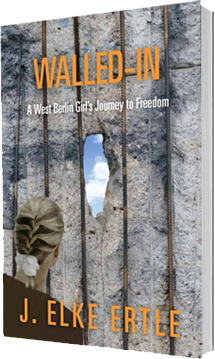
For a sneak peek at the first 20+ pages of my memoir, Walled-In: A West Berlin Girl’s Journey to Freedom, click “Download a free excerpt” on my home page and feel free to follow my blog about anything German: historic and current events, people, places and food.

Walled-In is my story of growing up in Berlin during the Cold War. Juxtaposing the events that engulfed Berlin during the Berlin Blockade, the Berlin Airlift, the Berlin Wall and Kennedy’s Berlin visit with the struggle against my equally insurmountable parental walls, Walled-In is about freedom vs. conformity, conflict vs. harmony, domination vs. submission, loyalty vs. betrayal.



Germany’s Basic Law

Thursday, May 23rd, 2013

On this day in 1949–on May 23–the Federal Republic of Germany (the former West Germany) adopted Germany’s Basic Law. Referred to as the Grundgesetz fuer die Bundesrepublik Deutschland, it is the highest law of the country and, therefore, akin to our constitution. But because Germany was occupied by four World War II Allies at the time the Basic Law was adopted, these four occupation forces–the United States, Great Britain, France, and the Soviet Union–had to approve the action. In May of 1949 only the three Western occupation forces approved the Basic Law. And they approved it only for their occupation zones. The Soviet Union did not endorse it for East Germany.

For that reason the term constitution was never used. The Basic Law was meant to serve merely on a temporary basis. The intent was to enact a permanent constitution once East and West Germany would be reunited. Instead, the two halves of the country remained split for twenty-eight years. Five months after the Basic Law was adopted in the Western zones of Germany, the Russian zone had adopted its own constitution.

After the fall of the Berlin Wall in November 1989 and the German reunification in October 1990, the Parliament of West Germany, the Bundestag, voted to incorporate East German territories under West Germany’s Basic Law. Its key components are the principles of democracy, social responsibility, and republicanism; human rights and human dignity are at its core. The once provisional Basic Law became, except for minor changes, the constitution of the reunited Germany, although the term “constitution” is still not used.

If you enjoyed reading this post, please like me.


For a sneak peek at the first 20+ pages of my memoir, Walled-In: A West Berlin Girl’s Journey to Freedom, click “Download a free excerpt” on my home page and feel free to follow my blog about anything German: historic or current events, people, places or food.

Walled-In is my story of growing up in Berlin during the Cold War. Juxtaposing the events that engulfed Berlin during the Berlin Blockade, the Berlin Airlift, the Berlin Wall and Kennedy’s Berlin visit with the struggle against my equally insurmountable parental walls, Walled-In is about freedom vs. conformity, conflict vs. harmony, domination vs. submission, loyalty vs. betrayal.
 

Barbie Dreamhouse

Wednesday, May 22nd, 2013

Barbie, the world’s most famous blonde, moved into her new temporary vacation home in Berlin last week. The Barbie Dreamhouse Experience opened on May 16, 2013, in Berlin’s central district of Mitte. For a stiff entrance fee of 22 euros visitors can view over 350 Barbie dolls. They may peruse the symbol of fashion and femininity’s walk-in closets, learn to be models, and to strut their stuff on the runway. They may also bake virtual cupcakes in the pink kitchen or do their own makeup to look like Barbie.

The giant Barbie Dreamhouse stretches over 27,000 square feet. Modeled after Mattel and EMS Entertainment’s Barbie mansion in Sunrise, Florida, the dollhouse is predominantly pink and contains endless closets.

Barbie moved into Berlin amid protests. Though the exhibition’s opening had been keenly awaited by some of the city’s little girls, the Barbie Dreamhouse Experience garnered massive criticism from German feminists, anti-capitalists, and members of the public. The controversial topless feminist protest group, Femen, burned a cross with a Barbie doll strapped to it. The doll’s naked torso bore the inscription, “Life in plastic is not fantastic.” A Another group protested, “Pink Stinks,” and the Linksjugend demonstrated against children being manipulated for financial gain.

Did you know that the American Barbie and German Bild Lilli are more than a little related? That’s right. Bild Lilli had her start as a sexy cartoon character in 1952 and was first marketed as a doll in in Germany in 1955. Aside from a few minor modifications and without obtaining copyright and patents to produce Bild Lilli, the American toy company, Mattel, began to manufacture almost identical dolls in 1959. They just named their dolls Barbie.


For a sneak peek at the first 20+ pages of my memoir, Walled-In: A West Berlin Girl’s Journey to Freedom, click “Download a free excerpt” on my home page and feel free to follow my blog about anything German: historic and current events, people, places and food.

Walled-In is my story of growing up in Berlin during the Cold War. Juxtaposing the events that engulfed Berlin during the Berlin Blockade, the Berlin Airlift, the Berlin Wall and Kennedy’s Berlin visit with the struggle against my equally insurmountable parental walls, Walled-In is about freedom vs. conformity, conflict vs. harmony, domination vs. submission, loyalty vs. betrayal.
 

Time’s Value

Tuesday, May 21st, 2013

To come to know the value of a year, ask a student who failed his finals.

To come to know the value of a month, ask a mother who bore a premature child.

To come to know the value of a week, ask the publisher of a weekly magazine.

To come to know the value of an hour, ask two lovers who are waiting for each other.

To come to know the value of a minute, ask someone who has missed his plane.

To come to know the value of a second, ask someone who has survived an accident.

To come to know the value of a millisecond, ask someone who won a silver medal at the Olympics.


Time waits for no one. Seize each moment because it is precious. Share it with a special friend, and it becomes priceless.


For a sneak peek at the first 20+ pages of my memoir, Walled-In: A West Berlin Girl’s Journey to Freedom, click “Download a free excerpt” on the home page of http://www.walled-in-berlin.com. Walled-In is a story of growing up in Berlin during the Cold War.


First Review

Monday, May 20th, 2013

Last week, I received the first review of Walled-In: A West Berlin Girl’s Journey to Freedom. It came from Laurel-Rain Snow and was posted on Goodreads and Laurel’s blog. When I read her review I was so thrilled that I did not sleep all night. Laurel gave Walled-In 5 of 5 stars! Here is what she had to say about Walled-In:

Laurel-Rain‘s review

May 15, 13

5 of 5 stars

Read from May 11 to 15, 2013

Tyranny takes many forms, from the restrictions of freedom imposed by governments to the familial constraints that markedly prevent an individual’s personal growth.

Growing up in post-war Germany, the author shows the reader what her world looked like, both at home and on the larger canvas that was her life within Berlin after the building of the Wall.


“Walled-In” reveals much about the young woman’s pursuit of individual freedom, and as I read about her personal struggles and the family dynamics, much of it tolled a familiar bell for me.

Our lives did not mirror one another’s, since I grew up in the US and did not face the governmental restrictions that dictated her life; however, the era in which we were each born was very similar and the family dynamics I experienced echoed hers. I could totally relate to her feelings and rooted for her escape.

My escape was made simpler by the governmental freedoms I enjoyed, but freedom from any tyranny can feel just as exhilarating, no matter how different the cage may be.

Other aspects of the story were wonderfully drawn, from the historical context in which she grew to the world at large that offered opportunities for change. This was a beautifully told story that is even more inspirational because of the parallels between Berlin under siege and the uncompromising world of family. Five stars.

Laurel-Rain Snow is an Amazon Vine reviewer and has a goal of reading 200 books a year. Follow her reviews on her blog, http://www.snowconnections.wordpress.com.Walled-In will be released in ten days. Let me know if you agree with Laurel’s assessment.


For a sneak peek at the first 20+ pages of my memoir, Walled-In: A West Berlin Girl’s Journey to Freedom, click “Download a free excerpt” on my home page and feel free to follow my blog about anything German: historic or current events, people, places or food.

Walled-In is my story of growing up in Berlin during the Cold War. Juxtaposing the events that engulfed Berlin during the Berlin Blockade, the Berlin Airlift, the Berlin Wall and Kennedy’s Berlin visit with the struggle against my equally insurmountable parental walls, Walled-In is about freedom vs. conformity, conflict vs. harmony, domination vs. submission, loyalty vs. betrayal.


Helmut Schmidt succeeds Willy Brandt

Thursday, May 16th, 2013

On this day in 1974–on May 16–Helmut Schmidt succeeded Willy Brandt as Chancellor of the Federal Republic of Germany (West Germany). Only days earlier, Guenter Guillaume, one of Willy Brandt’s personal assistants, had been exposed as an agent of the Stasi, the East German secret service. A disgraced Brandt had resigned in the wake of the espionage expose. Since that time, it is widely believed however, that the Guillaume affair was only the trigger, not the cause, for Brandt’s resignation. Willy Brandt’s leadership had also been plagued by scandals about serial adultery. And he had reportedly struggled with alcohol and depression.

From 1957 to 1966, Willy Brandt was the Mayor of West Berlin, a time when East-West tension peaked and ultimately led to the construction of the Berlin Wall. Brandt spoke out openly against Soviet Premier Nikita Khrushchev’s 1958 proposal that Berlin become a “free city.” His relationship with President John F. Kennedy was such that in early 1961, a year before elections in the Federal Republic of Germany, the United States were hoping that Brandt would replace Konrad Adenauer as Chancellor of West Germany. However, following the construction of the Berlin Wall in August 1961, Brandt was so disappointed in Kennedy that he criticized him publicly by stating, “Berlin expects more than words.”

A fellow Social Democrat, Helmut Schmidt, succeeded Brandt as the Chancellor of the Federal Republic of Germany. He successfully led his country through a worldwide economic recession and the oil crisis of the 1970s.


For a sneak peek at the first 20+ pages of my memoir, Walled-In: A West Berlin Girl’s Journey to Freedom, click “Download a free excerpt” on the home page of http://www.walled-in-berlin.com. Walled-In is a story of growing up in Berlin during the Cold War.


President Barack Obama to visit Berlin

Wednesday, May 15th, 2013

President Barack Obama and First Lady Michelle Obama will end a three-day trip to Europe trip with a visit to Berlin next month. Following a summit in Northern Ireland, the president is scheduled to meet with German Chancellor Angela Merkel to discuss bilateral global questions. Prior to his 2008 election, President Obama held a major campaign rally in Berlin, which drew an enthusiastic crowd of more than 200,000. A Democratic presidential candidate at the time, Mr. Obama had hoped to speak in front of Berlin’s historic Brandenburg Gate. But Chancellor Merkel would not have it. She maintained that this privilege was reserved for presidents. Mr. Obama ended up speaking at the nearby victory column.

According to the White House, President Obama’s visit will come one week before the 50th anniversary of President John F. Kennedy’s unforgettable “Ich bin ein Berliner” speech. Fifty years, ago, on June 26, 1963, I too, stood in the crowd of 450,000 who had gathered in front of Schoeneberger Rathaus, Berlin’s city hall, to hear John F. Kennedy speak. It was during the height of the Cold War when Mr. Kennedy pledged solidarity with West Berlin. When he said, “As a free man, I take pride in the words ‘Ich bin ein Berliner’,” we interpreted his words to mean that America would not sell us out to the Russians.

I recently wrote a book, entitled “Walled-In: A West Berlin Girl’s Journey to Freedom.” In it I describe what it was like to grow up in West Berlin during the time when the city was still divided into the capitalist west and the communist east.


For a sneak peek at the first 20+ pages of my memoir, Walled-In: A West Berlin Girl’s Journey to Freedom, click “Download a free excerpt” on my home page and feel free to follow my blog about anything German: historic and current events, people, places and food.

Walled-In is my story of growing up in Berlin during the Cold War. Juxtaposing the events that engulfed Berlin during the Berlin Blockade, the Berlin Airlift, the Berlin Wall and Kennedy’s Berlin visit with the struggle against my equally insurmountable parental walls, Walled-In is about freedom vs. conformity, conflict vs. harmony, domination vs. submission, loyalty vs. betrayal.


How to avoid criticism

Tuesday, May 14th, 2013

It is easy to avoid criticism.  All you have to do is say nothing, do nothing, and be nothing.


For a sneak peek at the first 20+ pages of my memoir, Walled-In: A West Berlin Girl’s Journey to Freedom, click “Download a free excerpt” on the home page of http://www.walled-in-berlin.com. Walled-In is a story of growing up in Berlin during the Cold War.


Onkel Dagobert

Monday, May 13th, 2013

Speaking of role models, mine was Onkel Dagobert Duck when I was ten. Christina, my classmate, had brought a Mickey Mouse comic book to school. The glossy introduced me to Disney’s cartoon characters. I thoroughly enjoyed the adventures of Donald Duck and his nephews Tick, Trick, and Track. But I idolized the triplet’s great uncle, Dagobert Duck. It was the stingy miser who set my imagination on fire.

Here was this elderly business duck, dressed in a red frock, top hat, pince-nez glasses, and spats who had accumulated so much money that the heaps of bills and coins piled high in his basement. In fact, Onkel Dagobert was forced to turn the pile regularly with a pitchfork to prevent his fortune from growing moldy. With shrewdness and thrift he had become the richest duck in the world.

At age ten, I wanted to be like Onkel Dagobert because in the mid 50s my parents and I still lived in a one-room apartment. There was barely enough money to make ends meet. Luxury items were out of the question. A touch of Onkel Dagobert was what we needed. I had been thrifty. I had bank-deposited every Pfennig I had won playing cards with my parents during long winter evenings. Still, to my knowledge, I did not need a pitchfork to turn the pile. What was I doing wrong? In any case, I was going to model myself after Onkel Dagobert and maybe I, too, would be able to dive into my mountain of money.

Decades later I learned that Donald Duck’s nephews were actually named Huey, Dewey, and Louie by their creator. And the children in the United States called my hero Uncle Scrooge. Where did these names originate? Uncle Scrooge, I learned, was named after the miser, Ebenezer Scrooge, from the novel “A Christmas Carol.” Onkel Dagobert, on the other hand, got his name from a Merovingian king. The Merovingian dynasty ruled Germania Superior from the middle of the 5th century. This region was a province of the Roman Empire at that time and included southwestern Germany and today’s cities of Wiesbaden and Mainz.

Fifty years have passed since those childhood fantasies, and I know only one thing for sure: I still don’t need a pitchfork, not even a hand shovel.


For a sneak peek at the first 20+ pages of my memoir, Walled-In: A West Berlin Girl’s Journey to Freedom, click “Download a free excerpt” on my home page and feel free to follow my blog about anything German: historic and current events, people, places and food.

Walled-In is my story of growing up in Berlin during the Cold War. Juxtaposing the events that engulfed Berlin during the Berlin Blockade, the Berlin Airlift, the Berlin Wall and Kennedy’s Berlin visit with the struggle against my equally insurmountable parental walls, Walled-In is about freedom vs. conformity, conflict vs. harmony, domination vs. submission, loyalty vs. betrayal.


The Schuman Plan

Thursday, May 9th, 2013

On this day in history in 1950–on May 9–the French foreign minister, Robert Schuman, made a proposal at a press conference that later became known as The Schuman Plan. He proposed a single authority to control the production of steel and coal. His plan led to the creation of the European Coal and Steel Community. The need for such an authority had grown out of the Second World War, which had ended only five years earlier. The conflict had nearly destroyed the European continent. By 1950, there was a great deal of momentum towards greater European co-operation in order to avoid future conflicts and destruction.

By placing the coal and steel industries of France and West Germany under a common authority and by opening membership to other European countries, the Schuman Plan laid the foundation for the establishment of the European Economic Community. In essence, The Schuman Plan marked the birth of Europe. It was the forerunner of the European Union,  and Robert Schuman is considered one of the Founding Fathers of the EU.


For a sneak peek at the first 20+ pages of my memoir, Walled-In: A West Berlin Girl’s Journey to Freedom, click “Download a free excerpt” on the home page of http://www.walled-in-berlin.com. Walled-In is a story of growing up in Berlin during the Cold War.