Archive for the ‘Walled In Berlin’ Category

Swapping history books

Wednesday, July 3rd, 2013

It might be a good idea if the various countries of the world would occasionally swap history books, just to see what other people are doing with the same set of facts.

–Bill Vaughan, journalist (1915-1977)


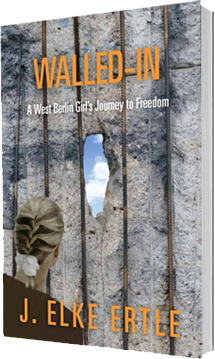
For a sneak peek at the first 20+ pages of my memoir, Walled-In: A West Berlin Girl’s Journey to Freedom, click “Download a free excerpt” on my home page and feel free to follow my blog about anything German: historic or current events, people, places or food.

Walled-In is my story of growing up in Berlin during the Cold War. Juxtaposing the events that engulfed Berlin during the Berlin Blockade, the Berlin Airlift, the Berlin Wall and Kennedy’s Berlin visit with the struggle against my equally insurmountable parental walls, Walled-In is about freedom vs. conformity, conflict vs. harmony, domination vs. submission, loyalty vs. betrayal.


The Zeppelin

Tuesday, July 2nd, 2013

The Zeppelin was a cigar-shaped rigid airship. In 1874 the German cavalry general, Count Ferdinand von Zeppelin, pioneered its rigid design. Its basic form was that of a long cylinder with tapered ends. It was on this day in history, on July 2, 1900, that the first Zeppelin, the LZ 1, made its maiden voyage. It flew across the Bodensee (Lake Constance) in Germany. The initial prototype was 420 feet long. Eventually, the term “zeppelin” came to refer to all rigid airships.

Count Ferdinand von Zeppelin

Count Ferdinand von Zeppelin

Count Ferdinand continued to improve the design of the LZ 1, and by 1910 his airships were flown commercially. By the middle of 1914, they had carried over 34,000 passengers on over 1,500 flights. The popularity of the Zeppelin peaked during the 1930s when they were flown on regular transatlantic flights between Germany and North America, and between Germany and Brazil. At one point, the count even toyed with the idea of connecting several independent airships to form a steerable airship train.

After Count Ferdinand von Zeppelin died in 1917, his successor, Hugo Eckener, took command of the business. He worked hard at reestablishing to company’s lead in rigid airship design in the wake of World War I, but political issues made it difficult. Then, in 1937, one of the Zepplins, the Hindenburg, landed in Lakehurst in New Jersey, after having completed another transatlantic flight, when its tail caught on fire. Within seconds, it burst into flames, killing many passengers and crewmembers. The event led to the demise of the Zeppelin.


For a sneak peek at the first 20+ pages of my memoir, Walled-In: A West Berlin Girl’s Journey to Freedom, click “Download a free excerpt” on the home page of http://www.walled-in-berlin.com. Walled-In is a story of growing up in Berlin during the Cold War.


“Berlinisch”, dialect of the Berliner

Monday, July 1st, 2013

Berlinisch is a vernacular that is spoken only in Berlin, Germany. It is not a written language, only a spoken one, and it mirrors the character of its people. The born-and-bred Berliner has a reputation of being a matter-of-fact, self-confident, often flippant individual who has at his disposal a sufficient dose of skeptical optimism, ready wit, and down-to-earth humor.

The city of Berlin is first mentioned in 1244, but we know that Germanic settlements existed in the region, dating as far back as the 6th century. Originally Plattdeutsch (Low German) was the official language and spoken at the courts. But in the 15th century, businessmen from Frankfurt/Oder and Leipzig (65 miles southeast and 200 miles southwest respectively) brought the language of Upper Saxony to Berlin. Upper Saxon was more similar in character to the High German that the reformer, Martin Luther, spoke. Over time, the upper circles and administrative bodies in Berlin combined the Upper Saxon sounds with their customary Low German language. And by the 17th and 18th centuries, all levels of Berlin’s society spoke Berlinisch.

But by the end of the 18th century, Berlin’s educated circles felt that Berlinisch sounded too vulgar and should be replaced by High German. Soon, the children of the middle class no longer learned Berlinisch in school. To this day, Berlinisch is not spoken in school; yet, somehow, every Berliner learns to speak the vernacular. Indeed, Berlinisch sounds a little rough around the edges, but it is a dialect with lots and lots of heart and honestly. It would be a shame if it disappeared.

So red't der Berliner by Wilhelm Franke, 1966, a guide to speaking "Berlinisch". www.walled-in-berlin.com

So red’t der Berliner by Wilhelm Franke, 1966, a guide to speaking “Berlinisch”. www.walled-in-berlin.com

(the history of the rise and fall of Berlinisch is taken from a small booklet, called “So red’t der Berliner” by Wilhelm Franke and was given to me by his daughter)


For a sneak peek at the first 20+ pages of my memoir, Walled-In: A West Berlin Girl’s Journey to Freedom, click “Download a free excerpt” on my home page and feel free to follow my blog about anything German: historic and current events, people, places and food.

Walled-In is my story of growing up in Berlin during the Cold War. Juxtaposing the events that engulfed Berlin during the Berlin Blockade, the Berlin Airlift, the Berlin Wall and Kennedy’s Berlin visit with the struggle against my equally insurmountable parental walls, Walled-In is about freedom vs. conformity, conflict vs. harmony, domination vs. submission, loyalty vs. betrayal.


50th Anniversary of JFK in Berlin

Thursday, June 27th, 2013

Yesterday, we celebrated the 50th anniversary of JFK in Berlin, Germany. Fifty years ago, on June 26, 1963, US President John F. Kennedy declared, “Ich bin ein Berliner” in front of West Berlin’s city hall. A crowd of 450,000 wanted to hug him, kiss him, keep him, adopt him. JFK delivered his speech during the height of the Cold War. I was standing among those people and will always remember the synergy that connected us. Never before or after this event did I experience a similar moment during which people of all ages and economic status melt together like that. Students, seniors, blue-collar workers, professionals, men and women, young and old pressed shoulder to shoulder in one big patchwork.

US President John F. Kennedy, Berlin's Mayor Willy Brandt, and German Chancellor Konrad Adenauer - Photo © J. Elke Ertle

US President John F. Kennedy, Berlin’s Mayor Willy Brandt, and German Chancellor Konrad Adenauer
in Berlin during Kennedy visit in 1963
Photo © J. Elke Ertle, www.walled-in-berlin.com

Many years later, a myth popped up. In the ensuring years, it gathered speed. The myth was that John F. Kennedy had said he was a doughnut when he said, “Ich bin ein Berliner.” Born a Berliner, let me assure you that there is no truth to this myth. Although a Berliner can also be a jelly-filled doughnut, anyone born and raised in Berlin considers him- or herself a Berliner. The same thing would be true of a native of the city of Hamburg. He would be considered a Hamburger, and that would not mean a patty of ground meat between the two halves of a bun, slathered with relish and ketchup. I don’t believe there was one person among the 450,000 in front of city hall who even fleetingly thought “doughnut!”


For a sneak peek at the first 20+ pages of my memoir, Walled-In: A West Berlin Girl’s Journey to Freedom, click “Download a free excerpt” on my home page and feel free to follow my blog about anything German: historic and current events, people, places and food.

Walled-In is my story of growing up in Berlin during the Cold War. Juxtaposing the events that engulfed Berlin during the Berlin Blockade, the Berlin Airlift, the Berlin Wall and Kennedy’s Berlin visit with the struggle against my equally insurmountable parental walls, Walled-In is about freedom vs. conformity, conflict vs. harmony, domination vs. submission, loyalty vs. betrayal.


John F. Kennedy spoke in Berlin

Wednesday, June 26th, 2013

On this day in history fifty years ago today, on June 26, 1963, John F. Kennedy spoke in Berlin. I stood in the crowd of 450,000 in front of Schoeneberger Rathaus to hear him speak. It was an experience I will never forget. Below is his speech (www.historyplace.com)

“I am proud to come to this city as the guest of your distinguished Mayor, who has symbolized throughout the world the fighting spirit of West Berlin. And I am proud to visit the Federal Republic with your distinguished Chancellor who for so many years has committed Germany to democracy and freedom and progress, and to come here in the company of my fellow American, General Clay, who has been in this city during its great moments of crisis and will come again if ever needed.

Two thousand years ago the proudest boast was “civis Romanus sum.” Today, in the world of freedom, the proudest boast is “Ich bin ein Berliner.”

I appreciate my interpreter translating my German!

There are many people in the world who really don’t understand, or say they don’t, what is the great issue between the free world and the Communist world. Let them come to Berlin. There are some who say that communism is the wave of the future. Let them come to Berlin. And there are some who say in Europe and elsewhere we can work with the Communists. Let them come to Berlin. And there are even a few who say that it is true that communism is an evil system, but it permits us to make economic progress. Lass’ sie nach Berlin kommen. Let them come to Berlin.

the cheering crowd in front of Schoeneberger Rathaus

the cheering crowd in front of Schoeneberger Rathaus

Freedom has many difficulties and democracy is not perfect, but we have never had to put a wall up to keep our people in, to prevent them from leaving us. I want to say, on behalf of my countrymen, who live many miles away on the other side of the Atlantic, who are far distant from you, that they take the greatest pride that they have been able to share with you, even from a distance, the story of the last 18 years. I know of no town, no city, that has been besieged for 18 years that still lives with the vitality and the force, and the hope and the determination of the city of West Berlin. While the wall is the most obvious and vivid demonstration of the failures of the Communist system, for all the world to see, we take no satisfaction in it, for it is, as your Mayor has said, an offense not only against history but an offense against humanity, separating families, dividing husbands and wives and brothers and sisters, and dividing a people who wish to be joined together.

What is true of this city is true of Germany–real, lasting peace in Europe can never be assured as long as one German out of four is denied the elementary right of free men, and that is to make a free choice. In 18 years of peace and good faith, this generation of Germans has earned the right to be free, including the right to unite their families and their nation in lasting peace, with good will to all people. You live in a defended island of freedom, but your life is part of the main. So let me ask you as I close, to lift your eyes beyond the dangers of today, to the hopes of tomorrow, beyond the freedom merely of this city of Berlin, or your country of Germany, to the advance of freedom everywhere, beyond the wall to the day of peace with justice, beyond yourselves and ourselves to all mankind.

Freedom is indivisible, and when one man is enslaved, all are not free. When all are free, then we can look forward to that day when this city will be joined as one and this country and this great Continent of Europe in a peaceful and hopeful globe. When that day finally comes, as it will, the people of West Berlin can take sober satisfaction in the fact that they were in the front lines for almost two decades.
All free men, wherever they may live, are citizens of Berlin, and, therefore, as a free man, I take pride in the words ‘Ich bin ein Berliner‘.”


For a sneak peek at the first 20+ pages of my memoir, Walled-In: A West Berlin Girl’s Journey to Freedom, click “Download a free excerpt” on my home page and feel free to follow my blog about anything German: historic or current events, people, places or food.

Walled-In is my story of growing up in Berlin during the Cold War. Juxtaposing the events that engulfed Berlin during the Berlin Blockade, the Berlin Airlift, the Berlin Wall and Kennedy’s Berlin visit with the struggle against my equally insurmountable parental walls, Walled-In is about freedom vs. conformity, conflict vs. harmony, domination vs. submission, loyalty vs. betrayal.



What matters

Tuesday, June 25th, 2013

“Our lives begin to end the day we become silent about things that matter.”
–Dr. Martin Luther King, Jr.


For a sneak peek at the first 20+ pages of my memoir, Walled-In: A West Berlin Girl’s Journey to Freedom, click “Download a free excerpt” on the home page of http://www.walled-in-berlin.com. Walled-In is a story of growing up in Berlin during the Cold War.


President Barack Obama

Monday, June 24th, 2013

President Barack Obama spoke in Berlin this week. The event took place on June 19, the hottest day of the year so far. After weeks of heavy rains, the sun shone brightly. Not a cloud in the sky. Who could have guessed? He had to deliver his 30-minute open-air address, standing in the blazing sun, sans shade of any kind. Likewise, 4,500 guests sat on their folding chairs in the Pariser Platz, on the east side of the Brandenburg Gate. Temperatures had hit 92° and felt more like 97° in Berlin’s humid continental climate. No shade was to be had for speaker or guests.

Obama Spoke in Berlin

Obama Spoke at Berlin’s Brandenburger Tor

Despite the intense heat and uncomfortable circumstances, Obama delivered a spirited talk. He covered the history of Berlin and Germany, referenced the milestone speeches of President John F. Kennedy and Ronald Reagan, and touched upon climate change, renewable energy, International responsibility, and disarmament of nuclear weapons.

Later, some commentators suggested that Berliners must have “cooled” to President Obama because of the paltry attendance of a mere 4,500 guests. People, people come on. Be fair. It is true that Kennedy drew a crowd of 450,000 in Berlin in 1963, and Democratic candidate Obama attracted over 200,000 in 2008. But both spoke to the public at large, not to a limited number of invited guests. Times have changed. While Kennedy still drove through Berlin in an open limousine, today’s presidents are protected behind bulletproof glass. Besides, President Obama was to deliver his address to 6,000 guests, many of them up in years. Do you blame the 1,500 who chose not expose themselves to the relentless heat? The small number of attendees at President Obama’s June 19 speech is hardly proof that his popularity in Berlin is waning. Maybe it is, but please people, use real, not manufactured, facts to argue the point.


For a sneak peek at the first 20+ pages of my memoir, Walled-In: A West Berlin Girl’s Journey to Freedom, click “Download a free excerpt” on my home page and feel free to follow my blog about anything German: historic and current events, people, places and food.

Walled-In is my story of growing up in Berlin during the Cold War. Juxtaposing the events that engulfed Berlin during the Berlin Blockade, the Berlin Airlift, the Berlin Wall and Kennedy’s Berlin visit with the struggle against my equally insurmountable parental walls, Walled-In is about freedom vs. conformity, conflict vs. harmony, domination vs. submission, loyalty vs. betrayal.


Deutsche Mark

Thursday, June 20th, 2013

On this day in history in 1948 – on June 20, a Sunday – Germans were issued a new currency: the Deutsche Mark. Their previous Reichsmark had become worthless. It no longer bought anything. In the absence of a viable hard currency, cigarettes had taken the place of money.

A few days preceding June 20, American, British, and French troops had quietly dispersed 23,000 wooden crates throughout the country. They were labeled, “Doorknobs.” In reality, these boxes contained Germany’s new bank notes, printed in the United States. To be exact, the crates contained 10,701,720,000 Deutsche Mark.

That Sunday, the places that had previously handed out ration stamps now issued 40 Deutsche Mark to every citizen. Another 20 Deutsche Mark were handed out one month later. Miraculously, the next morning, the previously empty shop-shelves were filling. Merchandise was becoming available for sale again at fixed prices. The cigarette economy was dying. It became apparent that factories and farmers had held back their finished goods and produce until they could be sold for hard currency.

Währungsreform

June 20, 1948,
currency reform in Germany
www.Kalendarblatt.de

Following the currency reform of 1948, Germany’s economy took off. Over the next decades it produced the “Wirtschaftswunder” (economic wonder). But it wasn’t only the three western Allies who were responsible for this economic wonder. A man by the name of Ludwig Erhard also deserves much of the credit. He convinced the Allies to declare all rationing systems invalid after the new Deutsche Mark was introduced. Erhard placed his trust in free market forces, and by the end of the 1960s the Deutsche Mark had become an anchor for the European economies.


For a sneak peek at the first 20+ pages of my memoir, Walled-In: A West Berlin Girl’s Journey to Freedom, click “Download a free excerpt” on my home page and feel free to follow my blog about anything German: historic or current events, people, places or food.

Walled-In is my story of growing up in Berlin during the Cold War. Juxtaposing the events that engulfed Berlin during the Berlin Blockade, the Berlin Airlift, the Berlin Wall and Kennedy’s Berlin visit with the struggle against my equally insurmountable parental walls, Walled-In is about freedom vs. conformity, conflict vs. harmony, domination vs. submission, loyalty vs. betrayal


Obama spoke in Berlin

Wednesday, June 19th, 2013

Today, President Barack Obama spoke in Berlin, 50 years after President John F. Kennedy’s famous address in the then-divided city. The last time Obama visited Berlin was during his 2008 run for president.

Fifty years ago, a euphoric crowd of 450,000 cheered Kennedy in front of Schöneberger Rathaus (city hall) when he declared, “Ich bin ein Berliner.” I stood in that crowd 50 years ago and was also swept away by those words, which were spoken at the height of the Cold War. Five years ago, Obama addressed a gathering of over 200,000 at the Siegessaeule (victory column) when he ran for president. Today, Obama spoke at Berlin’s historic 18th century Brandenburger Tor.

Obama Spoke at Berlin's Brandenburger Tor today

Obama Spoke at Berlin’s Brandenburger Tor today

President Obama arrived in Berlin as part of a three-day International Summit tour to discuss a variety of issues. At the top of German Chancellor Angela Merkel agenda were questions relative to global electronic and phone surveillance programs. Public outcry over the intrusion into the lives of private citizens is strong in Germany, far stronger than in the United States. The reason is that Germans have a deep-rooted distrust in governments that spy on their citizens. Germans have lived under the Gestapo (Geheime Staatspolizei) during the Nazi regime. More recently, East Germans citizens have lived under the Stasi–(Staatssicherheitsdienst). Both were secret police spying organizations. They have made Germans distrust any government that claims that broad surveillance activity is necessary for its citizens, safety. Merkel hopes to see a more equitable balance struck between providing security and protecting personal freedoms.

Obama spoke in Berlin today in the midst of a crushing heat wave that followed weeks of heavy rains and severe flooding throughout the country. The extreme temperatures, ranging in the 90s, reduced the number of guests in attendance. Instead of the invited 6,000, closer to 4,000 guests came. However, the poor attendance does not reflect a significant drop in Obama’s popularity in Germany. A recent poll indicates that Obama still holds close to a 90% approval rating in Germany.


For a sneak peek at the first 20+ pages of my memoir, Walled-In: A West Berlin Girl’s Journey to Freedom, click “Download a free excerpt” on my home page and feel free to follow my blog about anything German: historic or current events, people, places or food.

Walled-In is my story of growing up in Berlin during the Cold War. Juxtaposing the events that engulfed Berlin during the Berlin Blockade, the Berlin Airlift, the Berlin Wall and Kennedy’s Berlin visit with the struggle against my equally insurmountable parental walls, Walled-In is about freedom vs. conformity, conflict vs. harmony, domination vs. submission, loyalty vs. betrayal.


Opportunity

Tuesday, June 18th, 2013

If opportunity doesn’t knock, build a door.
–Milton Berle


For a sneak peek at the first 20+ pages of my memoir, Walled-In: A West Berlin Girl’s Journey to Freedom, click “Download a free excerpt” on the home page of http://www.walled-in-berlin.com. Walled-In is a story of growing up in Berlin during the Cold War.