Archive for the ‘Walled In Berlin’ Category

The Ascanian Dynasty

Monday, September 30th, 2013

Coelln and Berlin grew rapidly during the Ascanian Dynasty. The House of Ascania reigned from 1157 to 1320. Albert the Bear, the first Margrave of Brandenburg (which includes Berlin) inherited the territory upon the death of the childless Slavic Prince Pribislav. In short order Albert the Bear solidified his rule and led a number of military campaigns against the Slavic population that co-inhabited the area along with Germanic peoples. He encouraged Germanic migration and subjugated the Slaves to Christianity. Upon his death, control over the territory went to his descendants in succession: Otto I (Albert’s son), Otto II (son of Otto I), Albert II (brother of Otto II), and finally John I and Otto III (sons of Albert II and co-rulers).

Albert the Bear, founder of the Ascanian Dynasty

House Order of Albert the Bear
first Margrave of Brandenburg
1157-1170

During the years of John and Otto’s co-rule, the Margraviate saw massive geographic expansion. The brothers were instrumental in the rapid development of Coelln and Berlin by conferring special privileges upon the twin towns, such as staple rights. These were important rights sometimes given to selected ports. Staple rights required passing merchant ships to unload their cargo and display it for sale for a specified period before being allowed to reload any unsold goods and to continue their journey. Possessing staple rights gave Coelln and Berlin important economic advantages over other nearby ports, such as the much older fortification of Spandau.

In 1258 John and Otto divided the territory into Brandenburg Stendal and Brandenburg Salzwedel. From 1266 to 1319 the four sons of John I (John II, Conrad, Otto IV, and Henry) and the four descendants of Otto III (John III, Otto V, Otto VI, and Albert III) shared the title of “Margrave of Brandenburg” and ruled jointly. With the death of John V In 1317, the last grandson of Otto III, the Ottonian line died out. And when Henry II, eleven-year-old grandson of John I, died three years later that line became extinct as well.


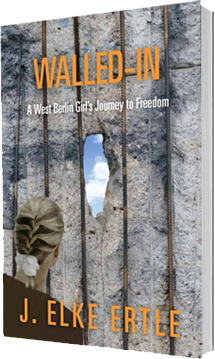
For a sneak peek at the first 20+ pages of my memoir, Walled-In: A West Berlin Girl’s Journey to Freedom, click “Download a free excerpt” on my home page and feel free to follow my blog about anything German: historic or current events, people, places or food.

Walled-In is my story of growing up in Berlin during the Cold War. Juxtaposing the events that engulfed Berlin during the Berlin Blockade, the Berlin Airlift, the Berlin Wall and Kennedy’s Berlin visit with the struggle against my equally insurmountable parental walls, Walled-In is about freedom vs. conformity, conflict vs. harmony, domination vs. submission, loyalty vs. betrayal.


brand new ending

Friday, September 27th, 2013

Though no one can go back and make a brand new start, anyone can start from now and make a brand new ending.

–Carl Bard


For a sneak peek at the first 20+ pages of my memoir, Walled-In: A West Berlin Girl’s Journey to Freedom, click “Download a free excerpt” on the home page of http://www.walled-in-berlin.com. Walled-In is a story of growing up in Berlin during the Cold War.


Coelln and Berlin

Monday, September 23rd, 2013

During the 13th century, itinerant merchants founded two trading posts, on opposite sites of the Spree River, Coelln and Berlin. Coelln was first cited in a 1237 deed. The date is commonly regarded as the origin of Berlin, although the city is not mentioned until 1244.

Cölln is first cited in 1237, Berlin in 1244

Berlin (red), Coelln (yellow) Two settlements on opposite sides of the River Spree

The twin settlements were located between the already established towns of Spandau to the northwest and Koepenick to the southeast. Since Coelln and Berlin were on the trading route between Madgeburg and Frankfurt/Oder, they grew quickly. Initially, the Muehlendamm – Mill Dam – that crossed the River Spree served as the only connection between them. Each settlement had its own town hall and mayor. Relations were often tense. When a fire swallowed up a large part of Coelln, the people of Berlin declined to help. But they begged Coelln for assistance only two years later when their own town was burning. An outbreak of the Bubonic plague in Coelln caused Berlin to block the Mill Dam in order to keep the contagions in check. But when a Berlin woman spotted a dead body on the far side of the causeway to Cölln, she climbed over the barriers to steal his jacket. By doing so, she spread the epidemic to Berlin.

In 1307 Coelln and Berlin merged into a single town to improve the inhabitants’ prospects for defending against the sovereign. They constructed a second crossing, the Lange Bruecke – Long Bridge which was later renamed the Rathausbruecke -Town Hall Bridge. It still exists today and is Berlin’s second oldest bridge. A bridge was also constructed to replace the Mill Dam. It was called the Muehlendammbruecke and is now Berlin’s oldest bridge, located between Gertraudenstrasse and Molkenmarkt.

The original two settlements were situated just southwest of today’s Alexanderplatz and the Nikolai section. While Berlin grew into a cosmopolitan city, Coelln became part of its historic core. Its northern peak has become known as Museum Island and its southern part as Fischerinsel – Fishermen’s Island. Coelln’s name survives only in Berlin’s southeastern borough of Neukoelln.


For a sneak peek at the first 20+ pages of my memoir, Walled-In: A West Berlin Girl’s Journey to Freedom, click “Download a free excerpt” on my home page and feel free to follow my blog about anything German: historic and current events, people, places and food.

Walled-In is my story of growing up in Berlin during the Cold War. Juxtaposing the events that engulfed Berlin during the Berlin Blockade, the Berlin Airlift, the Berlin Wall and Kennedy’s Berlin visit with the struggle against my equally insurmountable parental walls, Walled-In is about freedom vs. conformity, conflict vs. harmony, domination vs. submission, loyalty vs. betrayal.


reality

Friday, September 20th, 2013

“The difference between fiction and reality? Fiction has to make sense.”

–Tom Clancy


For a sneak peek at the first 20+ pages of my memoir, Walled-In: A West Berlin Girl’s Journey to Freedom, click “Download a free excerpt” on the home page of http://www.walled-in-berlin.com. Walled-In is a story of growing up in Berlin during the Cold War.


Berlin in antiquity

Monday, September 16th, 2013

Berlin in antiquity – what was it like? What do we know about that period? As early as the first centuries of the Common Era, various Germanic tribes inhabited the banks of the Spree and Havel. Both are rivers that flow through modern day Berlin. During the course of the Great European Migration, many of these Germanic tribes left their native territories and moved west toward the Rhine River and south toward the Western Roman Empire. The Western Roman Empire was huge and encompassed today’s Spain, France, England, Italy, Switzerland, Austria, parts of Yugoslavia, and parts of North Africa. Slavic peoples from central and Eastern Europe moved into the vacated lands.

As the vacated lands turned predominantly Slavic, two of these Slavic tribes settled in the Berlin area. Around 720, the Hevelli established themselves along the River Havel. They founded the trading post of Spandau, now a borough of Berlin. The Sprevane put down roots in the vicinity of today’s suburb of Koepenick, close to the River Spree. Two hundred years later, Slavic tribes settled the area that today represents the core of today’s Berlin.

Otto I reigned as a German King from 936 to 973

Otto the Great
founder of the Holy Roman Empire

Two hundred years later, in 948, Otto I, also known as Otto the Great, founded the Holy Roman Empire. In 962, he was crowned Emperor of the Romans by Pope John XII. The Holy Roman Empire is not synonymous with the Western or Eastern Roman Empires, however. The former proclaimed itself to be the successor to the Western Roman Empire. It quickly established German control over the largely Slavic inhabitants of the region. The territory of the Holy Roman Empire centered on the Kingdom of Germany along with several small neighboring lands, including the Kingdom of Italy. The Emperor’s appointee, Markgraf Gero, led several crusades against the Slaves until they rebelled against German overlordship in 983. Then the region, once again, returned to Slavic control.


For a sneak peek at the first 20+ pages of my memoir, Walled-In: A West Berlin Girl’s Journey to Freedom, click “Download a free excerpt” on the home page of http://www.walled-in-berlin.com. Walled-In is a story of growing up in Berlin during the Cold War.


imitation

Friday, September 13th, 2013

“It is better to fail in originality than to succeed in imitation.”

–Herman Melville


For a sneak peek at the first 20+ pages of my memoir, Walled-In: A West Berlin Girl’s Journey to Freedom, click “Download a free excerpt” on the home page of http://www.walled-in-berlin.com. Walled-In is a story of growing up in Berlin during the Cold War.


Berlin’s long history

Monday, September 9th, 2013

Berlin’s long history started in 1244. Visit https://www.walled-in-berlin.com/j-elke-ertle/berlins-colorful-history/ for a thumbnail sketch of Berlin since the Weimar Republic. Over the next eight centuries, the city rose from a medieval trading post with a population of 8,500 to a metropolis of almost 4 million during the Weimar Republic (see September 2 post, “Berlin’s Colorful History”)

(1933) Berlin – National Socialist era
Hitler assumed power and the democracy ended. The National Socialist era ushered in Germanys darkest period, which included persecution of the Jews and lead the country into World War II.


The Berlin Bear is the city's coat of arms

The Berlin Bear is the city’s coat of arms


(1945) Berlin – Post World War II
Germany surrendered and the country was divided into four zones. Berlin, located entirely within the Soviet zone, was also divided into four sectors. Growing differences in ideologies among the four Allies sparked a Cold War, and Berlin became its focus. Initially, clashes over currency reform triggered a Soviet-imposed blockade. The western Allies responded with the Berlin Airlift. In 1949, the Federal Republic of Germany was founded in Germany’s western sectors, and Bonn became its provisional capital. But Berlin retained its special status as a territory under Allied supervision, which it kept until German reunification. The German Democratic Republic (East Germany) was founded in the Soviet sector with East Berlin as the capital. In 1961, the East German government built a wall that separated the city and the country.

(1989) Berlin – The fall of the Berlin Wall
In 1989, when Guenter Schabowski, East German Central Committee secretary, made an unclear reference to new travel regulations for East German citizens, the people forced the government to open the borders once and for all.

(1990) Berlin – Today’s Capital
The two Germanys were reunited on 3 October 1990. Berlin became the capital of Germany once again. Currently, the city’s population nears 3.3 million.


For a sneak peek at the first 20+ pages of my memoir, Walled-In: A West Berlin Girl’s Journey to Freedom, click “Download a free excerpt” on my home page and feel free to follow my blog about anything German: historic and current events, people, places and food.

Walled-In is my story of growing up in Berlin during the Cold War. Juxtaposing the events that engulfed Berlin during the Berlin Blockade, the Berlin Airlift, the Berlin Wall and Kennedy’s Berlin visit with the struggle against my equally insurmountable parental walls, Walled-In is about freedom vs. conformity, conflict vs. harmony, domination vs. submission, loyalty vs. betrayal.
 

Berlin’s Colorful History

Monday, September 2nd, 2013

Berlin’s colorful history spans eight or more centuries. The city was first documented in 1244. But recent excavations suggest that the German capital may be even older. Archaeologists discovered an oak beam in 2008 that probably dates back to the year 1183. Throughout these centuries, Berlin saw dazzling to dark epochs.

(1244) Berlin – medieval trading center
Founded in 1244, the current metropolis began when the twin towns, Berlin and Coelln, merged and became one medieval trading center. At that time, the city had roughly 8,500 inhabitants.

(1411) Berlin – electors’ residence
Starting in the 14th century, the Hohenzollern ruled the city for 500 years. The first Hohenzollern to rule Berlin was Elector Friedrich I of Brandenburg. The last was King and Emperor Wilhelm II who ruled until 1918.

(1701) Berlin – royal capital
During the Hohenzollern rule, Berlin became the royal residence of Friedrich I, King of Prussia. He helped the city develop into a center of enlightenment. The city’s red brick city hall, which is still standing today, was built during that period.

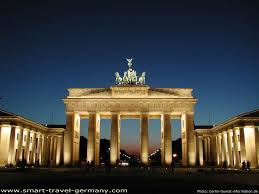
The Brandenburg Gate is an integral part of Berlin's colorful history

Berlin’s Brandenburg Gate
built 1788-1971
commisioned by Friedrich I, King of Prussia

(1871) Berlin – imperial capital
Berlin became the capital of the German Reich, and its population grew to over 1 Million. 1914 brought the beginning of World War I. Toward the end of that war, hunger and war-weariness lead to massive strikes in the city.

(1918) Berlin – Weimar Republic
When World War I ended in 1918, Emperor Wilhelm II was ousted and the Weimar Republic, Germany’s first democracy, was formed. Excessive reparation demands levied on Germany by the Treaty of Versailles caused run-away inflation and widespread unemployment. In 1923, when the inflation reached its peak, a kilo of rye bread sold for 3.6 million marks. Meanwhile, Berlin had incorporated many towns and rural communities so that the population had grown to almost 4 million.

Next week, the thumbnail sketch of Berlin’s colorful history will take the reader from 1933 to the present, visit

http://www.walled-in-berlin.com/j-elke-ertle/berlins-long-history/


For a sneak peek at the first 20+ pages of my memoir, Walled-In: A West Berlin Girl’s Journey to Freedom, click “Download a free excerpt” on my home page and feel free to follow my blog about anything German: historic or current events, people, places or food.

Walled-In is my story of growing up in Berlin during the Cold War. Juxtaposing the events that engulfed Berlin during the Berlin Blockade, the Berlin Airlift, the Berlin Wall and Kennedy’s Berlin visit with the struggle against my equally insurmountable parental walls, Walled-In is about freedom vs. conformity, conflict vs. harmony, domination vs. submission, loyalty vs. betrayal.


First Motorcycle

Thursday, August 29th, 2013

On this day in history – on 29 August 1885 – The German inventors, Gottlieb Daimler and Wilhelm Maybach, built the first motorcycle. In a greenhouse in Bad Cannstatt in the south of Germany, the two men invented the first gas-powered internal combustion engine. It put out 0.5 horsepower and fit under the seat of a wooden bicycle frame. The tires of their invention were studded with metal. Two outrigger wheels kept the contraption upright. Its maximum speed was 7.5 miles/hour, about the speed of a bicycle.

Daimler-Maybach had built the first motorcycle in the world, but at first, they did not call it “motorcycle.” Since its leather seat was shaped like a saddle, they initially called it Reitwagen auf zwei Raedern (riding car on two wheels.) For Daimler, the Reitwagen was only an experiment. He was looking toward showier groundbreaking inventions. Therefore, he never rode the Reitwagen himself and asked his son, Paul, to test the contraption’s performance on its initial 2-miles test run between Bad Cannstatt and Untertuerkheim.

Initially called Reitwagen auf zwei Rädern (riding car on two wheels), the first motorcycle had a speed of 7.5 miles/hour

The first motorcycle was invented by Gottlieb Daimler and Wilhelm Maybach in 1885

In the early days, the two-wheeler failed to catch on, aside from being popular in some upper circles in French society. German mass production did not start until the turn of the century. At that time, the Bavarian company, Hildebrandt and Wolfmueller, patented the invention under the name of Motorrad (motorcycle). The motorcycle reached its heyday in the post WWII years when it became an affordable means of transportation. With 78 miles/hour, it was fast compared to a bicycle. Then, in the 50s and 60s, people began to abandon motorcycles again in favor of cars. But starting in the 70s, motorcycles made a comeback. Ownership became synonymous with rebellion, freedom, and adventure.


For a sneak peek at the first 20+ pages of my memoir, Walled-In: A West Berlin Girl’s Journey to Freedom, click “Download a free excerpt” on my home page and feel free to follow my blog about anything German: historic and current events, people, places and food.

Walled-In is my story of growing up in Berlin during the Cold War. Juxtaposing the events that engulfed Berlin during the Berlin Blockade, the Berlin Airlift, the Berlin Wall and Kennedy’s Berlin visit with the struggle against my equally insurmountable parental walls, Walled-In is about freedom vs. conformity, conflict vs. harmony, domination vs. submission, loyalty vs. betrayal.


Berlin’s KaDeWe

Monday, August 26th, 2013

Berlin’s KaDeWe is Europe’s second-largest department store. The upscale Kaufhaus des Westens (Department Store of the West) is located in Berlin, Germany, and generally referred to by its abbreviation, KaDeWe. The store is located along the Tauentzienstrasse, a major shopping boulevard near the center of the former West Berlin.

When Berlin’s KaDeWe first opened its doors in 1907, it immediately set new standards for product variety and service. Shoppers could find almost everything in the 260,000 square foot store – ranging from everyday necessities to luxury items. Arrival of the KaDeWe changed the Tauentzienstrasse from a quiet residential street to one of the most famous boulevards in the city.

By 1930, Berlin’s KaDeWe was doing so much business that the store was enlarged. But three years later, during the National Socialist era, the predominantly Jewish owners of Berlin’s KaDeWe were forced to sell the store because Jewish ownership had become illegal. Ten years later, during World War II, a shot-down American bomber crashed into the store, and the KaDeWe almost burned to the ground. In 1950, Berliners celebrated the reopening of the first two floors, and in the mid 50s, construction of all seven floors was complete. By now, Berlin’s KaDeWe also featured a gourmet floor, which quickly became a mecca for lovers of epicurean delights. The fall of the Berlin Wall in 1989 brought record-breaking numbers of shoppers and prompted the KaDeWe to add another floor. The sales area now expanded to over 645,000 square feet.

Main entrance to Berlin's KaDeWe along the Tauentzienstrasse

Main entrance of Berlin’s KaDeWe along the Tauentzienstrasse

Today, Berlin’s KaDeWe has eight floors, each one focused on a different type of merchandise. The ground floor holds beauty accessories, salons and spas. The 1st floor is dedicated to men’s apparel, the 2nd floor to women’s fashion. On the 3rd floor you find luxury shoes and leather goods. The 4th floor is dedicated to furniture and design items. The 5th floor contains arts, electronics, toys, and office supplies. And the 6th and 7th floors are entirely devoted to delicatessen and gourmet counters filling an area the size of two football fields. The top floor includes a winter garden with a 1000-seat restaurant.

Since 1907, the same morning ritual is followed. Shortly before 10 a.m. the original iron gate is lowered, allowing customers to embark on their exciting shopping adventure. Two thousand employees stand ready to fill each customer’s needs. When visiting Berlin, the KaDeWe is a must.


For a sneak peek at the first 20+ pages of my memoir, Walled-In: A West Berlin Girl’s Journey to Freedom, click “Download a free excerpt” on my home page and feel free to follow my blog about anything German: historic or current events, people, places or food.

Walled-In is my story of growing up in Berlin during the Cold War. Juxtaposing the events that engulfed Berlin during the Berlin Blockade, the Berlin Airlift, the Berlin Wall and Kennedy’s Berlin visit with the struggle against my equally insurmountable parental walls, Walled-In is about freedom vs. conformity, conflict vs. harmony, domination vs. submission, loyalty vs. betrayal.