Archive for the ‘Walled In Berlin’ Category

Forced Adoptions in Former East Germany

Monday, March 18th, 2019

During the 1970s and 1980s, Germany remained split into East and West. During that period, as many as 2,000 East German children fell victim to politically motivated forced adoptions. The state took minor children of politically undesirable parents and placed them permanently with regime-compliant families. Most of these children were of elementary school age; some were newborns, taken from their mothers in the hospital. In case of the latter, parents were told that their babies had died shortly after birth. Not until after the collapse of East Germany in 1989 did many of these forced adoption cases come to light.

About 2,000 children in former East Germany fell victim to politically motivated forced adoptions. www.walled-in-berlin.com

About 2,000 children in former East Germany fell victim to politically motivated forced adoptions. www.walled-in-berlin.com

Parental “Crimes” and Forced Adoptions

In socialist East Germany, the state expected parents to teach their offspring the principles of communism and the importance of loyalty to the state. To properly instill those values in their children, parents had to be dedicated to the system. If parents spoke out against the regime, or worse, attempted to escape to the West, the state deemed them unqualified to raise children. In that case, authorities withdrew parenting rights and permanently placed the children with approved families.

There were other, far more obscure, reasons that could result in a politically motivated forced adoptions. The Spiegel Online International Newsletter reports several such cases. In one instance, the state put the children of a single mother up for adoption. Out of work, she had chosen to stay home to care for her children rather than continue to work outside the home, as required by East Germany’s compulsory labor laws. When the mother rejected placing her children in the state’s child care, authorities initiated forced adoption. The state told another mother that she would not be allowed to raise two children because her apartment was too small (a larger apartment was not available) and permanently placed one of the children with a regime-approved family.

Responsibility for Forced Adoption

Forced Adoptions were the responsibility of the East German Ministry of Education. Margot Honecker headed the Ministry of Education from 1963 to 1989. She was the wife of former East German head of state, Erich Honecker. Mrs. Honecker, whose agency created the forced adoption policies, allegedly also enforced them. However, allegations were never proven. Following German reunification in 1990, Mrs. Honecker left Germany and moved to Chile where she lived in exile for the rest of her life, collecting a German state pension. She was never charged and died in 2016.

Thirty Years Later

Thirty years after the fall of the Berlin Wall, many families, separated by forced adoptions, are still in search of each other. Reunions are difficult because adoption records are often hard to trace or are missing altogether. On top of that, unified Germany’s Child Protective Services cannot release names and addresses for 50 years because of data protection laws. In the meantime, some victims have formed their own search organizations and websites to help children and parents reconnect. So far, at least 600 families have been reunited.

Reunions of Forced Adoption Victims

Unfortunately, not all reunions of forced adoption victims have ended happily. Many of the children were never told that they were adopted. Others had long forgotten what their natural parents looked like because photographs were confiscated at the time of adoption. When a natural parent knocked on the door, the children – by now adults – were often unprepared to handle the revelation and cut all contact with natural and adoptive parents. While expectations run high, reality often proves disappointing. Grief and sorrow remain.


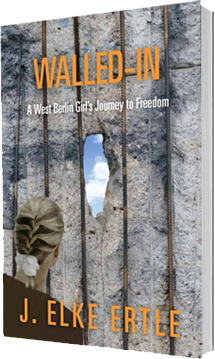
For a sneak peek at the first 20+ pages of my memoir, Walled-In: A West Berlin Girl’s Journey to Freedom, click “Download a free excerpt” on my home page and feel free to follow my blog about anything German: historic or current events, people, places or food.

Walled-In is my story of growing up in Berlin during the Cold War. Juxtaposing the events that engulfed Berlin during the Berlin Blockade, the Berlin Airlift, the Berlin Wall and Kennedy’s Berlin visit with the struggle against my equally insurmountable parental walls, Walled-In is about freedom vs. conformity, conflict vs. harmony, domination vs. submission, loyalty vs. betrayal.

Key to your true potential

Thursday, March 14th, 2019

Only you hold the key to your true potential.

— Anonymous

Only you hold the key to your true potential. www.walled-in-berlin.com

Only you hold the key to your true potential. www.walled-in-berlin.com


For a sneak peek at the first 20+ pages of my memoir, Walled-In: A West Berlin Girl’s Journey to Freedom, click “Download a free excerpt” on my home page and feel free to follow my blog about anything German: historic or current events, people, places or food.

Walled-In is my story of growing up in Berlin during the Cold War. Juxtaposing the events that engulfed Berlin during the Berlin Blockade, the Berlin Airlift, the Berlin Wall and Kennedy’s Berlin visit with the struggle against my equally insurmountable parental walls, Walled-In is about freedom vs. conformity, conflict vs. harmony, domination vs. submission, loyalty vs. betrayal.


Elphie – Hamburg’s Sydney Opera House Alternative

Monday, March 11th, 2019

Officially inaugurated on 11 January 2017, the Elphie (abbreviation of the German word Elb Philharmonie) is one of the largest and acoustically most advanced concert halls in the world. It is an architectural, cultural and civic masterpiece and dominates Hamburg’s harbor. Set on a small finger of land that protrudes into the River Elbe, this cultural and residential complex incorporates three superb concert venues. A 280-foot curved escalator transports visitors up six flights to a public observation deck with sweeping views of the city of Hamburg and its harbor. The ride takes two and a half minutes. While a parking garage occupies some of the lower levels, the upper floors accommodate 44 luxury condominiums, a conference center, restaurants, bars and a spa. In addition, the four-star Westin Hotel Hamburg with 250 rooms is located between the 9th and 20th floors.

Elphie (Elb Philharmonie) in Hamburg, Germany. Photo © Klaus Malonnek, 2018. www.walled-in-berlin.com

Elphie (Elb Philharmonie) in Hamburg, Germany. Photo © Klaus Malonnek, 2018. www.walled-in-berlin.com

The smallest of the condominiums has 1,300 square feet; the largest 4,300 square feet. Sales prices begin at $1,580 per square foot. A stay at the Westin Hotel will run about $220.00 per night for its least desirable room to $3,000 per night for its top suite.

History of the Elphie

The Elphie crests the skeleton of a 1963 warehouse that replaced an earlier one built in the same spot in 1875. The new structure is topped with a 1000-panel undulating glass roof. Swiss architects Herzog & de Meuron retained the original 1966 brick façade of the base building. They then designed a footprint-matching glassy superstructure with its own foundation on top of this base. The first eight floors of the building are within the brick façade, the remaining 18 floors extend above it. The curved glass windows give the Elphie the appearance of a hoisted sail.

Elphie concert halls

The Elphie has three concert venues.The Great Concert Hall accommodates 2,100 visitors. The audience surrounds the performers in a vineyard-style seating arrangement. Even the back seats are no more than 100 feet from the conductor. Acoustician, Yasuhisa Toyota, designed the Elphie’s acoustics. He installed about 10,000 acoustic panels that disperse the sound into every corner of the hall. The Great Concert Hall also is home to a pipe organ with 69 registers and 4,765 organ pipes, built by the German company, Klais Orgelbau.


Great Concert Hall, Elphie, Hamburg, Germany. Photo © Klaus Malonnek, 2018. www.walled-in-berlin.com

Great Concert Hall, Elphie, Hamburg, Germany. Photo © Klaus Malonnek, 2018. www.walled-in-berlin.com


The smaller Recital Hall holds 550 patrons and is used for the performance of recitals, chamber music and jazz concerts. The third venue, the Kaistudio, seats 170 visitors and is mainly used for educational events.

The Elphie’s Construction Woes

The foundation for the Elphie was laid in April 2007 with a projected completion date in 2010. Cost was estimated at €241 million. Like many other major projects worldwide, completion of the complex ran over schedule. Construction work finally ended in October 2016 at a cost of €789 million. Although the project was severely criticized for its cost and schedule overruns, it was successfully completed unlike Berlin’s new airport. The opening of BER has been delayed eight times already, with no end in sight.

Elphie’s Successes

Two years into the Elphie’s existence, the complex is still extremely popular with locals and visitors alike. Since its opening in 2017, each of the almost 800 concerts in the Great Concert Hall was almost always fully booked. The smaller Recital Hall was sold out over 90% of the time, and it still is difficult to obtain a ticket to a performance at the Elphi.


For a sneak peek at the first 20+ pages of my memoir, Walled-In: A West Berlin Girl’s Journey to Freedom, click “Download a free excerpt” on my home page and feel free to follow my blog about anything German: historic or current events, people, places or food.

Walled-In is my story of growing up in Berlin during the Cold War. Juxtaposing the events that engulfed Berlin during the Berlin Blockade, the Berlin Airlift, the Berlin Wall and Kennedy’s Berlin visit with the struggle against my equally insurmountable parental walls, Walled-In is about freedom vs. conformity, conflict vs. harmony, domination vs. submission, loyalty vs. betrayal.


What kind of citizen do governments like?

Thursday, March 7th, 2019

Governments don’t want well-informed citizens capable of critical thinking. They want obedient workers, people who are just smart enough to run the machines and do the paperwork. And just dumb enough to passively accept it.

— George Carlin

Governments don’t want well-informed citizens capable of critical thinking. They want obedient workers, people who are just smart enough to run the machines and do the paperwork. And just dumb enough to passively accept it. www.walled-in-berlin.com

Governments don’t want well-informed citizens capable of critical thinking. They want obedient workers, people who are just smart enough to run the machines and do the paperwork. And just dumb enough to passively accept it. www.walled-in-berlin.com


For a sneak peek at the first 20+ pages of my memoir, Walled-In: A West Berlin Girl’s Journey to Freedom, click “Download a free excerpt” on my home page and feel free to follow my blog about anything German: historic or current events, people, places or food.

Walled-In is my story of growing up in Berlin during the Cold War. Juxtaposing the events that engulfed Berlin during the Berlin Blockade, the Berlin Airlift, the Berlin Wall and Kennedy’s Berlin visit with the struggle against my equally insurmountable parental walls, Walled-In is about freedom vs. conformity, conflict vs. harmony, domination vs. submission, loyalty vs. betrayal.


Bremen’s House of the Glockenspiel

Monday, March 4th, 2019

The House of the Glockenspiel (Haus des Glockenspiels) is a gabled red brick building in Bremen’s historic Boettcherstrasse. It was designed by Bremen architects Alfred Runge and Eduard Scotland and constructed by Ludwig Roselius, the inventor of decaffeinated coffee.

Haus of the Glockenspiel in Bremen - the carillon with 30 Meissen porcelain bells chimes three times per day. Photo © J. Elke Ertle, 2017. www.walled-in-berlin.com

Haus of the Glockenspiel in Bremen – the carillon with 30 Meissen porcelain bells chimes three times per day. Photo © J. Elke Ertle, 2017. www.walled-in-berlin.com

The Carillon of the House of the Glockenspiel

The House of the Glockenspiel was constructed between 1923 and 1924, and the carillon, made of 30 Meissner porcelain bells, was added in 1934. The bells were placed between the gables and initially painted blue on the outside and gold on the inside. In 1944, during World War II, the building and the Glockenspiel suffered serious fire damage. Following the war, white porcelain bells were installed. The carillon chimes three times a day (at noon, 3 pm and 6 pm). https://www.youtube.com/watch?v=xlCXUK-j_pc&vl=en/

The Wooden panels in the tower of the House of the Glockenspiel

While the 30 bells in the tower chime, ten wooden panels rotate on a mechanism inside the tower. The panels were designed by Bernhard Hoetger and built by Zdzislaus Victor Kopytko. They survived the Second World War undamaged. Restored in 1991, they depict pioneering seafarers and aviators from around the world:

(1) Leif Erikson and Thorfinn Karlsefni (Icelandic explorers – first known Europeans to have set foot on continental North America)

(2) Didrik Pining and Hans Pothorst (German explorers who may have reached America twenty years before Columbus)

(3) Christopher Columbus (Italian explorer who discovered the viable sailing route to the Americas)

House of the Glockenspiel in Bremen. One of 10 wooden panels that rotate while the bells chime. Photo © J. Elke Ertle, 2017. www.walled-in-berlin.com

House of the Glockenspiel in Bremen. One of 10 wooden panels that rotate while the bells chime. Photo © J. Elke Ertle, 2017. www.walled-in-berlin.com

(4) Robert Fulton (American engineer and inventor who developed a commercially successful steamboat)

(5) Paul Koenig (German maritime pioneer)

(6) Herbert Scott, Sir Arthur Whitten Brown and John William Alcock (British airship pilots who navigated the first successful non-stop transatlantic flight)

(7) Charles Lindbergh (American aviator who made the first solo, non-stop transatlantic flight)

(8) Hermann Koehl and Freiherr von Huenefeld (German aviation pioneers) and James Fitzmaurice (Irish aviator) who piloted the first transatlantic flight by fixed-wing aircraft from East to West)

(9) Count Ferdinand von Zeppelin and Hugo Eckener (German inventor and pilot who piloted the first rigid airship flight around the world)

(10) Earth, Moon, Stars


For a sneak peek at the first 20+ pages of my memoir, Walled-In: A West Berlin Girl’s Journey to Freedom, click “Download a free excerpt” on my home page and feel free to follow my blog about anything German: historic or current events, people, places or food.

Walled-In is my story of growing up in Berlin during the Cold War. Juxtaposing the events that engulfed Berlin during the Berlin Blockade, the Berlin Airlift, the Berlin Wall and Kennedy’s Berlin visit with the struggle against my equally insurmountable parental walls, Walled-In is about freedom vs. conformity, conflict vs. harmony, domination vs. submission, loyalty vs. betrayal.


Ludwig Roselius – King of Decaffeinated Coffee

Monday, February 25th, 2019

Ludwig Roselius (1874 – 1943) was a prosperous German coffee merchant who founded Kaffee HAG. In 1903, he invented the first successful coffee decaffeination process. His invention required first steaming the coffee beans in salt water to open the pores and then repeatedly rinsing them with benzene to extract the caffeine. This process is no longer used because benzene is now known to be a human carcinogen. Other solvents are used in its place.

Why Ludwig Roselius Invented Decaf Coffee

Ludwig Roselius’ father was a heavy coffee drinker and died at the early age of 59. His physician attributed his early death to his coffee addiction. The loss of his father motivated Roselius to find a way of decaffeinating coffee. In 1906, he founded Kaffee HAG, (KaffeeHandels-Aktiengesellschaft) with a red lifebuoy ring as its trademark. Later, he replaced the buoy ring with a red heart. In 1979, Roselius’ son sold Kaffee HAG to General Foods, and in 2015, Douwe Egberts and Jacobs Douwe Egberts purchased over half of the coffee division.

Ludwig Roselius – Marketing Genius

Ludwig Roselius recognized the importance of marketing at a time when his collegues scoffed at the practice. Already in 1908, he marketed his decaf with slogans such as “Always harmless, always digestible.” Kaffee HAG  was the first coffee advertised in silent film cinemas and also one of the first companies to create a sophisticated promotional look. As result of his tireless efforts, Kaffee HAG became a household word worldwide. The cocoa powder, Kaba, added in 1929, and the coffee brand Onko, added in 1950, supplemented the line.

Ludwig Roselius – Father of Boettcherstrasse

Soon Roselius connected his business acumen and his fascination with art and architecture. In 1906, he purchased a dilapidated building on Bremen’s Boettcherstrasse. It became the “heart” of his coffee empire. Between 1922 and 1931 he purchased additional buildings along the short alleyway between the town’s market square and the harbor. Working with three architects, Eduart Scotland, Alfred Runge and Bernhard Hoetger, he gave several derelict buildings an instant face lift by installing expressionist clinker facades. In addition, he built a bell tower with a unique carillon, a museum for the painter Paula Modersohn-Becker and the Haus Atlantis, now operated as the Radisson Blu Hotel Bremen.

Bust of Ludwig Roselius in the Boettcherstrasse in Bremen - Bernhard Hoetger, 1922. Photo © J. Elke Ertle, 2017. www.walled-in-berlin.com

Bust of Ludwig Roselius in the Boettcherstrasse in Bremen – Bernhard Hoetger, 1922. Photo © J. Elke Ertle, 2017. www.walled-in-berlin.com

Ludwig Roselius Museum

The foundation walls of the oldest house on the street, the Roselius house, presumably date back to the 14thcentury. Ludwig Roselius redesigned and expanded it in 1907/1908 and 1937/1928. Except for the façade, it was destroyed during World War II, rebuilt by 1954, and completely restored with funds from Sparkasse Bremen in 1991. The Ludwig Roselius Museum is open to the public and houses valuable works of art, furnishings, carpets, paneling, silver and many other treasures.


For a sneak peek at the first 20+ pages of my memoir, Walled-In: A West Berlin Girl’s Journey to Freedom, click “Download a free excerpt” on my home page and feel free to follow my blog about anything German: historic or current events, people, places or food.

Walled-In is my story of growing up in Berlin during the Cold War. Juxtaposing the events that engulfed Berlin during the Berlin Blockade, the Berlin Airlift, the Berlin Wall and Kennedy’s Berlin visit with the struggle against my equally insurmountable parental walls, Walled-In is about freedom vs. conformity, conflict vs. harmony, domination vs. submission, loyalty vs. betrayal.


Boettcherstrasse – Street of the Coopers

Monday, February 18th, 2019

Boettcherstrasse – a 330-foot alleyway leading from the town market square to the River Weser – is a major tourist attraction in Bremen, Germany. Its history dates back to the Middle Ages. At that time, coopers (Boettcher in German) inhabited the short street. They were artisans who crafted wooden casks, barrels, vats, buckets and tubs from heated timber. The boettcher business boomed in the 18thcentury. But in the middle of the 19thcentury the harbor was relocated, and Boettcherstrasse went into decline. Over the years, its brick and sandstone buildings deteriorated one by one.

Boettcherstrasse is a 330-foot alleyway in Bremen, leading from the town market square to the River Weser. Photo © J. Elke Ertle, 2017. www.walled-in-berlin.com

Boettcherstrasse is a 330-foot alleyway in Bremen, leading from the town market square to the River Weser. Photo © J. Elke Ertle, 2017. www.walled-in-berlin.com

The Man who Saved Boettcherstrasse

By 1900, the houses on Boettcherstrasse were so dilapidated that the city of Bremen wanted to tear them down and replace them with new government buildings. But the Bremen coffee merchant and art collector, Ludwig Roselius, had a different idea. An aficionado of archaeology, culture and civilization, he purchased the house on Boettcherstrasse 6 (today the Ludwig Roselius Museum) and turned it into the headquarters of his coffee empire, Kaffee HAG (Kaffee-Handels-Aktiengesellschaft – Publicly Traded Coffee Company). Between 1922 and 1931, Roselius transformed the entire “Street of the Coopers” into a unique piece of art that combines traditional artisanry with modern architecture.

Boettcherstrasse during World War II

In 1944, British aerial bombs destroyed large portions of Boettcherstrasse. Having passed away the year before, Roselius did not have to see his life’s work destroyed. Following the war, his daughter Hildegard took on the task of slowly restoring the buildings with private funds. By 1954 the Kaffee HAG company had restored most of the facades to their original state. In 1979, Ludwig Roselius Jr. sold the company, along with Boettcherstrasse, to General Foods. Two years later, he bought Boettcherstrasse back. When it became apparent in 1989 that significant additional repairs were needed, a Bremen bank purchased the street and its buildings, restored them and transferred ownership to a non-profit foundation in 2004.

Boettcherstrasse Today

Today, the restored Boettcherstrasse remains a major tourist attraction. Along its winding alleyways, it houses arts and crafts shops, workshops, several art museums, bars, restaurants and a hotel. The street and its buildings are rare examples of modified Brick Expressionism. A major attraction is the carillon of Meissen porcelain bells at the Glockenspiel Haus.


For a sneak peek at the first 20+ pages of my memoir, Walled-In: A West Berlin Girl’s Journey to Freedom, click “Download a free excerpt” on my home page and feel free to follow my blog about anything German: historic or current events, people, places or food.

Walled-In is my story of growing up in Berlin during the Cold War. Juxtaposing the events that engulfed Berlin during the Berlin Blockade, the Berlin Airlift, the Berlin Wall and Kennedy’s Berlin visit with the struggle against my equally insurmountable parental walls, Walled-In is about freedom vs. conformity, conflict vs. harmony, domination vs. submission, loyalty vs. betrayal.


Who are the illiterate of the 21st century?

Thursday, February 14th, 2019

The illiterate of the 21stcentury will not be those who cannot read and write but those who cannot learn, unlearn and relearn.

— Alvin Toffler

The illiterate of the 21st century will not be those who cannot read and write but those who cannot learn, unlearn and relearn. www.walled-in-berlin.com

The illiterate of the 21st century will not be those who cannot read and write but those who cannot learn, unlearn and relearn. www.walled-in-berlin.com


For a sneak peek at the first 20+ pages of my memoir, Walled-In: A West Berlin Girl’s Journey to Freedom, click “Download a free excerpt” on my home page. Feel free to follow my blog about anything German: historic or current events, people, places or food.

Walled-In is my story of growing up in Berlin during the Cold War. Juxtaposing the events that engulfed Berlin during the Berlin Blockade, the Berlin Airlift, the Berlin Wall and Kennedy’s Berlin visit with the struggle against my equally insurmountable parental walls, Walled-In is about freedom vs. conformity, conflict vs. harmony, domination vs. submission, loyalty vs. betrayal.


Cultural Norms – American versus German

Monday, February 11th, 2019

Germans typically describe Americans as open, friendly, along with superficial. Americans consider Germans to be honest, straightforward and reliable, along with aloof. Are these perceptions true characteristics of the groups, or are they based on learned cultural norms?

What are Cultural Norms?

Cultural norms are standards we live by. They guide our behavior and expectations like a hidden language. When we encounter unexpected behaviors, we decode them in terms of our cultural norms. This often leads to cross-cultural misunderstandings.

Germans describe Americans as open, friendly, flexible and superficial. Americans consider Germans to be honest, straightforward, reliable and aloof. www.walled-in-berlin.com

Germans describe Americans as open, friendly, flexible and superficial. Americans consider Germans to be honest, straightforward, reliable and aloof. www.walled-in-berlin.com

Origin of American Cultural Norms

American attitudes and behaviors are rooted in a long history of going west. Americans gave up one set of circumstances for a better situation somewhere else. It created a culture that values optimism, initiative and openness towards strangers. To succeed in American society, one must be able to deal with many different people. The number of business contacts and personal friends tends to be large. The scores of contacts and the readiness to move on short notice has made Americans friendly but also disinclined to discuss things “in depth” with each other.

Origin of German Cultural Norms

Germany didn’t become unified until 1871. Until then, Germany had been a patchwork of more than a hundred small states, each with its own ruler. A person’s status was determined at birth and remained fixed throughout life. The two world wars changed all that. They brought periods of extreme instability to Germany and created an intense longing for security. Discipline, reliability and respect for authority restored that sense of stability and security. The circles of friends and business contacts tend to be small and stable and rarely comingle. Therefore, Germans value deep conversations with their friends while keeping business conversations confined to business matters.

Cultural Norms Can Lead to Cross-Cultural Misunderstandings

Because of these unique backgrounds, Americans and Germans decode attitudes and behaviors differently. Consider the following examples: (1) Germans tend to be direct in their verbal messages while Americans are more likely to temper them with expressions of politeness (some current politicians excepted). (2) Germans want you to know where they stand while Americans want to keep the communication upbeat. (3) To Americans their German business partners often appear aloof because of the line the Germans draw between business and play. To the latter, play is what happens in the company of family and friends and outside of business hours. (4) Germans are puzzled when a casual American acquaintance suggests getting together for a cup of coffee and then doesn’t follow through. Invariably, the German has concluded that the invitation signals an interest in establishing a closer friendship while the American was just interjecting a little pleasantry into the conversation.


For a sneak peek at the first 20+ pages of my memoir, Walled-In: A West Berlin Girl’s Journey to Freedom, click “Download a free excerpt” on my home page and feel free to follow my blog about anything German: historic or current events, people, places or food.

Walled-In is my story of growing up in Berlin during the Cold War. Juxtaposing the events that engulfed Berlin during the Berlin Blockade, the Berlin Airlift, the Berlin Wall and Kennedy’s Berlin visit with the struggle against my equally insurmountable parental walls, Walled-In is about freedom vs. conformity, conflict vs. harmony, domination vs. submission, loyalty vs. betrayal.

 

Don’t say you don’t have enough time

Thursday, February 7th, 2019

Don’t say you haven’t enough time. You have exactly the same number of hours per day that were given to Helen Keller, Pasteur, Michelangelo, Mother Teresa, Leonardo Da Vinci, Thomas Jefferson and Albert Einstein. Use it effectively!

— H. Jackson Brown Jr.

Don't say you don't have enough time. www.walled-in-berlin.com

Don’t say you don’t have enough time. www.walled-in-berlin.com


For a sneak peek at the first 20+ pages of my memoir, Walled-In: A West Berlin Girl’s Journey to Freedom, click “Download a free excerpt” on my home page         and feel free to follow my blog about anything German: historic or current events, people, places or food.

Walled-In is my story of growing up in Berlin during the Cold War. Juxtaposing the events that engulfed Berlin during the Berlin Blockade, the Berlin Airlift, the Berlin Wall and Kennedy’s Berlin visit with the struggle against my equally insurmountable parental walls, Walled-In is about freedom vs. conformity, conflict vs. harmony, domination vs. submission, loyalty vs. betrayal.