Archive for the ‘J. Elke Ertle’ Category

the Intellectual versus the artist

Thursday, October 15th, 2015

An intellectual says a simple thing in a hard way. An artist says a hard thing in a simple way.

–Charles Bukowski


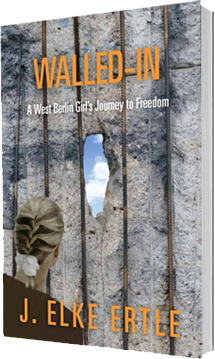
For a sneak peek at the first 20+ pages of my memoir, Walled-In: A West Berlin Girl’s Journey to Freedom, click “Download a free excerpt” on the home page of http://www.walled-in-berlin.com. Walled-In is a story of growing up in Berlin during the Cold War.


Beate Ulbricht’s Golden Cage – Part 2

Monday, October 12th, 2015

Read about Beate Ulbricht’s adoption in last week’s blog. http://walled-in-berlin.com/j-elke-ertle/beate-ulbrichts-golden-cage-part-1/

Beate Ulbricht’s life

From the beginning, Beate Ulbricht’s life was beset with problems. She started school in Berlin where her classmates bullied her because of her privileged status. When she reached the age of 15, her adoptive parents, Walter and Lotte Ulbricht, dispatched her to Leningrad, Russia, to complete high school. She was lonely there, but her cries for help remained unanswered. Her parents only advised to keep a stiff upper lip. Following graduation, Beate was to remain in Leningrad to study Russian and History.

At age 18 and still in Leningrad, she fell deeply in love with Ivanko Matteoli, the son of an Italian Communist Party functionary. The pair contemplated marriage, but Walter and Lotte Ulbricht opposed the union. Beate prevailed. A year later, in 1963, she broke off her studies, returned to Berlin and married Matteoli against her parents’ wishes. The Ulbrichts used their influence to block Beate’s in-laws from entering the country to attend the wedding, and the Ulbrichts themselves stayed away as well. Relations between the Matteolis and the Ulbrichts quickly deteriorated. After Beate bore a daughter, Patrizia, the young Matteoli family decided to return to Leningrad to sidestep further confrontations.

In 1965, Ivanko left for Leningrad to prepare for the move. The Ulbrichts saw their chance. Only hours after Ivanko had left, they arranged to have Beate’s passport taken. As a result, the young mother and her daughter were no longer able to leave Germany and join Ivanko. Furthermore, Walter Ulbricht had all communications between husband and wife intercepted. Beate and Patrizia were stuck in Berlin for two full years. During that time, Walter and Lotte Ulbricht pressured their daughter into a divorce. When Beate finally relented, her passport was returned. Soon thereafter, the young mother and daughter flew to Leningrad to join Ivanko. But he had vanished. At that point, Beate decided to remain in Leningrad anyway. She wanted to be far away from her parents.

Back in Leningrad and unable to locate Ivanko, Beate reconnected with an old friend from high school, Juri Polkownikow. She fell in love for the second time and the two married in March 1968. The following year their son, Andre, was born. When Juri turned out to be an alcoholic and a wife beater, Beate returned to Berlin with her two children. But the relationship with her adoptive parents did not improve. After Walter Ulbricht’s death in 1973, Beate, found herself divorced from Juri and disinherited by Walter Ulbricht. She took back the name of her first husband, Matteoli. But with two children, no university degree and only occasional odd jobs, she sought solace in alcohol. Eventually, Lotte Ulbricht gained custody of Beate’s two children, and in December of 1991, Beate Ulbricht Matteoli was found murdered in her apartment. The case was never solved. http://www.welt.de/politik/article4187033/Wie-Ulbrichts-Adoptivtochter-dem-Alkohol-verfiel.html

The German Television station MDR (Mitteldeutscher Runkfunk) aired a television movie based on Beate Ulbricht’s tragic life. The program aired on August 2, 2015. http://www.bild.de/regional/dresden/walter-ulbricht/walter-ulbrichts-dunkles-familien-geheimnis-40319274.bild.html


For a sneak peek at the first 20+ pages of my memoir, Walled-In: A West Berlin Girl’s Journey to Freedom, click “Download a free excerpt” on my home page and feel free to follow my blog about anything German: historic and current events, people, places and food.

Walled-In is my story of growing up in Berlin during the Cold War. Juxtaposing the events that engulfed Berlin during the Berlin Blockade, the Berlin Airlift, the Berlin Wall and Kennedy’s Berlin visit with the struggle against my equally insurmountable parental walls, Walled-In is about freedom vs. conformity, conflict vs. harmony, domination vs. submission, loyalty vs. betrayal.


The Problem with the world

Thursday, October 8th, 2015

The Problem with the world is that the intelligent people are full of doubts while the stupid ones are full of confidence

–Charles Bukowski


For a sneak peek at the first 20+ pages of my memoir, Walled-In: A West Berlin Girl’s Journey to Freedom, click “Download a free excerpt” on the home page of http://www.walled-in-berlin.com. Walled-In is a story of growing up in Berlin during the Cold War.


Beate Ulbricht’s golden cage – Part 1

Monday, October 5th, 2015

Beate Ulbricht – alias Maria Pestunowa – alias Beate Matteoli, was the adopted daughter of Walter Ulbricht, former East German head of state, and his second wife Lotte. Beate was born in 1944 in Leipzig, Germany, under the name of Maria Pestunowa. The Ulbricht’s renamed her Beate and gave the girl their last name. Beate remained the couple’s only child. These facts did not become public knowledge until the Berlin Wall fell. http://www.spiegel.de/spiegel/print/d-31900127.html

In many respects, Beate Ulbricht lived a privileged life. She went to the best schools, enjoyed splendid vacations with her parents and enjoyed many advantages in the socialist state – with one exception. Beate was not allowed to be herself. She was brought up to be the First Child of the Nation. Her parents expected her to be the perfect daughter, the impeccable student, the model pioneer. Her mother told her to always be “useful and cheerful.” Every aspect of Beate’s life was on public display. A slip-up was out of the question. The young girl came to feel trapped in her golden cage, had difficulty coping and finally succumbed to the unrelenting pressure. Shortly before she died in 1991, Beate Ulbricht said in the only interview she ever gave, “Ich hatte zu essen, zu trinken, anzuziehen – aber in diesem goldenen Käfig war keine Liebe – I had food, drink and clothes, but in this golden cage there was no love.” She died a few months later under mysterious circumstances.

The infant Beate Ulbricht

Beate Ulbricht came into the world as Maria Pestunowa, a citizen of the Soviet Union. Her mother was a Ukrainian forced laborer in Germany. The identity of her father remains unknown. Soon after Maria’s birth, her mother perished in a bomb attack. The baby was first placed in an orphanage, then with a foster family in Dresden. In January of 1946, Walter Ulbricht and his partner, Lotte Kuehn, applied to adopt the girl. At the time, Walter was still legally married to Martha Schmellinsky, although the couple had separated years earlier. As his political career was taking off, he planned to wed his personal assistant, Lotte Kuehn, once the divorce was final.

Beate Ulbricht’s adoption

Walter Ulbricht’s political star was on the rise (see last week’s post http://www.walled-in-berlin.com/j-elke-ertle/image-challenged-walter-ulbricht/). Having a family was likely to further his career. Since Lotte was unable to bear children, adoption looked like the perfect option. It all happened quickly. Walter pulled some strings with the youth authorities in Dresden. Although not yet married to Walter, Lotte already identified herself as Lotte Ulbricht. In January of 1946, the youth authorities took baby Maria from her original foster family and placed her with the Ulbrichts. In 1950 the adoption process was finalized though Walter and Lotte Ulbricht did not legally marry until 1953. http://www.spiegel.de/spiegel/print/d-31900127.html

Read about Beate Ulbricht’s tragic adult life at http://www.walled-in-berlin.com/j-elke-ertle/beate-ulbrichts-golden-cage-part-2/.


For a sneak peek at the first 20+ pages of my memoir, Walled-In: A West Berlin Girl’s Journey to Freedom, click “Download a free excerpt” on my home page and feel free to follow my blog about anything German: historic and current events, people, places and food.

Walled-In is my story of growing up in Berlin during the Cold War. Juxtaposing the events that engulfed Berlin during the Berlin Blockade, the Berlin Airlift, the Berlin Wall and Kennedy’s Berlin visit with the struggle against my equally insurmountable parental walls, Walled-In is about freedom vs. conformity, conflict vs. harmony, domination vs. submission, loyalty vs. betrayal.

A wise man adapts to circumstances

Thursday, October 1st, 2015

A wise man adapts himself to circumstances, 
as water shapes itself to the vessel that contains it.

–Anonymous


For a sneak peek at the first 20+ pages of my memoir, Walled-In: A West Berlin Girl’s Journey to Freedom, click “Download a free excerpt” on the home page of http://www.walled-in-berlin.com. Walled-In is a story of growing up in Berlin during the Cold War.

Image-challenged Walter Ulbricht

Monday, September 28th, 2015

Walter Ulbricht was a 20th century East German politician who always knew which side his bread was buttered on. By instinctively understanding whom to defer to and which efforts to pursue, he became East Germany’s postwar leader. Loyal to Leninist and Stalinist principles, he was described by peers and populace alike as an inflexible, dull and unlikeable man. It didn’t help that he spoke with a squeaky falsetto voice due to a childhood diphtheria infection. Still, he remained East Germany’s chief decision maker until 1971 – a period of more than twenty years. A joke made the rounds in East Germany during those years. It went like this: An airplane crashes carrying the presidents of the United States and France and the British Queen. They all perish. Which country mourns the most? The answer: East Germany because Ulbricht wasn’t on the plane.

Who was Walter Ulbricht?

Walter Ulbricht came from humble beginnings. He was born in 1893 to a tailor in Leipzig, Germany. After graduating primary school, Ulbricht trained as a cabinetmaker. Since both his parents were active in the Social Democratic Party (SPD), young Ulbricht joined the party as well. He was 19 at the time. Eight years later, in 1920, he left the SPD and joined the newly created KPD, the Communist Party of Germany. By aligning himself with the “right” people he rose swiftly through party ranks.

Walter Ulbricht, East German Statesman 1950-1971

Walter Ulbricht, East German Statesman
1950-1971

Walter Ulbricht’s political life

Walter Ulbricht quickly became an important member in the party. In 1923, he was elected to the Central Committee and five years later to the Reichstag (German parliament). He remained a member of the Reichstag until 1933 when the Nazis came to power. When they imprisoned other KPD leaders in connection with a high profile murder, Ulbricht fled to France, Czechoslovakia and finally Spain. Between 1937 and 1945, he settled in Moscow and resided in the famous Hotel Lux. While there, he worked on a variety of communist causes.

Walter Ulbricht – leader of East Germany

In April 1945, Soviet leader, Joseph Stalin, chose Walter Ulbricht to lead a group of party functionaries into Germany to begin reconstruction of the Communist party in Germany. Within the Soviet-occupied zone of Germany and the Soviet-occupied sector of Berlin, Social Democrats were pressured into merging with the Communist party to form the new Socialist Unity Party of Germany (SED). After the founding of the German Democratic Republic (East Germany) in 1949, Ulbricht became Deputy Chairman of the Council of Ministers. In 1950, he became General Secretary of the SED Central Committee and First Secretary in 1953. After the death of Stalin that same year, Ulbricht’s position was in danger. However, the East German Uprising of 1953 helped him to gain the Kremlin’s support. With Moscow’s backing, Ulbricht suppressed the uprising and secured his position in East Germany. From that point on, Walter Ulbricht was East Germany’s chief decision maker.

Ulbricht continued to plot his course. By 1952, he had nationalized 80 percent of the industry, which resulted in an economy that was short of consumer goods and often produced goods of shoddy quality. When his economic measures proved flawed, millions of East Germans fled to the west. Aware of the possibility of a total collapse of East Germany, Ulbricht pressured the Soviet Union in early 1961 to stop the outflow or workers and to resolve the status of Berlin. This led to the construction of the Berlin Wall, only two months after Ulbricht had emphatically denied that there were such plans when he stated, “No one has any intention of building a wall.” https://www.berlin.de/mauer/geschichte/index.en.html The Berlin Wall became a public relations disaster for Ulbricht and the Soviet Union. By the late 1960s, Ulbricht found himself more and more isolated, both at home and abroad. His refusal to work with West Germany on Soviet terms infuriated Soviet leader, Leonid Brezhnev. In 1971, Ulbricht was forced to resign from virtually all of his public functions. He was only allowed to remain head of state as Chairman of the Council of State in an honorary capacity.

Walter Ulbricht was a survivor

Image-challenged Walter Ulbricht came close to being toppled several times, but he always landed on his feet. His private life was beset with difficulties as well. Next time, I will write about his relationship with his wife, Lotte, and their daughter, Beate.


For a sneak peek at the first 20+ pages of my memoir, Walled-In: A West Berlin Girl’s Journey to Freedom, click “Download a free excerpt” on my home page and feel free to follow my blog about anything German: historic and current events, people, places and food.

Walled-In is my story of growing up in Berlin during the Cold War. Juxtaposing the events that engulfed Berlin during the Berlin Blockade, the Berlin Airlift, the Berlin Wall and Kennedy’s Berlin visit with the struggle against my equally insurmountable parental walls, Walled-In is about freedom vs. conformity, conflict vs. harmony, domination vs. submission, loyalty vs. betrayal. 


What is loyalty?

Thursday, September 24th, 2015

Loyalty cannot be blueprinted. It cannot be produced on an assembly line. In fact, it cannot be manufactured at all, for its origin is the human heart — the center of self-respect and human dignity. It is a force which leaps into being only when conditions are exactly right for it — and it is a force very sensitive to betrayal.

–Maurice Franks


For a sneak peek at the first 20+ pages of my memoir, Walled-In: A West Berlin Girl’s Journey to Freedom, click “Download a free excerpt” on the home page of http://www.walled-in-berlin.com. Walled-In is a story of growing up in Berlin during the Cold War.


Bueckware is Stoop Merchandise

Monday, September 21st, 2015

Bueckware is a German word that translates into “Stoop Merchandise.” It is a clever expression that alludes to the need for the sales person to have to stoop beneath the counter to unearth the goods.

Bueckware – WWII 

The term originated at the onset of WWII when Germany’s Nazi government rationed certain items, in particular foodstuffs and textiles. Producers and shop owners reacted by holding back some merchandise and storing it out of view. Generally, these were luxury items, such as chocolate, eggs or sausage. By hiding the goods from view, they were officially no longer on hand. When it came to finally selling the coveted items – and they were sold only to a select group – the shop owner had to literally stoop (buecken in German) beneath the counter to come up with the goods.

Bueckware – East Germany

During the communist era of East Germany the situation was similar. Bueckware referred to items that were locally scarce, could only be obtained through bartering, or were intentionally held back for friends, relatives and important persons. In those days, Bueckware often consisted of daily necessities. Shop owners would stoop beneath the counter to unearth hard-to-come-by items, such as exotic fruits, building materials, electrical outlets and replacement parts for cars. Bueckware also referred to items that were sold illegally, such as record albums from West Germany. Matthias Kaiser in Der Eichsfeld Report, Art de Cuisine, Erfurt 2009, states, “the pigs must have grown up without livers during those years because these popular innards were so scarce that they were available only as Bueckware.”

Bueckware – West Germany

Bueckware also existed in West Germany during those days. But the term had a slightly different connotation. During West Germany’s post WWII economic miracle, Bueckware referred to illegal items, such as pornography.

Bueckware – Today

The term has not disappeared. These days, Bueckware refers to the cheaper no-name brands of merchandise that are located on the bottom shelves at your grocery store. While the pricy brand-name products with higher profit margins are located at eye level, customers are forced to stoop down to the lower shelves if they wish to purchase the less expensive items. http://www.abendblatt.de/region/norderstedt/article132543192/Bueckware-ist-oft-billig-aber-meistens-wirklich-gut.html

Learn a new word and let me know if you need help with the pronunciation.

Bueckware at Ralphs, Photo © J. Elke Ertle 2015

Bueckware at Ralphs,
Photo © J. Elke Ertle 2015


For a sneak peek at the first 20+ pages of my memoir, Walled-In: A West Berlin Girl’s Journey to Freedom, click “Download a free excerpt” on my home page and feel free to follow my blog about anything German: historic or current events, people, places or food.

Walled-In is my story of growing up in Berlin during the Cold War. Juxtaposing the events that engulfed Berlin during the Berlin Blockade, the Berlin Airlift, the Berlin Wall and Kennedy’s Berlin visit with the struggle against my equally insurmountable parental walls, Walled-In is about freedom vs. conformity, conflict vs. harmony, domination vs. submission, loyalty vs. betrayal.

 

What wears you out?

Thursday, September 17th, 2015

It isn’t the mountain ahead that wears you out… 
It’s the grain of sand in your shoe.

–Anonymous


For a sneak peek at the first 20+ pages of my memoir, Walled-In: A West Berlin Girl’s Journey to Freedom, click “Download a free excerpt” on the home page of http://www.walled-in-berlin.com. Walled-In is a story of growing up in Berlin during the Cold War.

Comrade Lenin is back

Monday, September 14th, 2015

Twenty-four years after the 62-foot statue of Communist leader Vladimir Lenin was buried outside of Berlin, Germany, its granite head was unearthed this month and placed in a Berlin museum. Just last year, in August 2014, the Berlin senate had claimed that the giant statue was lost. At that time, authorities had maintained that they knew the general location of its burial place but had no records of the precise location. Digging up the entire pit, long overgrown with shrubs, to unearth Lenin’s head had seemed too costly an undertaking. http://www.theguardian.com/world/2014/aug/21/berlin-giant-lenin-statue-lost

Who was Comrade Lenin?

Vladimir Lenin (1870-1924) was a Russian communist revolutionary and politician. He played a senior role in the October Revolution of 1917. Under his administration the Russian Empire was dissolved and replaced by the Soviet Union. His political theories are known as Leninism. Admirers view him as a champion of working people’s rights and welfare. Critics see him as a dictator responsible for civil war and massive human rights abuses. In East Germany, Lenin was held up as a model communist.

Where was Comrade Lenin’s statue located?

Designed by Nikolai Tomsky, Lenin’s giant sculpture was originally located in Leninplatz (Lenin Square) in the Friedrichshain district of former East Berlin. A gift from the Soviet Union to East Germany, the monument was carved from Ukrainian red Kapustino granite. Three days before the 100th anniversary of Lenin’s birth it was unveiled before 200,000 guests. The celebration took place on 19 April 1970. Subsequently, in 1992, the square was renamed Platz der Vereinten Nationen (United Nations Square).

Lenin statue at Leninplatz, Berlin, photo Bundesarchiv, Germany

Lenin statue at Leninplatz, Berlin,
photo Bundesarchiv, Germany

Why was Comrade Lenin’s statue removed?

The East German government had commissioned the statue to express East Germany’s reverence for and gratitude toward Lenin. But following the fall of the Berlin Wall, many Germans wanted to get rid of Soviet symbols, and Berlin’s then mayor Eberhard Diepgen ordered the statue to be removed. Critics argued that the monument was part of the history of the neighborhood and should remain. https://www.washingtonpost.com/news/worldviews/wp/2015/09/10/a-giant-lenin-head-was-unearthed-in-germany/ Nonetheless, two years after the 1989 fall of the Berlin Wall, demolition took place.

Since 1994, a bubbling fountain has taken the place of Lenin’s sculpture in the Platz der Vereinten Nationen (United Nations Square). Now, water bubbles from five roughly hewn granite boulders in a group of fourteen that grace the square.

Where was Comrade Lenin’s statue buried?

The demolition of Lenin’s statue began in November 1991 and took several months. It was split in 129 sections and buried in a sand pit at Seddinberg in the district of Treptow-Koepenick, a southeastern suburb of Berlin. It seemed that Lenin’s statue would remain buried forever until historians started campaigning for its excavation last year. When the Berlin government claimed not to know where exactly it was buried, Rick Minnich, a Berlin-based US filmmaker, stepped up. He told the media that he knew its precise location because he had it partially unearthed a few years earlier for his 1990 film, Good-bye, Lenin.

Where is Comrade Lenin’s head now?

On 10 September 2015, Lenin’s 3.5-ton granite head was transported from the Seddinberg sand pit to Berlin’s Spandau Zitadelle museum. It is scheduled to be the showpiece in the Zitadelle’s exhibition, “Berlin and its Monuments,” which will display more than 100 original Berlin monuments from the 18th century to the fall of the Wall. According to Berlin officials, Lenin’s head will remain the only part of the statue to be excavated. All other sections will remain buried.


For a sneak peek at the first 20+ pages of my memoir, Walled-In: A West Berlin Girl’s Journey to Freedom, click “Download a free excerpt” on my home page and feel free to follow my blog about anything German: historic and current events, people, places and food.

Walled-In is my story of growing up in Berlin during the Cold War. Juxtaposing the events that engulfed Berlin during the Berlin Blockade, the Berlin Airlift, the Berlin Wall and Kennedy’s Berlin visit with the struggle against my equally insurmountable parental walls, Walled-In is about freedom vs. conformity, conflict vs. harmony, domination vs. submission, loyalty vs. betrayal.