Fallen Leaves in Berlin’s Jewish Museum

September 5th, 2016

Fallen Leaves is a powerful symbolic art installation in the Jewish Museum Berlin. One of the largest such museums in Europe, Berlin’s Jewish Museum actually consists of two buildings. The visitor enters through the baroque Kollegienhaus, an old gilded building (originally built as a courthouse http://www.walled-in-berlin.com/j-elke-ertle/berlins-kammergericht-appellate-court/ and later used by the Berlin Museum), and descends into the basement level of a stark, postmodern building. The 161,000 square foot new concrete structure, designed by Daniel Libeskind, has three corridors: the Axis of Exile with the personal effects of Jews who fled Germany during the 1930s on display, the Axis of the Holocaust with displays of letters and photographs of murdered Jews on exhibit and the Axis of Continuity, showing 2,000 years of German Jewish history.

Fallen Leaves installation

The most power installation for me was Fallen Leaves (Shalekhet), displayed in one of several empty “voided” spaces in the museum. The bare concrete Memory Void runs through the entire building. Its only light emanates from a small slit at the top of the space. Here the ground is covered with 10,000 flat iron disks that visitors are free to walk on. The disks are pressed into the shape of faces with crude cutouts for eyes, nose and mouth. The mouths are contorted and look like they might be screaming silently. The faces symbolize those lost during the Holocaust as well as the victims of war and violence in general. The display was designed by Israeli artist Menashe Kadisman.


Fallen Leaves - Symbolic Art Installation in the Jewish Museum Berlin, photo © J. Elke Ertle, 2016, www.walled-in-berlin.com

Fallen Leaves – Symbolic Art Installation in the Jewish Museum Berlin, photo © J. Elke Ertle, 2016, www.walled-in-berlin.com

What is the meaning of voids?

Libeskind created “voids” to symbolize the history and humanity lost as a result of the Holocaust. The architect explains that the voids represent “what can never be exhibited.” Libeskind created five voids – angular openings – in the Jewish Museum Berlin. Three of the voids are inaccessible. The visitor can only look into them through slit-like windows. The two accessible voids are: The Void of Voidness is an unheated tower with the only light emanating from a narrow slit in the roof. The other accessible void is the Void of Memory with the Fallen Leaves installation.


Void of Voidness, Jewish Museum Berlin, photo © J. Elke Ertle, 2016, www.walled-in-berlin.com

Void of Voidness, Jewish Museum Berlin, photo © J. Elke Ertle, 2016, www.walled-in-berlin.com


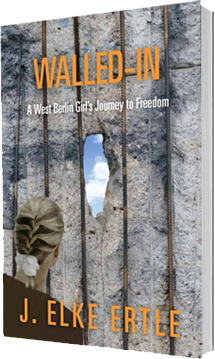
For a sneak peek at the first 20+ pages of my memoir, Walled-In: A West Berlin Girl’s Journey to Freedom, click “Download a free excerpt” on my home page and feel free to follow my blog about anything German: historic and current events, people, places and food.

Walled-In is my story of growing up in Berlin during the Cold War. Juxtaposing the events that engulfed Berlin during the Berlin Blockade, the Berlin Airlift, the Berlin Wall and Kennedy’s Berlin visit with the struggle against my equally insurmountable parental walls, Walled-In is about freedom vs. conformity, conflict vs. harmony, domination vs. submission, loyalty vs. betrayal.


More or less – the choice is yours

September 1st, 2016

Hope more – Fear less

Chew more – Eat less

Breathe more – Whine less

Say more – Talk less

Love more – Hate less

–Mueritzer Bauernmarkt, Klink, Germany


For a sneak peek at the first 20+ pages of my memoir, Walled-In: A West Berlin Girl’s Journey to Freedom, click “Download a free excerpt” on the home page of http://www.walled-in-berlin.com

Hackesche Hoefe with Old-Berlin Charm

August 29th, 2016


Hackesche Hoefe is a group of eight interconnected, beautifully restored courtyard buildings in the historical center of Berlin. A heritage site since 1972, they represent the largest, enclosed courtyard area in Germany. The project combined art, work, eateries and entertainment – a novel idea at the time. Today, the Hackesche Hoefe are one of the trendiest spots in Berlin because they possess that Old-Berlin charm that captivates the hearts of tourists and locals alike. But that charm came at a price.


ackesche Hoefe, Berlin, courtyard layout, photo © J. Elke Ertle, 2015, www.walled-in-berlin.com

Hackesche Hoefe, Berlin, courtyard layout, photo © J. Elke Ertle, 2015, www.walled-in-berlin.com

Hackesche Hoefe: outside swank – inside rank?

On the outside, the Hackesche Hoefe were a creative and successful venture. But on the inside, the courtyards were haunted by persistent financial failures. It all began in 1858 when Hans Quiltz, a glass manufacturer, acquired a license for commercial use of the then vacant lot. When real estate prices exploded in the early 1900s, his heirs built the series of eight interconnected buildings on the site. The Quiltz heirs did not built basic tenements, however, as was common at the time, http://www.walled-in-berlin.com/j-elke-ertle/heinrich-zille-and-his-milieu/ they opted for an upscale mixed-use project. Therefore, the Hackesche Hoefe held offices, a banquet hall and industrial space in the front. Residential flats with balconies, central heating and parquet flooring were constructed in the back.


Hackesche Hoefe with Old-Berlin charm, photo © J. Elke Ertle, 2015, www.walled-in-berlin.com

Hackesche Hoefe with Old-Berlin charm, photo © J. Elke Ertle, 2015, www.walled-in-berlin.com

In 1907 Kurt Berndt, a property developer, and August Endell, an architect, took over the property and restored the front courtyard (Hof 1) in Art Nouveau style with ceramic tiles that Endell had designed himself. Initially, the project was doing well, but WWI changed everything. One tenant business after the other foreclosed, and in 1924 the Quiltz heirs were forced to sell the Hackesche Hoefe.

The new buyer, Jakob Michael, was flush with cash. But when several of his other real estate investments began to fail in the wake of the worldwide economic crisis and he became involved in a bribery scandal on top of it, the Hackesche Hoefe went into receivership. However, Michael retained some interest in the project because one of his other business ventures, a department store, was able to purchase the property in a foreclosure sale. http://www.tagesspiegel.de/kultur/berliner-hoefe-8-die-hackeschen-hoefe-in-mitte-schabernack-ist-abgeschafft/12312774.html

Following WWII, the Soviet Military Administration requisitioned the Hackesche Hoefe. The grand banquet hall was turned into a canteen and storage space. The restaurant, which had closed in 1927 already, became an automotive shop for Trabants, the popular East German cars. And in 1951, a tenant’s association turned the building into a resident-owned apartment building.

By the time of the German reunification in 1990, Michael had passed away. His U.S. heirs received restitution and sold the property to Roland Ernst in 1993. Ernst, a West German real estate tycoon, purchased the Hackesche Hoefe for 24 million Mark and spent an additional 60 million Mark to bring the courtyards back to their original 20th century style and use. By 1997, restoration was complete, but Ernst did not get to enjoy the finished project for long. He went into bankruptcy in 2000 and was forced to sell the property to a group of investors. They, too, ran into financial difficulties and sold to a real estate concern in 2004. The most recent buyer prefers to remain anonymous. So far, all is well with the Hackesche Hoefe.

Where are the Hackesche Hoefe?

The Hackesche Hoefe are located between Rosenthaler Strasse 40 and Sophienstrasse 6, one block north of Hackescher Markt and the S-Bahn station by the same name. “Hoefe,” translates into courtyards. “Hackesche” refers to Count von Hacke, the Prussian General and Commandant of Berlin who was put in charge of the courtyards construction project in 1750. King Friedrich Wilhelm I had ordered the construction to keep up with Berlin’s rapid growth following German unification. http://www.walled-in-berlin.com/j-elke-ertle/otto-von-bismarck-visionary-or-villain/


Hackescher Markt with Hackesche Hoefe in the background, photo © J. Elke Ertle, 2015, www.walled-in-berlin.com

Hackescher Markt with Hackesche Hoefe in the background, photo © J. Elke Ertle, 2015, www.walled-in-berlin.com

The Hackesche Hoefe Today

Today the Hackesche Hoefe are one of the trendiest spots in central Berlin with restaurants, cafes and shops. They attract tons of visitors every day. Hof 1 includes a cinema, several bars and restaurants. Hof 2 houses the Chameleon Theatre, as well as several offices. The smaller remaining courtyards are quieter and feature mainly small shops, galleries and apartments.


For a sneak peek at the first 20+ pages of my memoir, Walled-In: A West Berlin Girl’s Journey to Freedom, click “Download a free excerpt” on my home page and feel free to follow my blog about anything German: historic and current events, people, places and food.

Walled-In is my story of growing up in Berlin during the Cold War. Juxtaposing the events that engulfed Berlin during the Berlin Blockade, the Berlin Airlift, the Berlin Wall and Kennedy’s Berlin visit with the struggle against my equally insurmountable parental walls, Walled-In is about freedom vs. conformity, conflict vs. harmony, domination vs. submission, loyalty vs. betrayal.


Genius as opposed to stupidity

August 25th, 2016


Everybody is a genius. But if you judge a fish by its ability to climb a tree, it will live its whole life believing that it is stupid.

— Albert Einstein


For a sneak peek at the first 20+ pages of my memoir, Walled-In: A West Berlin Girl’s Journey to Freedom, click “Download a free excerpt” on my home page and feel free to follow my blog about anything German: historic and current events, people, places and food.

Walled-In is my story of growing up in Berlin during the Cold War. Juxtaposing the events that engulfed Berlin during the Berlin Blockade, the Berlin Airlift, the Berlin Wall and Kennedy’s Berlin visit with the struggle against my equally insurmountable parental walls, Walled-In is about freedom vs. conformity, conflict vs. harmony, domination vs. submission, loyalty vs. betrayal.


Otto von Bismarck – visionary or villain?

August 22nd, 2016

Otto von Bismarck (1815-1898) was a powerful Prussian statesman, credited with unifying 25 previously independent German states in 1871. As a result of the unification, Germany became one of the most powerful nations in Europe. During most of his nearly 30-year tenure, Bismarck held undisputed control over the government’s policies.

Bismarck’s rise

Born in 1815 to a Prussian nobleman, Bismarck spent his early years studying law and running the family estate. In 1847, he became a delegate to the new Prussian parliament in Berlin. From 1851 to 1862 he held various ambassadorships: he served as an ambassador at the German Confederation in Frankfurt, in St. Petersburg (Russia) and in Paris (France). These posts gave him valuable insight into weaknesses of the great powers of Europe, an understanding he later used to his advantage.

In 1862, Prussian King Wilhelm I appointed him as his Minister President and Foreign Minister. Although technically subservient to the king, it was Bismarck who actually pulled the government strings. In the mid-1860s he orchestrated and won three successive short wars against Denmark, Austria and France. He engineered the wars in order to unify the German states into a powerful German Empire under Prussian leadership. In 1871, Wilhelm I became Emperor and raised Otto von Bismarck’s rank to Fuerst (Prince). The Emperor then appointed him as the first Reichskanzler (Imperial Chancellor) of the German Empire.

For much of the 1870s Bismarck pursued a Kulturkampf (cultural struggle) against Catholicism by placing parochial schools under state control and expelling the Jesuits. But in 1878 Bismarck reversed his position and aligned himself with the Catholics against what he perceived to be a growing socialist threat. To gain the support of the working class and to stave-off calls for more radical socialist alternatives, Bismarck created the world’s first comprehensive government social safety net by establishing national healthcare (1883), accident insurance (1884) and old age pensions (1889). https://www.ssa.gov/history/ottob.html In 1890, following the death of King Wilhelm I, Bismarck resigned at Wilhelm II’s insistence.


Otto von Bismarck statue across from the victory column in Berlin, photo © J. Elke Ertle, 2016, www.walled-in-berlin.com

Otto von Bismarck statue across from the victory column in Berlin, photo © J. Elke Ertle, 2016, www.walled-in-berlin.com

Bismarck – the visionary

Many historians praise Bismarck as a visionary for uniting Germany while keeping the peace in Europe. He was able to do so through skilled diplomacy and powerful rule at home and by carefully manipulating the balance of international rivalries. Bismarck has been called a master strategist who possessed not only a long-term national and international vision but also the short-term ability to juggle multi-faceted developments.

 U.S. historian William L. Langer, sums up the statesman by saying, “Bismarck at least deserves full credit for having steered European politics through this dangerous transitional period without serious conflict between the great powers.” (Langer, European Alliances and Alignments: 1871–1890 pp 503–04)

Bismarck – the villain

Other historians condemn Bismarck as a villain who dominated his cabinet ministers and smeared their reputations as soon as he no longer needed them. The historian Jonathan Steinberg portrays him as a demonic genius who was deeply vengeful, even toward his closest friends and family members. Bismarck’s friend, German diplomat Kurd von Schloezer, describes him as a kind of evil genius who successfully concealed his contempt for his fellow men while being determined to control and ruin them. British historian Richard J. Evans states that Bismarck was “intimidating and unscrupulous, playing to others’ frailties, not their strengths.” (Evans ,February 23, 2012, “The Gambler in Blood and Iron,” New York Review of Books)


For a sneak peek at the first 20+ pages of my memoir, Walled-In: A West Berlin Girl’s Journey to Freedom, click “Download a free excerpt” on my home page and feel free to follow my blog about anything German: historic and current events, people, places and food.

Walled-In is my story of growing up in Berlin during the Cold War. Juxtaposing the events that engulfed Berlin during the Berlin Blockade, the Berlin Airlift, the Berlin Wall and Kennedy’s Berlin visit with the struggle against my equally insurmountable parental walls, Walled-In is about freedom vs. conformity, conflict vs. harmony, domination vs. submission, loyalty vs. betrayal.


Tomorrow is a second chance

August 18th, 2016


Life always offers us a second chance. It’s called tomorrow.

— Mueritzer Bauernmarkt, Klink, Germany


For a sneak peek at the first 20+ pages of my memoir, Walled-In: A West Berlin Girl’s Journey to Freedom, click “Download a free excerpt” on the home page of http://www.walled-in-berlin.com

House of One – three faiths under one roof

August 15th, 2016

Berlin’s House of One, when completed, will be the spiritual equivalent of the confederation of Switzerland, which has four main linguistic and cultural regions. The House of One will bring together three different faiths under one roof: a church, a synagogue and a mosque. The concept of a house of worship shared by Christians, Jews and Muslims is a “first” in the world. It is the hope of the project’s initiators that the House of One will eventually tear down the walls between religions just as the fall of Berlin Wall removed the barriers between East and West Berlin a quarter of a century ago.

What the House of One will look like

Plans have already been drawn. Berlin architect Wilfried Kuehn of Kuehn Malvezzi GmbH designed an interfaith prayer house that has three separate sections. A communal room in the center of the building will link the three areas and seat 380 people. Each of the worship areas will be the same in size but of different shape, allowing each religion to keep its own identity.

Originators of The House of One

The three men now heading the House of One project are: Pastor Gregor Hohberg, Rabbi Tovia Ben Chorin, and Imam Kadir Sanci.

Protestant pastor Gregor Hohberg of Berlin’s St. Marienkirche (St. Mary’s) first conceived of the idea of an interfaith house of worship when a 2009 redevelopment excavation unearthed the ruins of Berlin’s very first church. That archaeological discovery pointed to fragments of the foundation of St. Petri (St. Peters), built in the 13th century. The church was named after St. Peter, the patron saint of fishermen. St. Petri had already been destroyed and rebuilt several times when the communist government of East Germany decided to demolish the church altogether in the 1960s. Currently, a parking lot occupies the space.

Location of the House of One

Once built, the House of One will be located at the Petriplatz (Petri Square) in the historical birthplace of Berlin between Breite Strasse and Gertraudenstrasse. In medieval times, the square was not located in the historical center of Berlin but that of Coelln, Berlin’s sister city. http://www.walled-in-berlin.com/j-elke-ertle/coelln-and-berlin/

Funding of House of One

The religious leaders are still in the process of raising funds for the construction of the House of One. The goal is to raise 43 million euros and to finance the project entirely through crowdfunding, by selling bricks for €10 each. http://house-of-one.org/en So far, one million euros have been raised. Construction is to begin in earnest once the first €10,000,000 has been raised.


For a sneak peek at the first 20+ pages of my memoir, Walled-In: A West Berlin Girl’s Journey to Freedom, click “Download a free excerpt” on my home page and feel free to follow my blog about anything German: historic or current events, people, places or food.

Walled-In is my story of growing up in Berlin during the Cold War. Juxtaposing the events that engulfed Berlin during the Berlin Blockade, the Berlin Airlift, the Berlin Wall and Kennedy’s Berlin visit with the struggle against my equally insurmountable parental walls, Walled-In is about freedom vs. conformity, conflict vs. harmony, domination vs. submission, loyalty vs. betrayal.


The anatomy of a lie

August 11th, 2016


People never lie so much as after a hunt, during a war or before an election.

— Otto von Bismarck

(Not much has changed since the 19th century, has it?)


For a sneak peek at the first 20+ pages of my memoir, Walled-In: A West Berlin Girl’s Journey to Freedom, click “Download a free excerpt” on the home page of http://www.walled-in-berlin.com


Bikers Paradise Extraordinaire – Berlin

August 8th, 2016


Exploring the 800-year-old city of Berlin on two wheels should be on every biker’s bucket-list. Love to bike? With 650 miles of bike paths and 710 bicycles per 1000 residents, Berlin is incredibly bike-friendly. In fact, bikers account for close to 20% of the total traffic in the city. That is no real surprise because automobile parking is so difficult to come by in the city, that biking is a popular alternative.

What makes Berlin a bikers paradise?

First of all, most of the city is flat. Secondly, Berlin has a highly developed bicycling infrastructure with bike lanes on roads, mandatory bicycle paths, plenty of bike parking, off-road bicycle routes, shared bus lanes, combined pedestrian/bike paths and marked bikes lanes on sidewalks. There are even dedicated Fahrradstrassen (bicycle streets) where bikes have priority, and vehicles are limited to 30km/hour (18 miles/hour). Don’t want to bike the entire distance to your destination? No problem. With the purchase of a bike ticket, bikers are allowed to carry their cycles on the S- and U-Bahn trains, trams and busses.

Bikers Paradise Berlin. Bikes parked along the Hauptbahnhof, Berlin's main train station. Photo © J. Elke Ertle, 2016, www.walled-in-berlin.com

Bikers Paradise Berlin. Bikes parked along the Hauptbahnhof, Berlin’s main train station. Photo © J. Elke Ertle, 2016, www.walled-in-berlin.com

Bike Rentals

Berlin is a bikers’ paradise because bikes may be rented at rental stations throughout the city. Many of the stations are located in the heart of the city near Friedrichstrasse, Kreuzberg, Friedrichshain and Zoologischer Garten. All you need to do is decide what you want to see. At http://www.visitberlin.de/en/experience/sport-metropolis/bicycle-tours/ you may choose from 56 guided tours. But if you prefer to explore the city on your own, visit https://www.komoot.de/ for maps to plan your own tour. Finally, the German railway company, Deutsche Bahn, offers  rental bikes. Available at major intersections in the central part of the city, these bikes may be rent for just just €1 for 30 minutes and €9 for the day. The program is called “Call A Bike” and is offered in conjunction with train tickets. For details go to https://www.callabike-interaktiv.de

Popular Bike routes through and from Berlin

One of the most popular bike paths, the Mauerweg (Wall trail), traces the ex-frontier between east and west Berlin. Or you may opt to ride along the runways of the former Tempelhof airport or of the controversial and not yet completed Berlin Brandenburg International Airport. (http://www.walled-in-berlin.com/j-elke-ertle/berlin-brandenburg-airport-boondoggle/ and http://www.walled-in-berlin.com/j-elke-ertle/berlin-brandenburg-airport-project-from-hell/) The choice is yours. There are even several long-distance bike paths that start in Berlin: the Berlin-Copenhagen route, the Berlin-Usedom route and the Berlin-Leipzig route. Or try the Berlin section of the European Route R1. Whatever you decide, you have come to a bikers’ paradise when you visit Berlin.


For a sneak peek at the first 20+ pages of my memoir, Walled-In: A West Berlin Girl’s Journey to Freedom, click “Download a free excerpt” on my home page and feel free to follow my blog about anything German: historic and current events, people, places and food.

Walled-In is my story of growing up in Berlin during the Cold War. Juxtaposing the events that engulfed Berlin during the Berlin Blockade, the Berlin Airlift, the Berlin Wall and Kennedy’s Berlin visit with the struggle against my equally insurmountable parental walls, Walled-In is about freedom vs. conformity, conflict vs. harmony, domination vs. submission, loyalty vs. betrayal.

 

Where to find Happiness

August 4th, 2016


Happiness is an inside job.

–Sign at “Mueritzer Bauernmarkt”, Klink, Germany

inner peace, savoring the moment, fulfillment


For a sneak peek at the first 20+ pages of my memoir, Walled-In: A West Berlin Girl’s Journey to Freedom, click “Download a free excerpt” on the home page of http://www.walled-in-berlin.com